
The Book of Enoch: A Complete Guide to the Watchers, the Nephilim, and the Text That Almost Made the Bible
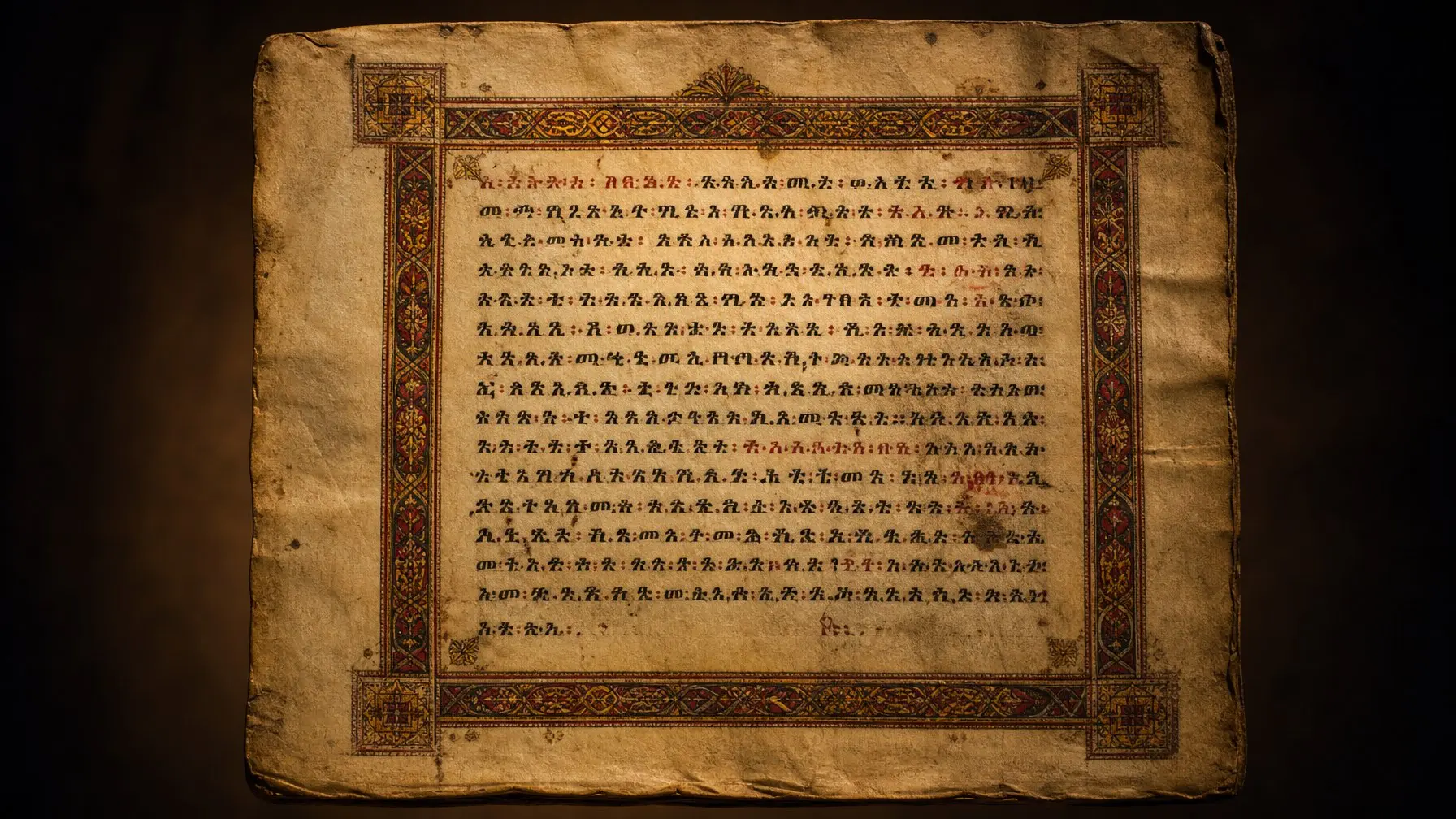
Genesis gives Enoch a single strange sentence and moves on. "Thus all the days of Enoch were 365 years. Enoch walked with God, and he was not, for God took him" (Genesis 5:23–24). No death. No burial. Just a righteous man who walked with God and then simply wasn't there anymore.
That gap — the space between "he walked with God" and whatever happened next — is where an entire body of literature grew up. The Book of Enoch, or 1 Enoch, claims to fill in exactly what happened during that walk: what Enoch saw in heaven, what he learned about the stars, and above all, what he witnessed when a group of angels called the Watchers descended to earth, took human wives, and fathered a race of giants called the Nephilim.
It's one of the most influential religious texts most Christians have never read. It shaped early Jewish and Christian ideas about fallen angels, demons, and the end of the world. It's quoted directly in the New Testament. And it never made it into the Bible — except in one place, where it still has.
This guide walks through what the Book of Enoch actually contains, how it was rediscovered after centuries of near-total loss in the West, and why — despite its influence — it ended up outside the canon almost everywhere except Ethiopia.
What Is the Book of Enoch?
The Book of Enoch isn't a single, unified composition. It's a collection of at least five separate works, written by different authors at different times, later stitched together into one book. Scholars typically date the material across roughly the 3rd century BC to the 1st century AD — meaning parts of Enoch were already centuries old by the time of Jesus, while other sections may have been composed around the same period as the New Testament itself.
The five sections, in the order they appear in the standard text, are:
- The Book of the Watchers (chapters 1–36) — the fall of the angels, the birth of the Nephilim, and Enoch's cosmic tour of heaven, hell, and the ends of the earth
- The Book of Parables, also called the Similitudes of Enoch (chapters 37–71) — visions of a coming judgment centered on a mysterious "Son of Man" figure
- The Astronomical Book, or Book of the Luminaries (chapters 72–82) — a detailed account of the sun, moon, and stars, and the solar calendar Enoch is said to have learned from the angel Uriel
- The Book of Dream Visions (chapters 83–90) — an allegorical retelling of biblical history using animals to represent nations and figures, often called the "Animal Apocalypse"
- The Epistle of Enoch (chapters 91–107) — Enoch's closing warnings to his descendants, condemning the rich and oppressive and promising a final reversal for the righteous
Only the Book of the Watchers and the Astronomical Book show up among the Dead Sea Scrolls fragments, which is part of why scholars think the Book of Parables was composed later — possibly too late to have circulated at Qumran at all.
The only complete surviving text of 1 Enoch exists in Ge'ez, the classical liturgical language of Ethiopia. Fragments also survive in Aramaic (from Qumran), Greek, and Latin, but none of those traditions preserved the whole work. Everything modern readers know about the complete book ultimately traces back to Ethiopian manuscripts.
The Rediscovery of a Lost Text
For most of European Christian history, the Book of Enoch was effectively gone. It's referenced by early Christian writers — Tertullian, for instance, argued it should be considered scripture — but as the centuries passed, complete copies stopped circulating in the West entirely. What remained was rumor.
One of those rumors surfaces in an unexpected place: the Tower of London. Sir Walter Raleigh, imprisoned there beginning around 1607 on charges of conspiracy against King James I, spent his captivity writing an ambitious, ultimately unfinished History of the World, published in 1614. In it, Raleigh mentions having heard of a lost book attributed to the biblical Enoch — one that supposedly "contained the course of the stars, their names and motions." He had no access to the text itself. He was recording a rumor about a book he'd never seen, sourced from centuries-old reports that a complete Enoch tradition survived somewhere in the land of Sheba — what Europeans of his era understood to be Ethiopia.
Raleigh was right about the location, even if he never lived to see the text himself — he was executed in 1618.
It took another century and a half for that rumor to be confirmed. In 1773, the Scottish explorer James Bruce returned to Europe after roughly six years traveling through Ethiopia in search of the source of the Nile. He brought back three Ge'ez manuscripts of the Book of Enoch — copies that had been preserved continuously within the Ethiopian Orthodox Church, which had regarded the text as scripture the entire time Europe had lost track of it. Those three manuscripts now reside in the Bodleian Library at Oxford, the French National Library, and a private collection.
From there, the text moved slowly into wider circulation. Richard Laurence produced the first English translation in 1821. R.H. Charles's scholarly edition, still widely cited today, followed in 1912 and remains in the public domain. Then, in the mid-20th century, fragments of Enoch turned up among the Dead Sea Scrolls, discovered in caves above Qumran near the Dead Sea. These Aramaic fragments — cataloged primarily as 4Q201 through 4Q212 — are among the oldest non-biblical manuscripts ever found, and they did something crucial for the text's credibility: they confirmed that the Book of Enoch wasn't a late medieval invention. It was genuinely ancient, circulating among Jewish communities more than a century before Christ.
The Book of the Watchers: Origins of the Nephilim
This is the section of Enoch most relevant to biblical giants research, and the one that expands most dramatically on a passage the Hebrew Bible treats almost in passing.
The Text Behind the Text
Genesis 6:1–4 is the seed of the whole story:
"When man began to multiply on the face of the land, and daughters were born to them, the sons of God saw that the daughters of man were attractive, and they took as their wives any they chose. The Nephilim were on earth in those days, and also afterward, when the sons of God came into the daughters of man, and they bore children to them. These were the mighty men who were of old, the men of renown."
Four verses, no explanation of who the "sons of God" actually were, no description of the Nephilim's nature beyond the label "mighty men... of renown." The Book of the Watchers exists to answer the questions Genesis leaves open.
Mount Hermon and the Oath
According to Enoch, a group of angels called the Watchers — beings whose original role was to observe and guide humanity — became fixated on human women. Their leader, Shemihazah, proposed a plan to his fellow Watchers: descend, take wives, and father children. Because the other Watchers feared the consequences of acting alone, they bound themselves together with a mutual oath before descending — traditionally located at Mount Hermon, whose name the text connects to the Hebrew root for "curse" or "ban," marking the site of their transgression.
Two hundred Watchers are named as taking part in the descent. Among them, Azazel stands out for a distinct role beyond fathering children: he taught humanity forbidden knowledge — metallurgy, weapon-making, and the crafting of jewelry and cosmetics. Other Watchers distributed their own specialties: Shemihazah taught enchantments and root-cutting, Baraqel taught astrology, Kokabel the knowledge of constellations, Araqiel the signs of the earth, Shamsiel the signs of the sun, Sariel the courses of the moon. The text frames this transfer of knowledge — not just the biological union itself — as a central part of the Watchers' corruption of the world. Civilization itself, in Enoch's telling, arrives tangled up with transgression.
The Nephilim's Birth and Violence
The human women who bore the Watchers' children gave birth to the Nephilim — described in the text as beings of enormous size and destructive appetite. 1 Enoch 7 describes them consuming everything humanity produced, then turning to devour animals, and finally each other. The earth itself, in the text's language, "cried out" under the weight of what the Nephilim had done to it.
This is also where Enoch offers a detail Genesis never provides: what happened to the Nephilim's spirits after the Flood destroyed their bodies. According to 1 Enoch 15:8–12, because the Nephilim were born from the union of angelic and human natures, the flood could kill their physical forms but not eliminate them entirely — evil spirits proceeded from their bodies and remained on the earth, described as the origin of the demonic forces that continued to trouble humanity long after the Flood. This passage is the primary textual basis for reading demons as disembodied Nephilim spirits rather than as fallen angels themselves — a distinction with real interpretive weight, since the text is explicit that the bound Watchers and the roaming spirits of their offspring are described as two separate categories of being.
Enoch's Commission and Journey
God's response to the Watchers' transgression unfolds across several scenes. First, the four archangels — Michael, Sariel (sometimes rendered Uriel), Raphael, and Gabriel — appeal directly to God on humanity's behalf, having watched the earth descend into violence. God answers by revealing a plan already set in motion: a flood to cleanse the corruption, and a specific commission for Enoch himself.
Enoch is taken up into heaven, where he sees a throne "like the appearance of fire" surrounded by attending angels, and receives a direct commission: he is to go and pronounce judgment on the Watchers. When Enoch finds them — described as cowering, unable to lift their eyes in shame — they beg him to intercede with God on their behalf. Enoch agrees to try. His attempt fails; in a second vision, God confirms there will be no forgiveness for what the Watchers have done.
The remainder of the Book of the Watchers follows Enoch on a guided tour of the cosmos, led by different angels at different stages. Uriel shows him the mechanics of the sun, moon, winds, and stars, and eventually leads him to a burning chasm — identified as the place being prepared to hold the fallen angels until final judgment. Gabriel takes him to a walled garden containing the tree of wisdom, identified as the Garden of Eden itself, the place where "your father and mother of old ate and learned wisdom" before their expulsion.
The Book of Parables: The Son of Man
The second section of 1 Enoch shifts tone and subject. Scholars generally treat it as a later addition — its absence from the Dead Sea Scrolls fragments is the strongest evidence for this, since every other section of Enoch is represented at Qumran in some form.
The Book of Parables centers on a coming judgment and a figure called the Son of Man — a title that also appears prominently in the Book of Daniel, but which Enoch develops into something closer to a distinct heavenly, messianic figure who will judge the wicked and vindicate the righteous. "The Son of Man" language here predates and likely informs how the title gets used centuries later in the Gospels, including in passages like Mark 13.
In one of the more theologically striking moments in the whole text, the closing chapters identify Enoch himself as this Son of Man (1 Enoch 71) — a detail scholars continue to debate, since it sits somewhat awkwardly against the figure's more transcendent portrayal earlier in the same section.
The Astronomical Book: Enoch's Calendar
The third section is, on its surface, the least dramatic — and the most technically detailed. Presented as knowledge revealed to Enoch by the angel Uriel, it catalogs the movements of the sun, moon, and stars with the precision of a working almanac.
Its centerpiece is a 364-day solar calendar, organized into four seasons of 91 days each — a system that, notably, matches the calendar tradition associated with the Qumran community, suggesting the group that preserved these Dead Sea Scroll fragments actually used a version of this calendar liturgically rather than treating it as a curiosity. Because 364 days falls short of a true solar year by roughly a day and a quarter, the text also describes periodic correction — an ancient version of a leap-year adjustment, added to keep the calendar aligned with the actual seasons over time.
The section is a useful reminder that for the Second Temple Jewish communities producing this literature, astronomy, calendar-keeping, and theology weren't separate disciplines. Getting the calendar right — knowing precisely when festivals and sacred times fell — was itself a form of righteousness, and getting it wrong (as the text elsewhere implies rival groups did) was a form of corruption.
The Book of Dream Visions: The Animal Apocalypse
The fourth section retells the sweep of biblical history — from Adam through the Flood, the Exodus, the monarchy, and into the era of foreign domination under Greek rule — using an extended animal allegory. Humanity begins as white cattle. The Watchers appear as stars that fall from heaven and interbreed with the herd, producing the corruption that leads to the Flood. Israel becomes a flock of sheep, harassed across history by predators representing the empires that ruled over it — lions, bears, eagles, and ravens standing in for Egypt, Babylon, Persia, and Greece in turn.
The vision culminates in a rescue: the flock's oppressors are judged and cast into a fiery abyss, and a great white bull — a messianic figure — rises to lead a transformed and restored flock. This kind of coded animal symbolism wasn't unique to Enoch; the same technique appears in Daniel 7, where four beasts rising from the sea represent successive earthly kingdoms, and later in the Book of Revelation's own menagerie of symbolic creatures.
The Epistle of Enoch
The final section takes the form of a testament — Enoch's closing words to his descendants, structured around a series of prophetic warnings. "Woe to you, O rich, for in your riches you have trusted. From your riches you will depart, because you have not remembered the Most High in the days of your riches" (1 Enoch 94). The wealthy and the powerful who built their position through injustice are promised a reckoning; the humble and the wronged are promised vindication. It closes the book on the same note the Book of the Watchers opened it: a coming judgment, its timing unknown, its certainty not in question.
Why Isn't the Book of Enoch in the Bible?
This is the question that follows naturally from everything above, and it deserves a straightforward answer rather than a suppression narrative.
The Historical Context That Produced It
To understand why Enoch exists at all, it helps to understand the world it came from. In 167 BC, the Seleucid king Antiochus IV Epiphanes desecrated the Jewish Temple in Jerusalem, installing a pagan altar and, according to Jewish tradition, an image associated with Zeus inside the sanctuary itself. The historian Josephus records that Antiochus's broader campaign against Jewish religious practice included forced violations of dietary law and the suppression of circumcision, with resistance met by execution.
This crisis reshaped how many Jews of the period understood evil itself — less as a purely human failing, and increasingly as the work of external, cosmic forces at war with a righteous world. Out of this environment came a new genre of literature: apocalyptic writing, from the Greek apokalypsis, "an uncovering" or "revealing." These texts described visions of hidden cosmic realities and promised that God would eventually intervene decisively to set the world right. The Book of Daniel — which did make it into the canon — belongs to this same genre and emerged from roughly the same historical pressure. The Book of Enoch is best understood as a close cousin to Daniel: a product of the same crisis, addressing the same fears, but never granted the same canonical status.
The Case Against Canonization
A few converging factors kept Enoch out of the Hebrew and most Christian canons:
- Content: the idea of angels physically descending to intermarry with humans, and the resulting demonology, sat outside the theological mainstream that eventually shaped the Hebrew Bible's Old Testament, which prioritized law, covenant, and Israel's national history over cosmic angelic rebellion narratives.
- Authorship concerns: despite its attribution to the patriarch Enoch, the text's actual composition many centuries after Enoch's supposed lifetime raised authenticity questions even among ancient readers.
- Diversity of Second Temple Judaism: it's worth remembering that Judaism in this period wasn't monolithic. Enoch appears to have circulated at the margins — read and valued by some groups (likely including the community at Qumran) without ever becoming mainstream.
Its Real Influence, Despite Exclusion
None of this means Enoch was obscure or without real influence. The clearest evidence sits directly inside the New Testament: the Epistle of Jude quotes Enoch by name and treats the quotation as authoritative prophecy — "Enoch, the seventh from Adam, prophesied, saying, 'Behold, the Lord comes with ten thousands of his holy ones...'" (Jude 1:14–15, drawing directly on 1 Enoch 1:9). Whatever its canonical status, at least one New Testament author knew the text well and treated it as carrying real prophetic weight.
Enoch's fingerprints are visible elsewhere too — the concept of a fallen angel, so foundational to later Christian thought about Satan and demons, owes far more to the Book of the Watchers than to anything explicit in the Hebrew Bible itself. As Christianity expanded beyond its origins in Judea and shifted its theological focus — under figures like Athanasius, whose 39th Festal Letter (AD 367) helped fix the New Testament canon, and later Augustine — apocalyptic literature generally receded in favor of doctrinal questions about the nature of Christ. Enoch drifted out of Western Christian use as that shift took hold.
Where It Remained Scripture
One tradition never let it go. The Ethiopian Orthodox Tewahedo Church, along with the Eritrean Orthodox Tewahedo Church, has continuously regarded 1 Enoch as canonical scripture since at least the 4th century AD — making it one of only two major Christian bodies in the world to include it in their Bible. That continuous tradition is the entire reason the complete text survived at all. Without Ethiopian and Eritrean Christians preserving it as scripture through the centuries when the rest of Christendom had all but forgotten it existed, the Book of Enoch would very likely be known today only through scattered, incomplete fragments.
Original Language Notes
A few terms worth knowing if you're reading Enoch alongside the Hebrew Bible:
- Nephilim (נְפִילִים) — traditionally connected to the Hebrew root nafal, "to fall," giving the common gloss "the fallen ones." The Greek Septuagint translates the term as gigantes — "giants" — which shaped how the word was understood in the Hellenistic Jewish and early Christian world, even though "giant" isn't a strict translation of the underlying Hebrew.
- Watchers — rendered Grigori in later Greek and Slavonic tradition, from a root meaning "those who watch" or "wakeful ones," describing their original angelic role of observation before their fall.
- Ge'ez — the classical Ethiopic language of the only complete surviving manuscript tradition of 1 Enoch, still used liturgically by the Ethiopian and Eritrean Orthodox churches today.
- Apocalypsis (ἀποκάλυψις) — Greek for "uncovering" or "revelation," the root of the English "apocalypse" and the genre label modern scholars apply to Enoch, Daniel, and Revelation alike.
How This Connects to the Nephilim Spirit Theory
The Book of the Watchers is the primary textual foundation for a reading we return to often on this site: that demonic activity described elsewhere in scripture may be better understood as the disembodied spirits of the Nephilim, rather than as fallen angels acting directly. 1 Enoch 15 draws that distinction explicitly — the Watchers themselves are bound and awaiting judgment (see our coverage of their confinement and the significance of Mount Hermon and Dudael), while their offspring's spirits, no longer possessing physical bodies after the Flood, are described as remaining active on the earth.
That's a meaningful textual basis for treating "bound Watchers" and "roaming spirits" as two separate categories — and it's worth being clear that this remains one interpretive framework among several ways scholars and traditions have read these passages, not a settled consensus. We think it's the most textually grounded reading, and we've built out related coverage of the Nephilim, the Elioud, and the broader biblical giants tradition to explore it further.
Frequently Asked Questions
Is the Book of Enoch banned from the Bible? Not "banned" in the sense of being actively suppressed — it simply was never included in the Hebrew Bible or the Old Testament canons adopted by Catholic, Orthodox, or Protestant Christianity, largely due to its content and disputed authorship. It remains canonical scripture in the Ethiopian and Eritrean Orthodox Tewahedo churches.
Did Jesus quote the Book of Enoch? The Gospels don't record Jesus directly quoting Enoch. The clearest New Testament citation comes from the Epistle of Jude (1:14–15), which quotes 1 Enoch 1:9 by name as prophecy.
Is the Book of Enoch canonical anywhere? Yes — the Ethiopian Orthodox Tewahedo Church and the Eritrean Orthodox Tewahedo Church both include it in their biblical canon.
How old is the Book of Enoch? Its earliest sections likely date to the 3rd century BC, with later sections composed as late as the 1st century AD. Aramaic fragments found among the Dead Sea Scrolls confirm portions of the text were circulating well before the time of Jesus.
What does the Book of Enoch say about the Nephilim? It identifies them as the offspring of the Watchers (fallen angels) and human women, describes their violence and destructive appetite, and states that their spirits survived the Flood as disembodied entities after their physical bodies were destroyed.
Primary Source Reference List
- 1 Enoch — chapters cited above by section; standard critical editions include R.H. Charles (1912, public domain) and George Nickelsburg's 1 Enoch: A Commentary (2001, 2012)
- Genesis 5:21–24 — Enoch's life and disappearance
- Genesis 6:1–4 — the sons of God, the daughters of man, and the Nephilim
- Numbers 13:33 — the Nephilim/Anakim reference during the wilderness period
- Jude 1:14–15 — direct New Testament citation of 1 Enoch 1:9
- Dead Sea Scrolls fragments — 4Q201–4Q212 (Aramaic Enoch fragments, Qumran Cave 4)
Categories:
Related Articles
Are Nephilim Descendants Alive Today? Six Fingers, Giant DNA, and Cross-Cultural Evidence
Scripture, Native American oral history, and modern military accounts all describe the same physical markers: six fingers, double rows of teeth, red hair, and massive stature. Could Nephilim bloodlines still walk the earth?
The Gospel of Salvation: Understanding 1 Corinthians 15 and the Resurrection That Saves
Discover the complete gospel message from 1 Corinthians 15. Learn why Christ's death, burial, and resurrection are essential for salvation, and how you can receive eternal life through faith in Jesus.
Ancient Texts and Modern UFOs: Connecting the Watchers to Alien Encounters
Discover striking parallels between Genesis 6's Watchers and modern UFO abductions. Ancient texts and contemporary accounts describe the same phenomenon across millennia.
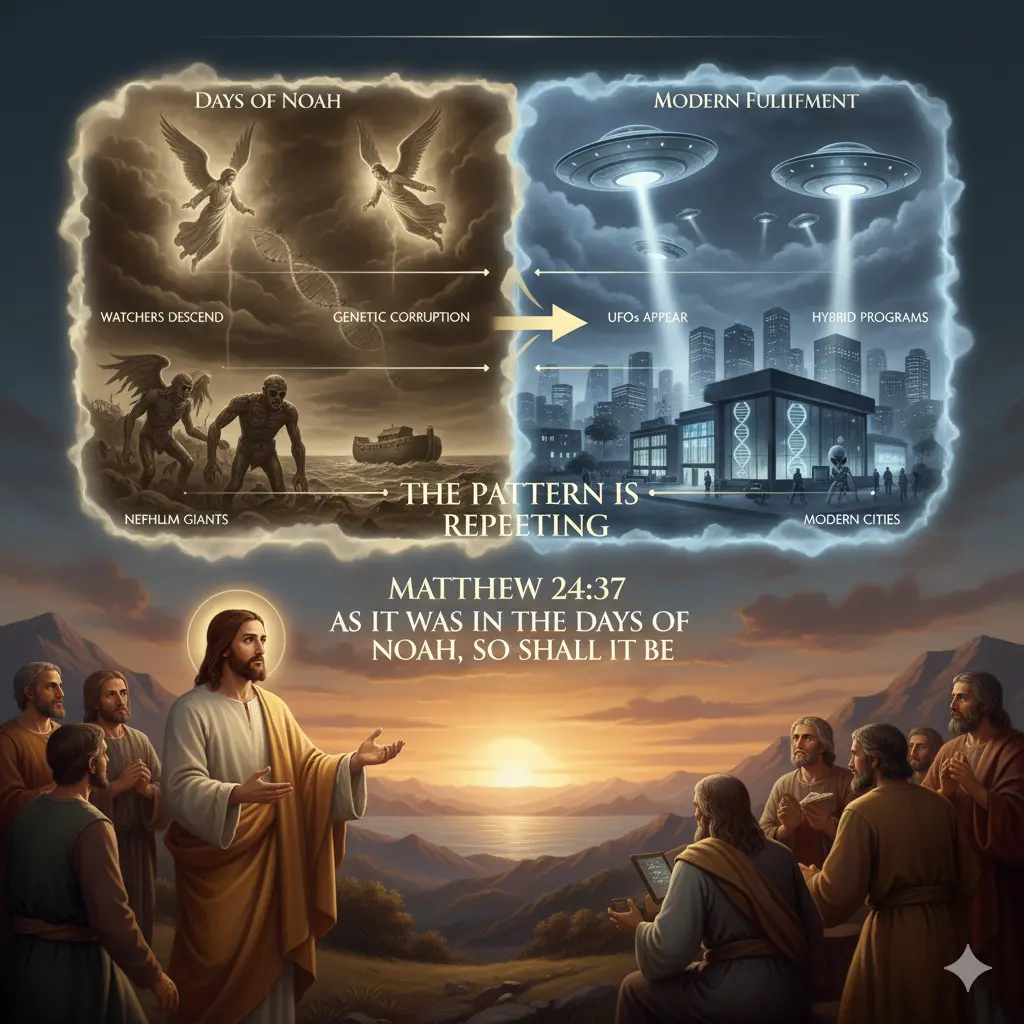
As in the Days of Noah: Why Jesus' Prophecy Points to UFO Phenomena Returning
Discover why Jesus' prophecy 'as in the days of Noah' specifically points to UFO phenomena and Genesis 6 conditions repeating.