Tartarus in the Bible: The Prison of the Fallen Angels in 2 Peter 2:4
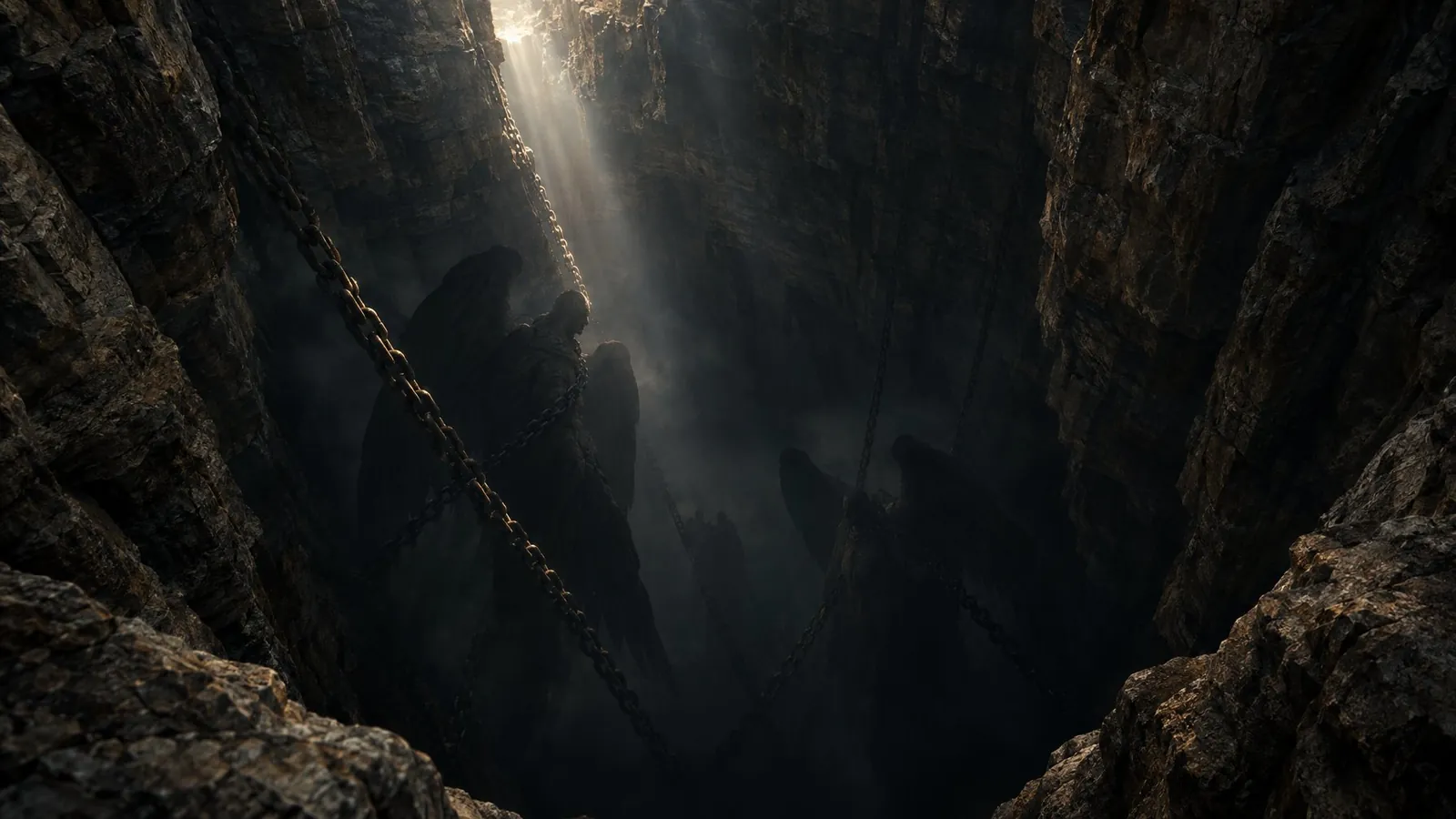
Tartarus appears exactly once in the Bible, in 2 Peter 2:4, where Peter says God did not spare angels when they sinned but cast them into Tartarus and held them in chains of darkness until the judgment. It is the place where certain fallen angels are confined now, ahead of their final sentence.
Most English Bibles hide the word behind "hell," so many readers never know it is there. That one word, though, opens a window onto how the apostles read Genesis 6, how Jewish writers before them spoke about rebellious heavenly beings, and why a name from Greek mythology ended up in the New Testament at all.
This article traces Tartarus from its first appearance in Greek poetry, through the Greek Old Testament and the Book of Enoch, to Peter's letter — and then sets it beside Sheol, Hades, Gehenna, the Abyss and the Lake of Fire so you can see exactly how they differ.
What Does Tartarus Mean in the Bible?
The Greek word behind 2 Peter 2:4 is not actually the noun Tartarus. It is a Greek verb, tartaroō (often written tartaroo; Strong's G5020), which means "to cast into Tartarus" or "to confine in Tartarus." Peter uses it as a participle, tartarōsas: God, "having cast them into Tartarus." The verb appears nowhere else in the New Testament or the Greek Old Testament.
So why do the KJV, ESV and most other translations simply say "hell"? Because English has no separate word for this place. Translators had to choose between importing an unfamiliar Greek name and using the general English word for a place of punishment. Most chose "hell," and a few add a footnote reading "Greek Tartarus."
That choice is understandable, but it flattens a real distinction. In the New Testament, "hell" translates three different Greek words — Hades, Gehenna and Tartarus — and each one carries its own meaning. Tartarus is the most specific of the three. It is never used for human beings. It is used once, for angels.
What Does 2 Peter 2:4 Mean?
"For if God did not spare angels when they sinned, but cast them into hell and committed them to chains of gloomy darkness to be kept until the judgment..." — 2 Peter 2:4 (ESV)
The verse sits inside a warning. In 2 Peter 2:1–3 the apostle says false teachers will arise in the church, bringing in destructive heresies and exploiting believers. He then gives three examples from the Old Testament to prove that God judges rebellion and rescues the faithful:
- The angels who sinned were cast into Tartarus (2:4).
- The ancient world was destroyed in the flood, but Noah and seven others were preserved (2:5).
- Sodom and Gomorrah were reduced to ashes, but righteous Lot was rescued (2:6–8).
Then comes the point of the whole passage: "the Lord knows how to rescue the godly from trials, and to keep the unrighteous under punishment until the day of judgment" (2:9). Tartarus is not mentioned to frighten readers with speculation about the underworld. It is mentioned as evidence that God's judgment reaches even the heavenly realm — and that his care for the righteous is just as sure.
Notice the order. Peter places the angels directly before the flood. That is exactly where the story of the "sons of God" and "the daughters of man" sits in Genesis 6:1–4, immediately before the flood narrative. Most interpreters, ancient and modern, see that ordering as deliberate.
Chains or Pits? A Manuscript Detail Most Readers Never See
The ancient Greek manuscripts of 2 Peter 2:4 do not all say the same thing. Some read seirais, "chains." Others read sirois, "pits" — the words differ by only a letter or two in Greek. The evidence is fairly evenly split, according to the UBS translator's handbook on 2 Peter, which follows the "chains" reading.
That is why your Bible may differ from a friend's. The KJV, ESV and current NIV read "chains of darkness." The NASB reads "pits of darkness," and the RSV "pits of nether gloom." Either way, the picture is the same: confinement in darkness, with no freedom to act, until the day of judgment.
Jude 6: The Angels Who Left Their Proper Dwelling
Jude describes the same group of angels in nearly the same words:
"And the angels who did not stay within their own position of authority, but left their proper dwelling, he has kept in eternal chains under gloomy darkness until the judgment of the great day." — Jude 6 (ESV)
The KJV phrases it memorably: these angels "kept not their first estate, but left their own habitation." Two details stand out. First, their sin is described as leaving something — a position of authority and a proper abode that God had assigned them. Second, Jude immediately compares them with Sodom and Gomorrah, which "indulged in sexual immorality and pursued unnatural desire" (Jude 7). The comparison only works if the angels also crossed a boundary God had set, which is why many readers connect Jude 6 to the sons of God taking human women in Genesis 6.
Jude does not use the word Tartarus, but the description — angels in eternal chains under darkness, held for the judgment of the great day — matches 2 Peter 2:4 closely. The two letters share a great deal of material, and scholars have long debated which one drew on the other. The majority view today is that 2 Peter used Jude, though some argue the reverse. Either way, Peter and Jude are describing the same imprisoned angels.
Jude also quotes the Book of Enoch directly. Jude 14–15 cites 1 Enoch 1:9, the prophecy that "the Lord comes with ten thousands of his holy ones, to execute judgment on all." That matters, because 1 Enoch is the ancient book that tells the fullest story of the Watchers and their imprisonment. For background on that book, see our guide to the Book of Enoch.
Tartarus Before the Bible: Hesiod and Homer
Tartarus was a familiar word long before Peter used it. In Greek mythology it was the deepest part of the underworld, far below Hades, and it had one main purpose: holding divine rebels.
The poet Hesiod, writing around 700 BC, describes it in his Theogony. After Zeus and the Olympian gods defeat the Titans, the older generation of gods who fought them for control of the cosmos, the Titans are bound in chains and imprisoned in Tartarus. Hesiod measures its depth with an image:
"For a brazen anvil falling down from heaven nine nights and days would reach the earth upon the tenth: and again, a brazen anvil falling from earth nine nights and days would reach Tartarus upon the tenth." — Hesiod, Theogony 722–725 (trans. H. G. Evelyn-White)
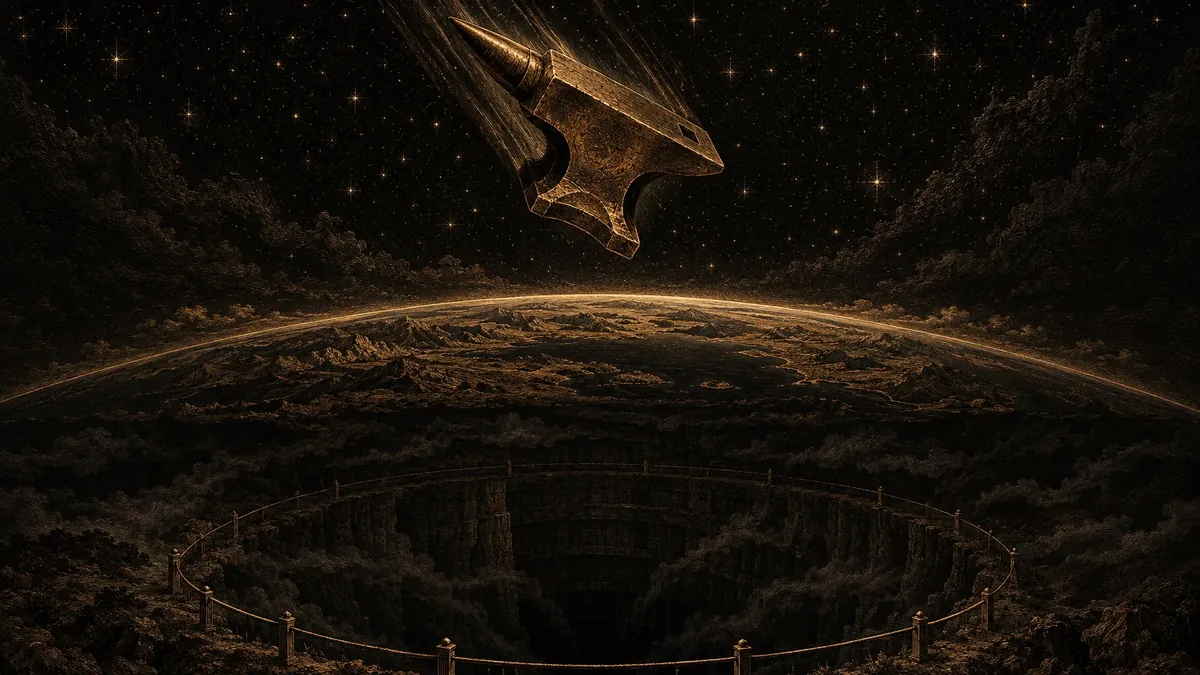
Hesiod adds that a bronze fence runs around it and that night is poured around its neck in three rows. Homer's Iliad (8.13–16) has Zeus threaten to hurl any disobedient god into "murky Tartarus," as far beneath Hades as heaven is above the earth.
So when a first-century Greek speaker heard the word, it did not mean "the afterlife" in general. It meant the bottom of the cosmos — the maximum-security prison where rebellious heavenly beings were chained in darkness. That is precisely the picture Peter needed.
None of this means Peter was endorsing Greek mythology. He was writing in Greek to readers who spoke Greek, and he used the word that best named the reality he wanted to describe. Paul did something similar in Athens when he quoted Greek poets to make a point about the true God (Acts 17:28).
How Jewish Writers Used the Word
Peter was not the first to bring Tartarus into biblical language. Jewish writers working in Greek had already done so for centuries.
1. c. 700 BC
Hesiod's Theogony
The prison of the defeated Titans, as far below earth as heaven is above it.
2. 3rd–2nd century BC
Septuagint
Greek translators use tartaros for the depths in Job 40:20, Job 41:24 and Proverbs 30:16.
3. 3rd–1st century BC
1 Enoch 20:2
The archangel Uriel is set over "the world and Tartarus."
4. 1st century AD
2 Peter 2:4
Peter uses the verb tartaroō: God "cast into Tartarus" the angels who sinned.
The Septuagint. When Jewish scholars translated the Hebrew Scriptures into Greek in the third and second centuries BC, they used tartaros three times: in Job 40:20, Job 41:24 (41:32 in English Bibles) and Proverbs 30:16. In each case it stands for the lowest depths — the places beneath the earth and the sea. There the word is not yet a prison for angels. It simply names the deepest part of creation.
1 Enoch. The Book of the Watchers, the oldest section of 1 Enoch and a landmark of Jewish apocalyptic writing, tells how about two hundred Watchers descended on Mount Hermon, took human wives and fathered giants. God then orders their imprisonment. The archangel Raphael binds the Watcher Asael hand and foot and casts him into darkness (1 Enoch 10:4–6). Michael binds Shemihaza and his companions "for seventy generations in the valleys of the earth, till the day of their judgment" (10:11–12). A little later, the Greek text of 1 Enoch 20:2 names Uriel as the archangel "over the world and Tartarus."
Put those pieces together and the trail is clear. Greek poets used Tartarus for the prison of rebel gods. Jewish translators used it for the deepest depths. The Enoch tradition described a dark, subterranean prison for the Watchers and linked it to Tartarus by name. Peter, writing to people who knew this background, used a single verb that summoned the whole picture.
To read more about these heavenly beings and their oath, see Who Are the Watchers? and our article on Mount Hermon in the Bible.
Who Is in Tartarus According to the Bible?
The Bible says only that Tartarus holds "angels when they sinned" (2 Peter 2:4) — the angels who "left their proper dwelling" (Jude 6). It does not say all fallen angels are there. In fact, the New Testament is clear that Satan and many demons are still active (Ephesians 6:12; 1 Peter 5:8). Tartarus holds a specific group whose sin was serious enough to warrant immediate confinement.
Who were they? The earliest and most common answer — held by the Book of Enoch, by Jewish writers before Christ and by most early church fathers — is that they are the sons of God of Genesis 6:1–4 — the sons of God imprisoned in Tartarus for crossing the boundary between heaven and earth, the angelic beings who took human women as wives and fathered the Nephilim. Peter's placement of the angels right before the flood, and Jude's comparison with Sodom's "unnatural desire," both fit that reading. For more on their offspring, see Who Were the Nephilim?
Not every Christian reads Genesis 6 this way. From the third century on, writers such as Julius Africanus, and later Augustine, argued that the "sons of God" were the godly descendants of Seth who intermarried with the ungodly line of Cain. On that view, 2 Peter 2:4 refers to an angelic fall that Scripture does not describe in detail. Both positions take the text seriously. The angelic reading, though, is the one that best explains why Peter and Jude speak of a particular group of angels confined for a particular sin.
Tartarus vs Hades, Sheol, Gehenna and the Abyss
English Bibles use "hell" for several different words. Here is how they differ:
| Word | Language | Who is there | When | Key verses |
|---|---|---|---|---|
| Sheol | Hebrew | The dead in general, righteous and wicked | Before the final judgment | Genesis 37:35; Psalm 16:10 |
| Hades | Greek | The dead; the Septuagint's usual word for Sheol | Before the final judgment | Luke 16:23; Revelation 20:13–14 |
| Tartarus | Greek | Angels who sinned | Now, until the judgment | 2 Peter 2:4 |
| The Abyss (bottomless pit) | Greek | Demons; the beast; Satan for a thousand years | Now and in the end-time events of Revelation | Luke 8:31; Revelation 9:1–11; 11:7; 20:1–3 |
| Gehenna | Greek, from Hebrew | The wicked after judgment | After the final judgment | Matthew 10:28; Mark 9:43–48 |
| Lake of Fire | Greek | The devil, his angels, death and Hades, the unrepentant | After the final judgment | Matthew 25:41; Revelation 20:10, 14–15 |
Tartarus vs Hades. Hades is the realm of the dead in general — the place Jesus describes in the story of the rich man and Lazarus (Luke 16:19–31). Tartarus is narrower and deeper. Even in Greek mythology it lay far beneath Hades, and in Scripture it holds angels, not human souls.
Tartarus vs Gehenna. Gehenna takes its name from the Valley of Hinnom outside Jerusalem, where children were once sacrificed (Jeremiah 7:31). Jesus uses it for final judgment after the resurrection. Tartarus is a holding place before that judgment.
Is Tartarus the same as the bottomless pit? Possibly. The Abyss (abyssos) is where the demons begged Jesus not to send them (Luke 8:31), and in Revelation an angel is given the key to it, releasing a plague led by a king named Abaddon in Hebrew and Apollyon in Greek (Revelation 9:1–11). Some interpreters treat the Abyss and Tartarus as two names for one prison. Others keep them distinct, noting that Tartarus is described as holding its prisoners "until the judgment." Scripture does not settle the question.
What about 1 Peter 3:19–20? Peter also speaks of Christ proclaiming his victory to "the spirits in prison, because they formerly did not obey... in the days of Noah." Many interpreters link these imprisoned spirits to the angels of Genesis 6 and 2 Peter 2:4, though the passage is one of the most debated in the New Testament.
Is Tartarus a Real Place?
Christians answer this in two main ways. Some read Tartarus as a literal place within the created, unseen realm — a real prison, as real as the angels it holds. Others read Peter's verb as a vivid figure of speech: God has stripped these angels of their freedom and power, and Tartarus is the name his readers would understand for that condition.
Both readings agree on what matters most. These angels are not free. They are not roaming the earth. They are held under God's authority, and their fate is already decided. Whether Tartarus is a location or a condition, it is not outside God's rule — it is one more place where his rule is enforced.
Will Tartarus Ever Be Emptied?
Peter and Jude both say these angels are kept "until the judgment" (2 Peter 2:4) — "the judgment of the great day" (Jude 6). That suggests Tartarus is not their final destination. It is a holding cell before sentencing. At the final judgment, Scripture says the eternal fire was "prepared for the devil and his angels" (Matthew 25:41). In that sense Tartarus will one day be emptied — not into freedom, but into final judgment.
Some readers also connect the opening of the Abyss in Revelation 9 with a release of imprisoned spirits in the last days. That depends on whether the Abyss and Tartarus are the same place, which, as noted above, the text leaves open.
What Tartarus Teaches Today
It would be easy to read about Tartarus and focus on the darkness. Peter does not. His conclusion is a promise: "the Lord knows how to rescue the godly from trials" (2 Peter 2:9).
The same God who confined rebellious angels preserved Noah through the flood and brought Lot out of Sodom. Peter's readers were surrounded by false teachers and moral confusion, much as Noah and Lot were. Tartarus told them that no rebellion, human or heavenly, is beyond God's reach — and that faithfulness is never overlooked.
That is still the message. God's justice is certain, but his rescue is just as certain. The story of the angels in chains is ultimately a story about the God who keeps his word.
Frequently Asked Questions About Tartarus
Only once, in 2 Peter 2:4, where Peter uses the Greek verb tartaroō, meaning "to cast into Tartarus." Most English translations render it as "hell." Jude 6 describes the same imprisoned angels without using the word.
Not exactly. English Bibles use "hell" for several different words: Sheol and Hades (the realm of the dead), Gehenna (final judgment), and Tartarus. Tartarus is the most specific — a prison for angels who sinned, held until the judgment.
Hades is the realm of the dead in general, where human souls await the resurrection. Tartarus is deeper and narrower: in Greek thought it lay far below Hades, and in Scripture it holds sinning angels rather than human beings.
The angels who sinned (2 Peter 2:4) and who left their proper dwelling (Jude 6). Most early Jewish and Christian interpreters identified them with the sons of God of Genesis 6:1–4, the Watchers of the Book of Enoch.
Scripture does not say. Some interpreters treat the Abyss of Luke 8:31 and Revelation 9 and 20 as another name for Tartarus; others see two different places. Both are places of confinement for rebellious spirits.
Categories:
Related Articles
Is AI the Antichrist or the Beast of Revelation? What Scripture Actually Says
Many videos claim AI is the beast of Revelation. Here's what Revelation 13 actually says about the beast, its image and its mark, and why AI doesn't fit.
Nephilim Daughters: What Genesis and the Book of Enoch Actually Say
Did the Watchers have daughters? Here's what Genesis, the Book of Enoch, and biblical scholarship actually say about female Nephilim — and where popular theories go beyond the text.
Nephilim and Giants Across Ancient Texts: A Side-by-Side Comparison
Genesis gives the Nephilim four verses. Here's what 1 Enoch, the Book of Giants, Numbers, and Josephus actually say — laid side by side, without blending the accounts.
Why the Covenant Runs Through Isaac: Genesis 17, the Jeconiah Curse, and the Narrowing Line to Jesus
Genesis 17 names Isaac, not Ishmael, as the covenant line — and it's the first of several narrowing points scripture traces all the way to Jesus. Here's the full pattern, with genealogy tables.