
Why the Covenant Runs Through Isaac: Genesis 17, the Jeconiah Curse, and the Narrowing Line to Jesus
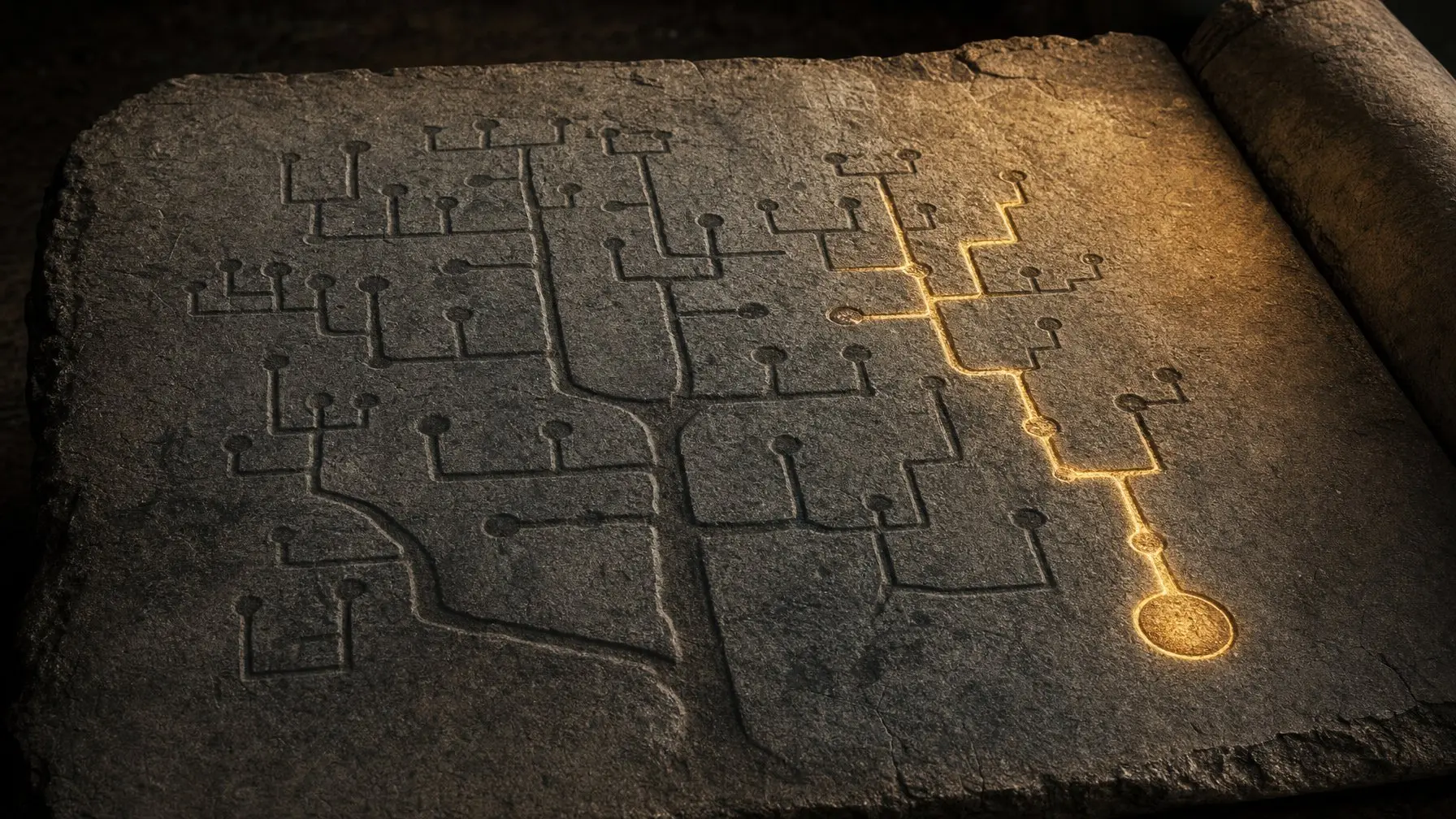
Genesis 17 records a moment easy to read past quickly: God renews his covenant with Abraham, and Abraham — already the father of Ishmael — asks God to let the blessing rest on the son he already has. God's answer is direct. Ishmael will be blessed substantially. But the covenant itself, the "everlasting covenant," is named for a son not yet born: Isaac.
That's not an isolated moment. It's the first clear instance of a pattern that runs through the entire Hebrew Bible and into the New Testament genealogies of Jesus: covenant descent in scripture has never simply followed the widest bloodline. At several specific points, the text narrows the promise to one branch of a family — while still meaning what it says about blessing the branches it doesn't choose.
This piece traces that pattern from Genesis 17 through to its final, most sophisticated instance: how Matthew and Luke's genealogies of Jesus resolve a real textual problem — a curse placed on part of David's own royal line — using the same narrowing logic scripture has been using since Abraham.
Genesis 17: What the Text Actually Says About Ishmael
The full exchange is worth reading closely. God tells Abraham that Sarah will bear a son, to be named Isaac, and that the covenant will be established with him "for an everlasting covenant, and with his descendants after him" (Genesis 17:19). Abraham's response is immediate: "Oh, that Ishmael might live before you!" (Genesis 17:18) — a plea to let his existing son inherit the promise instead.
God's answer to that plea has two parts, and both matter:
"And as for Ishmael, I have heard you. Behold, I have blessed him and will make him fruitful and multiply him greatly. He shall father twelve princes, and I will make him into a great nation. But I will establish my covenant with Isaac..." (Genesis 17:20-21)
Ishmael's blessing here is substantial, not a consolation prize: fruitfulness, multiplication, twelve princes, a great nation. Islamic tradition, independently of this passage, holds Ishmael in major standing — traditionally credited with helping rebuild the Kaaba in Mecca (Quran 2:127) and regarded as a prophet in his own right (Quran 19:54-55). This is a case where two traditions read the same patriarchal figures through different frameworks about which scriptures carry final authority, not a case where one tradition is simply unaware of or embarrassed by the other's account.
What Genesis 17 establishes, on its own terms, is narrower and more specific than "who is blessed": it names which son the covenant itself — the specific promise of an everlasting relationship and a coming line — runs through. That distinction, blessing versus covenant, is the hinge the rest of this pattern turns on.
The Pattern Repeats: Jacob, Then Judah
Genesis 17 isn't a one-time exception. The same narrowing structure recurs at each major generational turn in the patriarchal narrative:
- Isaac's sons: Esau is the firstborn, but the covenant blessing passes to Jacob (Genesis 25:23, 27:27-29), whom God renames Israel.
- Jacob's sons: Reuben, as firstborn, would traditionally hold the leading blessing, but Genesis 49 reassigns it. Reuben is passed over for instability (Genesis 49:3-4), and the scepter promise — kingship, the ancestor of the coming ruler — goes to Judah specifically: "The scepter shall not depart from Judah, nor the ruler's staff from between his feet, until tribute comes to him; and to him shall be the obedience of the peoples" (Genesis 49:10).
By the time the line reaches Judah, the covenant has been narrowed three separate times — Isaac over Ishmael, Jacob over Esau, Judah over his older brothers — each time by explicit divine statement, not by birth order or general genealogical breadth.
The Fourth Narrowing: A Curse Inside the Chosen Line Itself
The pattern's final and most surprising instance happens generations later, and it's internal — it narrows the promise even within the line that had already been chosen.
By the time of the Babylonian exile, the Davidic throne (promised as an eternal line in 2 Samuel 7:12-16) had passed down through Solomon to a king named Jeconiah (also called Jehoiachin, or Coniah). Jeremiah 22:30 records a striking divine judgment against him specifically:
"Thus says the LORD: 'Write this man down as childless, a man who shall not succeed in his days, for none of his offspring shall succeed in sitting on the throne of David and ruling again in Judah.'"
This creates a genuine textual problem worth stating plainly: Matthew's genealogy of Jesus (Matthew 1:11-12) runs directly through Jeconiah. If the curse means no descendant of Jeconiah can ever sit on David's throne, and Jesus is a descendant of Jeconiah, that appears to disqualify him from the very messianic claim the genealogy exists to establish.
How the Text Resolves It
The resolution turns on a detail both genealogies preserve carefully. Matthew's genealogy uses genealogical language consistent with direct biological succession ("Abraham was the father of Isaac...") down through Solomon and Jeconiah to Joseph — establishing Joseph's legal right to David's throne. Luke's genealogy (Luke 3:23-38) runs through a different son of David entirely: Nathan, not Solomon — and most commentators read Luke's line as Mary's genealogy, tracing Jesus's biological descent from David through a branch that never passed through Jeconiah or the curse at all.
The decisive fact is simpler than either genealogy alone: Jesus was not Joseph's biological son. Because of the virgin birth (Matthew 1:18-25, Luke 1:34-35), Jesus does not carry Jeconiah's blood — the curse, which concerns descendants, biological offspring, does not apply to him. He inherits the legal right to David's throne through Joseph's line by adoption, while his biological descent from David runs through Mary's line, which never passes through the cursed branch.
It's worth being precise about how much argument this actually requires. Some teachers — Chuck Missler among them — have built out a more elaborate version of this resolution, proposing that Luke's genealogy specifically demonstrates Mary's line inherited through her father Heli under an inheritance provision similar to the daughters of Zelophehad in Numbers 27 (where daughters could inherit in the absence of a son). That's an interesting and textually engaged elaboration, but it isn't strictly necessary for the resolution to hold. The Christian Research Institute has published a direct critique of this more elaborate framing, noting plainly that "there is no clear New Testament teaching that the curse of Jeconiah necessitated the Virgin Birth. In fact, the New Testament writers never acknowledge that there is such a problem to overcome" — meaning the core answer (Jesus isn't Joseph's biological son, so the curse doesn't reach him) already resolves the issue on its own, without requiring the additional legal-precedent argument.
The Full Pattern, Side by Side
| Narrowing point | Passed over | Chosen | Text |
|---|---|---|---|
| Sons of Abraham | Ishmael | Isaac | Genesis 17:18-21 |
| Sons of Isaac | Esau | Jacob | Genesis 25:23, 27:27-29 |
| Sons of Jacob | Reuben (and others) | Judah | Genesis 49:3-4, 49:10 |
| Davidic royal line | Solomon → Jeconiah (cursed) | Nathan (uncursed) | Jeremiah 22:30; Matthew 1:11-12; Luke 3:23-31 |
Matthew's Genealogy vs. Luke's Genealogy: Where They Diverge
| Matthew 1:1-17 | Luke 3:23-38 | |
|---|---|---|
| Direction | Abraham → Jesus (forward) | Jesus → Adam (backward) |
| Line traced | Legal / royal (through Joseph) | Biological (widely read as Mary's line) |
| Son of David through | Solomon | Nathan |
| Includes Jeconiah? | Yes (1:11-12) | No |
| Purpose | Establishes Jesus's legal claim to David's throne | Establishes Jesus's actual bloodline descent from David and Adam |
It's honest to note the two genealogies also diverge in several names between David and Joseph, which is a genuine point of scholarly discussion beyond the Jeconiah question — commonly explained by the two lists tracing different lines entirely (Joseph's legal line vs. Mary's, per above), though the identification of Heli as Joseph's father-in-law rather than father is itself an inference the text doesn't state outright.
Why This Pattern Matters More Than Any Single Verse
Read in isolation, Genesis 17 can look like a single proof-text. Seen as part of this larger pattern — repeated at Jacob and Esau, at Judah and his brothers, and resolved with real textual sophistication at Jeconiah and Nathan — it reads instead as the consistent grain of how the biblical narrative describes covenant descent throughout: a specific, named line, narrowed by explicit divine statement at several points, including within its own chosen branch. That consistency is a stronger case than any one passage taken alone, and it's the same logic the Gospel writers themselves reach for centuries later to explain how Jesus can be a genuine descendant of David's cursed line without being disqualified by it.
Frequently Asked Questions
Does Genesis 17 say Ishmael was rejected by God? No. God explicitly blesses Ishmael with fruitfulness, multiplication, and a promise of twelve princes and a great nation. What Genesis 17 specifically states is that the covenant — as distinct from blessing generally — is established with Isaac.
How can Jesus be the Messiah if his genealogy includes the cursed king Jeconiah? Matthew's genealogy traces Joseph's legal line through Jeconiah, but because Jesus was virgin-born, he was not Joseph's biological son and does not carry Jeconiah's bloodline. Luke's genealogy traces Jesus's actual biological descent from David through a different son, Nathan, which was never subject to the curse.
Do Matthew and Luke's genealogies contradict each other? They diverge in the names listed between David and Joseph, most commonly explained as Matthew tracing Joseph's legal line and Luke tracing a separate line (often read as Mary's biological line). Both converge on Jesus as a genuine descendant of David through different paths.
Is the "daughters of Zelophehad" argument necessary to resolve the Jeconiah curse? No. It's an elaboration some teachers add to explain how inheritance could pass through Mary specifically, but the core resolution only requires that Jesus was not Joseph's biological son — which the virgin birth accounts of both Matthew and Luke already establish.
Primary Source Reference List
- Genesis 17:15-21 — the covenant established with Isaac; Ishmael's separate blessing
- Genesis 25:23, 27:27-29 — Jacob chosen over Esau
- Genesis 49:3-4, 49:10 — Reuben passed over; the scepter promise to Judah
- 2 Samuel 7:12-16 — the Davidic covenant of an eternal throne
- Jeremiah 22:24-30 — the curse on Jeconiah (Jehoiachin/Coniah)
- Matthew 1:1-17 — the legal genealogy through Joseph and Solomon
- Luke 3:23-38 — the genealogy through Nathan, commonly read as Mary's line
- Matthew 1:18-25, Luke 1:34-35 — the virgin birth accounts
Categories:
Related Articles

Nephilim Daughters: What Genesis and the Book of Enoch Actually Say
Did the Watchers have daughters? Here's what Genesis, the Book of Enoch, and biblical scholarship actually say about female Nephilim — and where popular theories go beyond the text.

Why Did Human Lifespans Decline After the Flood? What Scripture Doesn't Say — And What Scholars Have Proposed
Genesis 5 records lifespans over 900 years. By Psalm 90, it's 70-80. Scripture never explains why. Here's what rabbinic, patristic, and modern scholarship have proposed instead.

Are Nephilim Descendants Alive Today? Six Fingers, Giant DNA, and What the Evidence Actually Shows
Scripture describes six-fingered giant descendants surviving well after the Flood. Modern folklore claims the same. Here's what the biblical text actually says — and why the Lovelock Cave and Kandahar stories don't hold up as evidence.

The Gospel of Salvation: Understanding 1 Corinthians 15 and the Resurrection That Saves
Discover the complete gospel message from 1 Corinthians 15. Learn why Christ's death, burial, and resurrection are essential for salvation, and how you can receive eternal life through faith in Jesus.