
What Happened to the Elioud After the Flood? The Wilderness Dweller Theory
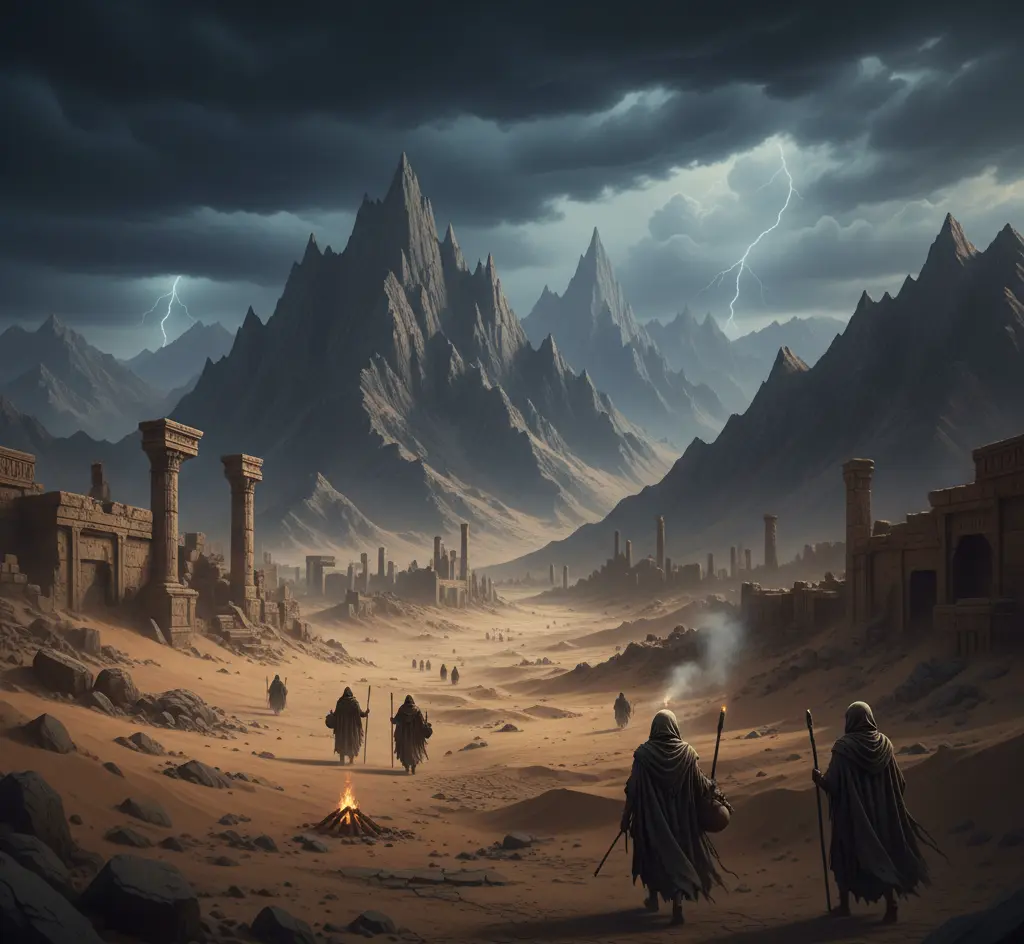
Note: This article builds on Elioud in the Bible: Ancient Lineage Explored in Sacred Texts. Read that first for complete background on who the Elioud were.
The ancient texts clearly describe the Elioud—the second-generation offspring of the Nephilim—but remain conspicuously silent on their ultimate fate. While the Book of Enoch details the destruction of the Nephilim and the binding of the Watchers, the question lingers: What happened to the Elioud?
Were they completely destroyed in the flood? Did some survive in altered form? Could they have been condemned to a different fate than their Nephilim fathers? The textual ambiguity has sparked centuries of theological debate and given rise to what scholars call the "Wilderness Dweller Theory."
Let's examine what Scripture and ancient texts actually say—and what they conspicuously don't say—about the fate of these mysterious beings.
The Textual Silence on Elioud's Fate
What We Know About the Nephilim's End
The Book of Enoch provides explicit details about the Nephilim's judgment:
1 Enoch 10:9-10:
"Proceed against the bastards and the reprobates, and against the children of fornication: and destroy the children of the Watchers from amongst men: send them one against the other that they may destroy each other in battle."
Clear outcomes for the Nephilim:
- They would destroy each other in battle
- Their physical bodies would die
- Their spirits would become wandering demons (1 Enoch 15:8-12)
- Complete destruction was decreed
Genesis 6:7 confirms God's intention:
"And the LORD said, I will destroy man whom I have created from the face of the earth."
The flood accomplished this destruction. But here's where it gets puzzling.
The Elioud: A Different Category?
Key distinctions in ancient texts:
Generation removed from angelic origin:
- Watchers = pure fallen angels
- Nephilim = half-angel, half-human
- Elioud = quarter-angel, three-quarter human
Nature and composition:
- More human than their Nephilim fathers
- Less supernatural power and size
- Potentially different spiritual status
- Ambiguous classification in judgment
The critical question ancient rabbis debated: Were the Elioud judged identically to the Nephilim, or did their more diluted angelic nature result in a different fate?
Genesis 6:4's Cryptic Addition
The phrase "and also afterward":
"There were giants in the earth in those days; and also after that, when the sons of God came in unto the daughters of men." (Genesis 6:4)
Three possible interpretations:
- During the pre-flood period - Giants existed throughout the time leading to judgment
- After the Watchers' descent - Giants continued being born after the initial incident
- After the flood - Giants somehow existed post-flood (most controversial)
Numbers 13:33 complicates the picture:
"And there we saw the giants, the sons of Anak, which come of the giants: and we were in our own sight as grasshoppers."
The Hebrew literally says the Anakim "come from the Nephilim." How is this possible if all Nephilim died in the flood?
Proposed theological solutions:
- Genetic recessive theory - Noah's family carried dormant giant genes
- Second incursion theory - Angels again violated boundaries post-flood (unlikely, given divine response)
- Terminology confusion - "Nephilim" became a generic term for any giants
- Survival theory - Some hybrid beings survived in altered form
The Wilderness Dweller Theory attempts to address this textual puzzle while respecting both Scripture and ancient Jewish understanding.
The Biblical Pattern: Cursed Beings in Desolate Places
A Consistent Scriptural Theme
Throughout the Bible, certain beings are consistently associated with wilderness regions—not populated areas, not temples, but remote, desolate places.
Isaiah's Wilderness Creatures
Isaiah 13:21-22:
"But wild beasts of the desert shall lie there; and their houses shall be full of doleful creatures; and owls shall dwell there, and satyrs shall dance there. And the wild beasts of the islands shall cry in their desolate houses, and dragons in their pleasant palaces."
The Hebrew term se'irim (שְׂעִירִים):
- Translated as "satyrs," "wild goats," or "hairy ones"
- Appears in contexts of judgment and desolation
- Associated with demonic or supernatural beings
- Consistently placed in wilderness settings
Isaiah 34:14:
"The wild beasts of the desert shall also meet with the wild beasts of the island, and the satyr shall cry to his fellow; the screech owl also shall rest there, and find for herself a place of rest."
Key observations:
- These beings "cry to his fellow" (communicate)
- They inhabit ruins and waste places
- They're grouped with other mysterious creatures
- They seek but don't find "rest"
Some English translations include "Lilith" in Isaiah 34:14:
- Hebrew: לִילִית (lilit)
- Mentioned only once in canonical Scripture
- Jewish tradition describes as a night demon or wilderness spirit
- Consistently associated with desolate places, not civilization
Leviticus and the Scapegoat Ritual
Leviticus 16:8-10, 20-22 describes the Day of Atonement:
"And Aaron shall cast lots upon the two goats; one lot for the LORD, and the other lot for the scapegoat. And Aaron shall bring the goat upon which the LORD's lot fell, and offer him for a sin offering. But the goat, on which the lot fell to be the scapegoat, shall be presented alive before the LORD, to make an atonement with him, and to let him go for a scapegoat into the wilderness."
The Hebrew term Azazel (עֲזָאזֵל):
- Often translated as "scapegoat"
- Literally could mean "goat that departs" or a proper name
- In 1 Enoch 8:1 and 10:4-8, Azazel is a chief fallen angel
- The goat was sent to the wilderness, not the temple
Theological implications:
If Azazel is indeed a fallen angel's name (as 1 Enoch and Jewish tradition hold), this ritual symbolically sent sin back to its source—a fallen angel condemned to the wilderness, not heaven, not human cities, but desolate places.
The pattern emerges:
- Sin offerings go to God (temple)
- The scapegoat goes to Azazel (wilderness)
- Fallen angels and their influence = wilderness association
- Clean, holy things = temple/city association
New Testament Confirmation
Matthew 12:43-45:
"When the unclean spirit is gone out of a man, he walketh through dry places, seeking rest, and findeth none. Then he saith, I will return into my house from whence I came out."
Luke 8:31:
"And they besought him that he would not command them to go out into the deep [abyss]."
Key points:
- Demons prefer inhabiting bodies over wandering wilderness
- They walk through "dry places" (deserts, desolate areas)
- They seek rest but don't find it
- The "abyss" or "deep" is where they fear being sent
Mark 5:1-5 - The Gerasene demoniac:
"And when he was come out of the ship, immediately there met him out of the tombs a man with an unclean spirit, who had his dwelling among the tombs... and he was in the mountains, and in the tombs, crying."
The pattern:
- Severe demonic possession
- Lives in wilderness (tombs, mountains)
- Away from human civilization
- Crying out (similar to se'irim crying to each other)
- Uncontrollable strength
The Theological Framework
Cursed or judged beings consistently inhabit:
- Wilderness regions
- Mountains and forests
- Desolate, ruined places
- Tombs and waste areas
- Locations far from human community
They are characterized by:
- Restlessness and wandering
- Seeking but not finding peace
- Avoiding or being excluded from civilization
- Supernatural or corrupted nature
- Existence under divine judgment
Could the Elioud fit this pattern?
The Wilderness Dweller Theory Explained
Core Hypothesis
The Wilderness Dweller Theory proposes that the Elioud, being more human than their Nephilim fathers but still corrupted by angelic admixture, were not destroyed in the flood but rather:
Condemned to wilderness exile as judgment Progressively degraded across generations Lost human characteristics over millennia Became fully feral beings bearing little resemblance to their origins Continue to exist in remote, desolate regions as mysterious "wild men"
Theological Basis for Differentiated Judgment
Why might the Elioud's fate differ from the Nephilim?
Biblical precedent for gradated judgment:
Sodom and Gomorrah vs. Lot - Judgment fell on cities, but Lot escaped The Flood vs. Noah - Humanity destroyed, but Noah's family spared Israel's disobedience vs. Caleb/Joshua - Wilderness wanderers died, but faithful entered
Varying degrees of culpability:
- Watchers = fully culpable (chose to rebel)
- Nephilim = born into corruption but more angelic than human
- Elioud = born into corruption but more human than angelic
- Humans seduced = varying responsibility
Ancient Jewish debate:
Rabbinic tradition discusses whether hybrid beings had:
- Souls capable of repentance (probably not)
- Full moral agency (unclear)
- Status as "persons" vs. "abominations"
- Rights to mercy (debated)
The Elioud occupied ambiguous territory:
- Too corrupted to live among pure humans
- Too human to be judged exactly like Nephilim
- Condemned but possibly not to immediate destruction
- Exiled rather than annihilated?
The Degradation Model
Generational progression of corruption:
Pre-Flood:
Generation 1 - Watchers (pure fallen angels)
- Fully spiritual with physical manifestation ability
- Powerful, intelligent, malevolent
- Taught forbidden knowledge
Generation 2 - Nephilim (half-angel, half-human)
- "Mighty men of renown" (Genesis 6:4)
- 15-30+ feet tall (various ancient estimates)
- Violent, cannibalistic, tyrannical
- Destroyed in flood, spirits became demons
Generation 3 - Elioud (quarter-angel, three-quarter human)
- 9-12 feet tall (speculation based on dilution)
- Violent but less organized than Nephilim
- More human appearance and behavior
- Fate unclear in texts
Post-Flood (Theoretical):
Generation 4+ - Degraded survivors
- Increasingly animalistic with each generation
- Further loss of intelligence, speech, civilization
- Height reduced to 7-10 feet by historical times
- Fully feral wilderness adaptation by modern era
Mechanism of degradation:
Physical deterioration:
- Each generation smaller than the last
- Progressive loss of supernatural abilities
- Increasing physical deformities
- Adaptation to wilderness survival
Mental/spiritual deterioration:
- Loss of forbidden knowledge over time
- Degradation of language capacity
- Reduction to instinct-based behavior
- Complete loss of culture and civilization
Social deterioration:
- Inability to form complex societies
- Regression to solitary or small group living
- Loss of all building/crafting abilities
- Complete wilderness isolation
Biblical Precedent: Nebuchadnezzar's Curse
Daniel 4:33 provides a scriptural example of human-to-beast degradation:
"The same hour was the thing fulfilled upon Nebuchadnezzar: and he was driven from men, and did eat grass as oxen, and his body was wet with the dew of heaven, till his hairs were grown like eagles' feathers, and his nails like birds' claws."
Key elements:
- A human becoming beast-like as divine judgment
- Physical transformation (hair like eagles' feathers, nails like claws)
- Mental degradation (eating grass like animals)
- Exile from human civilization
- Living in fields/wilderness
If God cursed a powerful king to become beast-like within one lifetime, could He curse a hybrid race to degrade across multiple generations?
Theological principle established:
- God can and does impose transformative curses
- Physical and mental degradation can result from judgment
- Exile to wilderness is a form of divine punishment
- Restoration is possible (Nebuchadnezzar was restored) but not guaranteed
Application to Elioud:
If Nebuchadnezzar degraded in 7 years, what might happen across 4,000+ years under divine curse?
Explaining Post-Flood Giants
The Anakim Problem
Numbers 13:33 explicitly states:
"We saw the Nephilim there (the descendants of Anak come from the Nephilim)."
Deuteronomy 2:10-11:
"The Emim dwelt therein in times past, a people great, and many, and tall, as the Anakim; which also were accounted giants, as the Anakim; but the Moabites call them Emim."
Three post-flood giant races explicitly mentioned:
- Anakim - Descendants of Anak, terrified the Israelite spies
- Rephaim - Ancient giant race, Og of Bashan was "last of the Rephaim"
- Emim - "Terrors," tall as Anakim
Traditional explanations:
1. Genetic recessive theory:
- Giant genes carried through Ham or his wife
- Expressed in certain descendants
- Natural variation in human height
Problems:
- Numbers 13:33 says they "come from the Nephilim," not from Noah
- Doesn't explain supernatural elements
- Requires significant theological gymnastics
2. Second angelic incursion:
- Angels violated boundaries again after flood
- Produced new giants
Problems:
- No biblical text supports this
- Why wouldn't God send another flood?
- Jude 6 suggests the original Watchers are permanently bound
3. Elioud survival theory:
- More human Elioud survived flood in some form
- Were judged to wilderness exile, not death
- Became progenitors of post-flood giant races
- Degraded over time but retained size
Strengths:
- Explains "come from Nephilim" language
- Accounts for textual silence on Elioud fate
- Fits biblical wilderness pattern
- Explains gradual disappearance of giants
Geographic Patterns
Pre-flood Watchers' descent: 1 Enoch 6:6 - Mount Hermon
Post-flood giant territories:
- Bashan (Mount Hermon region) - Og's kingdom, Rephaim
- Hebron (mountainous) - Anakim stronghold
- Hill country (mountains) - Where Joshua drove out Anakim
- Canaan highlands (mountains/forests) - Various giant clans
Surviving Anakim after Joshua: Joshua 11:22 - "Only in Gaza, in Gath, and in Ashdod did some remain"
- Philistine coastal cities
- Goliath came from Gath
- Last giants defeated by David's men
The pattern:
- Giants consistently in mountainous/remote regions
- Gradual retreat to increasingly isolated areas
- Final remnants in border territories (Philistine cities)
- Complete disappearance after David's era
Wilderness Dweller Theory explanation:
Elioud/degraded beings naturally gravitated to:
- Mountains (like Mount Hermon, their ancestral descent point)
- Forests (concealment from humans)
- Border regions (between civilizations, not within them)
- Remote areas (under curse of exile)
As human civilization expanded and giant populations dwindled, they were progressively pushed into more remote wilderness until effectively isolated from human contact entirely.
The "No Bodies" Archaeological Problem
Expected Evidence vs. Actual Findings
If giants existed at 9-15+ feet tall:
- Massive skeletal remains should exist
- Burial sites should be discoverable
- Bones should be proportionally thick and dense
- Archaeological record should show clear evidence
What we actually find:
- No verified giant skeletons in reputable museums
- Occasional abnormally large human remains (7-8 feet) with gigantism
- Ancient legends and artwork depicting giants
- No physical evidence matching biblical descriptions
Traditional Explanations
Skeptical view:
- Giants never existed
- Biblical accounts are mythological
- Ancient people exaggerated normal tall people
Problems:
- Dismisses Scripture as unreliable
- Doesn't explain consistency across cultures
- Ignores biblical testimony
Believer explanations:
1. Complete decomposition:
- Ancient bones deteriorated completely
- Climate and conditions destroyed evidence
- Burial practices scattered remains
Problems:
- We find dinosaur fossils millions of years old
- We find human remains from 10,000+ years ago
- Shouldn't giants' bones be better preserved?
2. Bones were destroyed:
- Deliberately destroyed by ancient peoples
- Ground up for various uses
- Hidden or lost
Possible but speculative
3. Looking in wrong places:
- Giant territories not yet excavated
- Evidence exists but misidentified
- Future discoveries may prove their existence
Hopeful but incomplete answer
Wilderness Dweller Theory Explanation
If Elioud were not entirely physical:
Hybrid nature implications:
- Partially spiritual composition
- Bodies less dense than pure humans
- Rapid decomposition upon death
- Possibly no bones left at all
Biblical precedent:
Angels appearing physically:
- Abraham entertained angels who ate (Genesis 18)
- Jacob wrestled an angel (Genesis 32)
- Angels appeared to Mary, Joseph, disciples
Yet angels don't have:
- Normal biological bodies
- Bones that remain after manifestation
- Physical remains in our realm
If Elioud were quarter-angelic:
- Could their bodies be quasi-physical?
- Might they decompose differently than humans?
- Would they leave no archaeological trace?
This could explain:
- Thousands of reported sightings over millennia
- Zero physical remains recovered
- Extraordinary elusiveness
- Inability to capture or kill one
The degradation component:
If Elioud degraded over 4,000+ years:
- Their bodies became increasingly physical (more human)
- But curse remained (wilderness exile)
- By modern times, nearly indistinguishable from animals
- But still possessing preternatural awareness preventing capture
Modern Implications and the Cryptid Connection
This section explores theories some researchers propose. We present these perspectives for consideration, not as established doctrine.
Persistent Wilderness Legends Across Cultures
North America - Sasquatch/Bigfoot:
- 7-10 feet tall
- Covered in hair
- Remote forest dwelling
- Thousands of sightings, zero bodies
Asia - Yeti/Almas:
- Similar size estimates
- Himalayan mountains
- Ancient oral traditions
- No physical evidence
Australia - Yowie:
- Aboriginal legends pre-dating European contact
- Large, hairy, wilderness-dwelling
- Consistent descriptions
South America - Mapinguari:
- Amazon rainforest
- Indigenous legends
- Giant, hairy being
- Extreme remoteness
Global pattern similarities:
- Size: 7-10 feet (between human and ancient giants)
- Habitat: Remote wilderness, mountains, forests
- Behavior: Avoid humans, nocturnal, elusive
- Evidence: Thousands of reports, zero bodies
- Legends: Pre-date modern communication
Why Some Connect These to Elioud
Researchers who draw parallels note:
1. The size fits degradation model:
- Smaller than Nephilim (15-30+ feet)
- Larger than humans (5-6 feet average)
- Consistent with quarter-angel hybrid further degraded
2. Wilderness pattern matches:
- Biblical: Cursed beings in desolate places
- Modern: Cryptids exclusively in remote wilderness
- Never in cities, towns, or agricultural areas
3. The elusiveness is explained:
- Not purely physical (partial spiritual nature)
- Preternatural awareness (angelic heritage)
- Under divine curse to avoid humans
- Quasi-physical bodies leave no remains
4. No bodies/bones problem resolved:
- If hybrid spiritual-physical nature
- Bodies decompose differently
- No archaeological trace expected
- Matches angel appearances in Scripture
5. Consistent across cultures:
- Collective human memory of ancient beings
- Pre-dating modern communication
- Independent similar descriptions
- Suggests actual entities, not pure mythology
The Careful Framing Required
What we are NOT claiming:
- "Bigfoot definitely exists and is Elioud"
- "This theory is biblical fact"
- "You must believe this interpretation"
- "Cryptozoology proves Scripture"
What we ARE suggesting:
The Wilderness Dweller Theory provides:
- A biblically-grounded framework
- An explanation for textual silence on Elioud fate
- Reconciliation of post-flood giants with flood judgment
- Potential explanation for global wilderness legends
- Testable hypothesis respecting Scripture
Believers can disagree on this while maintaining:
- Biblical inerrancy
- Historic Christian faith
- Orthodox theology
- Respect for mystery where Scripture is silent
Theological Objections and Responses
Objection 1: "The Flood Destroyed ALL Flesh"
Genesis 6:17:
"And, behold, I, even I, do bring a flood of waters upon the earth, to destroy all flesh, wherein is the breath of life, from under heaven; and every thing that is in the earth shall die."
Response:
"All flesh" had exceptions:
- Fish and marine creatures survived
- Noah and family survived
- Animals on the ark survived
The question: Were Elioud "flesh" in the same category as pure humans and Nephilim, or were they judged differently due to their unique nature?
Possibility: "Destroyed" could mean:
- Destroyed as civilized beings
- Destroyed their human society
- Reduced to feral state
- Not necessarily physical annihilation
Compare: Nebuchadnezzar was "destroyed" as a functioning king but physically survived.
Objection 2: "This Gives Too Much Power to Satan"
Concern: If Elioud survive in any form, doesn't this suggest Satan's corruption couldn't be fully undone?
Response:
Romans 8:28 - God works all things together for good Genesis 50:20 - "Ye thought evil... but God meant it unto good"
If Elioud exist as wilderness exiles:
- They're under divine curse, not demonic blessing
- Utterly degraded from original state
- Completely excluded from humanity
- Living testament to judgment on corruption
- Perpetual reminder of God's holiness
Satan's goal: Corrupt Messiah's bloodline, prevent redemption Result: Failed completely - Jesus came, died, rose, redeemed humanity Elioud survival (if true): Irrelevant to Satan's plan, which failed utterly
Their theoretical existence would demonstrate:
- God's comprehensive judgment
- Various forms of divine punishment
- Complete isolation of corruption
- Permanent exile from humanity
Objection 3: "This Contradicts Scripture's Silence"
Concern: If Elioud survived significantly, why doesn't later Scripture mention them?
Response:
Scripture is also silent on:
- Most of human history
- What happened to Cain's mark after the flood
- The fate of most biblical figures
- Countless historical details
Silence ≠ denial Silence = not essential to revelation's purpose
Consider:
- Elioud relegated to complete wilderness exile
- No interaction with God's people
- No relevance to salvation history
- Not worth mentioning after initial judgment
By David's time:
- Last remnants of giants defeated
- No more encounters with hybrid beings
- Israel established in Promised Land
- Redemptive history moves forward
Mentioning wilderness exiles becomes irrelevant to Scripture's purpose of revealing:
- God's character
- Redemption plan
- Human responsibility
- Path to salvation
Objection 4: "This Is Just Speculation"
Concern: We shouldn't build theology on theories about unclear texts.
Response:
Absolutely agreed.
The Wilderness Dweller Theory is:
- Not doctrine - Just a hypothesis
- Not essential - Irrelevant to salvation
- Not binding - Believers can reject it entirely
- Not proven - Remains theoretical
But it is:
- Biblically grounded - Uses actual scriptural patterns
- Historically attested - Ancient Jews discussed similar ideas
- Logically coherent - Explains textual puzzles
- Humbly presented - Acknowledges uncertainty
Core theology remains unchanged:
- God judged pre-flood corruption
- The flood destroyed wickedness
- Noah and family were saved
- Post-flood giants existed somehow
- Christ came, died, rose, saves
Whether Elioud survived in any form doesn't affect:
- The gospel
- Salvation by grace through faith
- Biblical authority
- Christian living
- Eternal truths
Practical Application: Why This Matters
1. Humility Before Mystery
Job 38-41 - God's response to Job's questions:
God doesn't answer all Job's "why" questions. Instead, He reveals His majesty and Job's limited perspective.
The Elioud mystery reminds us:
- We don't need to know everything
- Some questions remain unanswered this side of eternity
- God's ways are higher than ours (Isaiah 55:8-9)
- Faith doesn't require comprehensive understanding
Practical impact:
- Hold theories loosely
- Respect biblical mystery
- Avoid dogmatism on unclear matters
- Focus on what Scripture clearly teaches
2. Reality of Spiritual Warfare
Whether or not Elioud survived physically, the spiritual reality is clear:
Ephesians 6:12:
"For we wrestle not against flesh and blood, but against principalities, against powers, against the rulers of the darkness of this world, against spiritual wickedness in high places."
The spirits of dead Nephilim/Elioud:
- 1 Enoch says they became demons
- They operate today
- They oppose God's people
- They're under Christ's authority
Practical impact:
- Recognize spiritual opposition is real
- Put on the armor of God
- Exercise authority in Christ's name
- Don't be ignorant of Satan's devices
3. God's Comprehensive Judgment
The Elioud question highlights:
- God judges all corruption
- Varying forms of judgment exist (death, exile, transformation)
- Nothing escapes divine justice
- Mercy and judgment coexist
Noah's flood demonstrates:
- God's patience has limits (120 years warning)
- Judgment, when it comes, is thorough
- Salvation is available (the ark)
- New beginnings follow judgment
Practical impact:
- Take sin seriously
- Don't presume on God's patience
- Accept salvation offered in Christ
- Expect future judgment (2 Peter 3:7)
4. Christ's Complete Victory
Whatever happened to the Elioud, Christ is victorious:
Colossians 2:15:
"And having spoiled principalities and powers, he made a shew of them openly, triumphing over them in it."
Hebrews 2:14:
"That through death he might destroy him that had the power of death, that is, the devil."
Even if degraded Elioud exist:
- They're completely defeated
- They're utterly isolated from humanity
- They're under divine curse
- They're irrelevant to redemption
- Christ has conquered all
Practical impact:
- Don't fear any spiritual entity
- Trust Christ's complete victory
- Walk in His authority
- Greater is He in you (1 John 4:4)
Conclusion: Living with Holy Curiosity and Biblical Focus
The question "What happened to the Elioud?" represents the kind of biblical mystery that:
- Intrigues thoughtful students of Scripture
- Remains ultimately unanswered in canonical texts
- Invites humble speculation grounded in biblical patterns
- Reminds us of what we don't know
The Wilderness Dweller Theory suggests:
The Elioud, being more human than their Nephilim fathers, may have been condemned to wilderness exile rather than immediate destruction. Over thousands of years under divine curse, they degraded from quasi-human hybrids to fully feral wilderness creatures, progressively losing intelligence, civilization, and human characteristics until becoming utterly isolated from humanity.
This theory would explain:
- Textual silence on their specific fate
- Post-flood giants "coming from Nephilim"
- Biblical pattern of cursed beings in wilderness
- No archaeological remains despite reported sightings
- Consistent cross-cultural wilderness legends
- The gradual disappearance of giants from biblical record
But whether this theory is accurate or not:
- Scripture remains authoritative
- Christ remains victorious
- Salvation remains by grace through faith
- The gospel remains unchanged
- Our calling remains to love God and others
The mystery invites us to:
- Study Scripture carefully
- Think deeply about biblical cosmology
- Acknowledge what we don't know
- Hold theories humbly
- Focus on what matters most
As Paul wrote in 1 Corinthians 13:12:
"For now we see through a glass, darkly; but then face to face: now I know in part; but then shall I know even as also I am known."
Some questions will be answered in eternity. Until then, we walk by faith, trust God's Word, and remain curious about the mysteries while anchored in the certainties.
The Elioud's fate—whatever it was—doesn't change the most important truth: Christ has won, death is defeated, and we who believe are saved.
Everything else is fascinating exploration of biblical mystery.
Related Articles
Categories:
Related Articles
Nephilim Daughters: What Genesis and the Book of Enoch Actually Say
Did the Watchers have daughters? Here's what Genesis, the Book of Enoch, and biblical scholarship actually say about female Nephilim — and where popular theories go beyond the text.

Nephilim and Giants Across Ancient Texts: A Side-by-Side Comparison
Genesis gives the Nephilim four verses. Here's what 1 Enoch, the Book of Giants, Numbers, and Josephus actually say — laid side by side, without blending the accounts.

Why Did Human Lifespans Decline After the Flood? What Scripture Doesn't Say — And What Scholars Have Proposed
Genesis 5 records lifespans over 900 years. By Psalm 90, it's 70-80. Scripture never explains why. Here's what rabbinic, patristic, and modern scholarship have proposed instead.
Are Nephilim Descendants Alive Today? Six Fingers, Giant DNA, and What the Evidence Actually Shows
Scripture describes six-fingered giant descendants surviving well after the Flood. Modern folklore claims the same. Here's what the biblical text actually says — and why the Lovelock Cave and Kandahar stories don't hold up as evidence.