Has the Bible Been Changed? What the Dead Sea Scrolls Reveal About Its Accuracy
"The Bible has been translated and copied so many times that no one knows what it originally said." You have probably heard some version of that. It comes from skeptics, from people who have left the church, and from many Muslims, who are taught that the Torah and the Gospel were changed after they were given.
It's a fair question, and the honest answer has two parts. Yes, copies of the Bible differ, and in a few places words were added. But we know that only because so many ancient copies survive, and the oldest of them let us check what the text said long before the printing press, the King James Version, or even the rise of Islam.
The most dramatic test came out of a cave near the Dead Sea in 1947.
What People Mean When They Say "The Bible Was Changed"
The claim usually takes one of three forms:
- The telephone game. Copy a text by hand for 2,000 years and it drifts, the way a whispered sentence changes as it passes around a room.
- Deliberate editing. Church leaders or scribes added, removed or reworded verses to support their doctrines.
- The original is lost. In the Islamic version of the claim, God gave the Tawrat (Torah), Zabur (Psalms) and Injil (Gospel), but the books Christians and Jews now hold are not those originals.
Each of these is a claim about evidence, so it can be tested.
One thing should be cleared up first: a new Bible translation is not a copy of the last English Bible. Translators of the King James Version, the NIV, the ESV and every other major version of the Bible worked from Hebrew, Aramaic and Greek manuscripts, not from earlier translations. So the telephone game does not apply to translation. The real question is about the copying of those ancient manuscripts.
We don't have the original scrolls Moses, Isaiah or Paul wrote. What we have are copies, and copies of copies, from different centuries and places. Compare them and you can see exactly where the text has changed over time and where it hasn't. That comparison is called textual criticism, and it is the only honest way to answer the question.
The Telephone Game Problem: Before 1947
Before the Dead Sea Scrolls, the oldest complete Hebrew Bibles were medieval. The Aleppo Codex dates to around AD 920, and the Leningrad Codex, still the basis of most printed Hebrew Bibles, to AD 1008. They preserve the Masoretic Text, the standard Hebrew text copied with great care by Jewish scribes called the Masoretes.
That left a gap of over a thousand years between the last Old Testament prophets and our oldest full Hebrew copy. Anything could have happened in that gap, or so the argument went.
The Great Isaiah Scroll
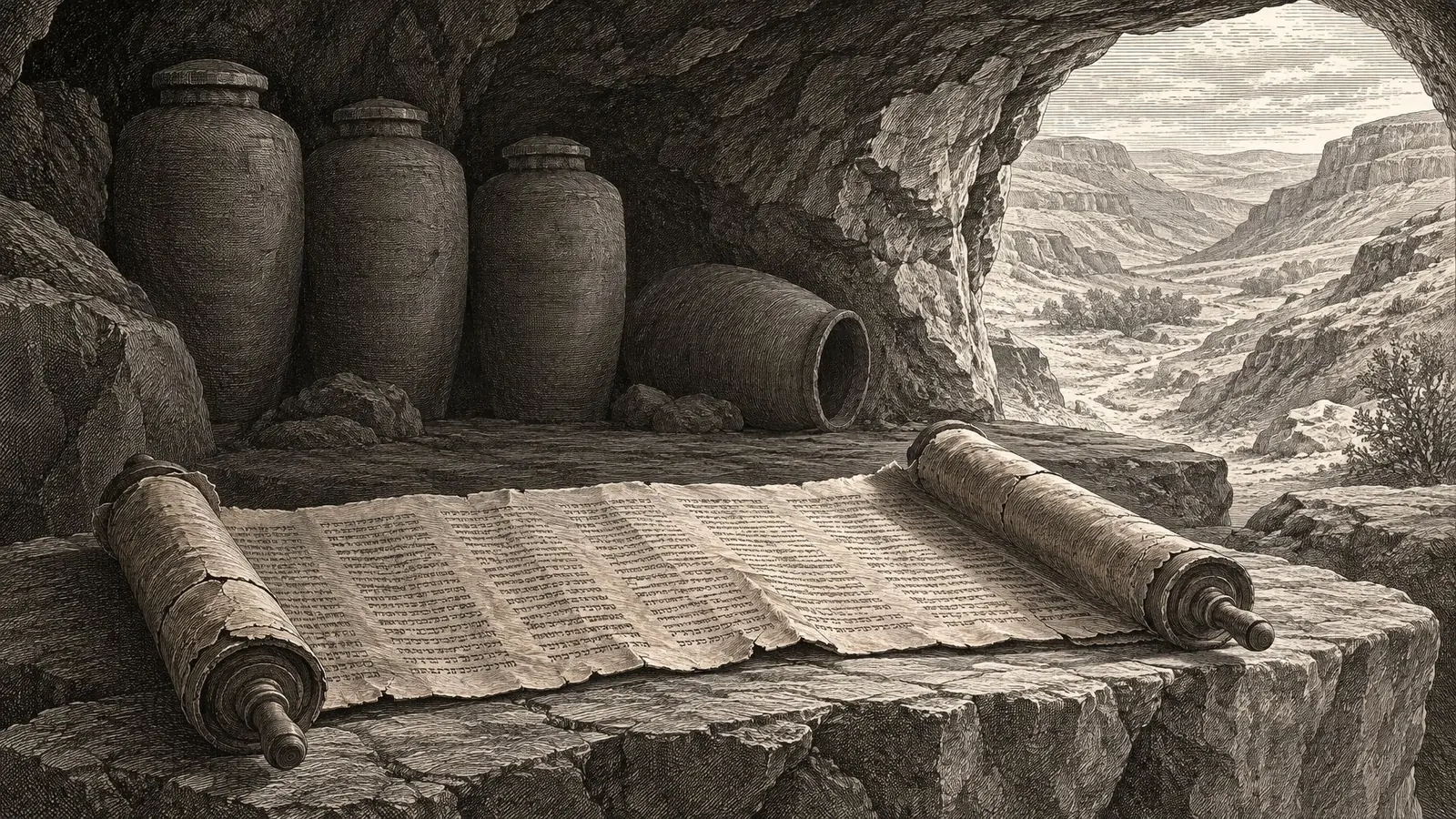
In late 1946 or early 1947, Bedouin shepherds exploring the cliffs above Qumran found clay jars in a cave. One held a leather scroll wrapped in linen. It turned out to be the whole book of Isaiah.
| Great Isaiah Scroll (1QIsaᵃ) | Leningrad Codex | |
|---|---|---|
| Date | about 125-100 BC | AD 1008 |
| Material | 17 sheets of leather sewn together, about 24 feet long | Parchment book (codex) |
| Contents | All 66 chapters of Isaiah, in the same order | The whole Hebrew Bible |
| Found | Qumran Cave 1, 1947 | Preserved in Jewish communities |
Emanuel Tov, the leading Dead Sea Scrolls editor, dates the scroll's handwriting to 125-100 BC, and radiocarbon tests have given ranges centred on the second century BC. Either way, it was copied roughly a thousand years before the Leningrad Codex.
So how different was it?
Not identical. Scholars count more than 2,600 small differences between the scroll and the Masoretic Text. That number sounds alarming until you see what they are. Most are spelling: the Qumran scribe liked longer spellings that add vowel letters, the way "honor" and "honour" are the same word. Others are slips of the pen, swapped word order, singular for plural, or an added "and." The scribe and later correctors also fixed their own mistakes, and you can still see dots and words written above the lines.
But remarkably close. The Old Testament scholar Gleason Archer wrote that the Isaiah scrolls from Cave 1 proved to be word for word identical with the standard Hebrew Bible in more than 95 percent of the text, and that the other 5 percent was chiefly obvious slips of the pen and spelling. Current scholars tend to emphasize the differences more than Archer did, but the conclusion holds: once you set aside spelling, the Great Isaiah Scroll is very close to the text in your Bible. A second Isaiah scroll from the same cave, 1QIsaᵇ, is closer still.
A test case: Isaiah 53
Christians read Isaiah 53, the chapter of the Suffering Servant, as a prophecy of Jesus. If anyone had a motive to edit a chapter, this would be it. Norman Geisler and William Nix, in A General Introduction to the Bible, compared the chapter in the scroll with the Masoretic Text. Of its 166 Hebrew words, only 17 letters differ. Ten are spelling, four are small stylistic changes like conjunctions, and the remaining three letters spell one word, "light," in verse 11.
The King James Version, which follows the Masoretic Text, reads:
"He shall see of the travail of his soul, and shall be satisfied." (Isaiah 53:11)
The scroll reads that he shall see light. The Greek Septuagint, translated before the time of Jesus, has "light" too, so several modern translations now follow it (the NIV, for example, reads "he will see the light of life"). After a thousand years of copying, the biggest difference in the chapter is one word, and it adds hope rather than taking anything away.
Not Every Scroll Is a Perfect Match
If we stopped there, the story would be simpler than the evidence. The roughly 220 biblical scrolls found at Qumran show something else as well: before the Hebrew text was standardized, some books circulated in more than one form. Hiding that is how bad apologetics loses trust, so here are three of the clearest examples.
Jeremiah came in two editions. The Greek Septuagint version of Jeremiah has long been known to be about one-seventh to one-eighth shorter than the Hebrew, with the chapters in a different order. Many assumed the Greek translators had cut it. Then two Hebrew fragments from Qumran Cave 4, 4QJerᵇ and 4QJerᵈ, turned out to follow the shorter form, while other Jeremiah fragments from the same cave follow the longer Masoretic form. Both editions existed in Hebrew side by side.
Interestingly, Jeremiah itself describes a second, expanded edition. After King Jehoiakim burned the first scroll, Jeremiah dictated it again to Baruch, "and there were added besides unto them many like words" (Jeremiah 36:32, KJV). Scholars debate whether that verse explains the two later forms of the book, but it does show the prophet's own book growing during his lifetime.
Goliath's height. In the Masoretic Text, Goliath stands "six cubits and a span" (1 Samuel 17:4), about 9 feet 9 inches. The Samuel scroll 4QSamᵃ and the Septuagint give "four cubits and a span," closer to 6 feet 9 inches, still a giant among men of his day. (We cover the giants of Gath in Goliath and the Giants.)
Deuteronomy 32:8. The Masoretic Text says the Most High set the borders of the nations "according to the number of the children of Israel" (KJV). A Qumran manuscript, 4QDeutʲ, reads "the sons of God," and the Septuagint has "angels of God." Many scholars think this is the older reading, and that a later scribe changed it because it seemed to hint at other divine beings. Several modern translations, including the ESV, now follow the scroll. It is one of the clearest cases where an early copy restores a reading, and it matters for the biblical picture of the angelic "sons of God," which we explore in Who Are the Watchers?.
What do these examples add up to? The scrolls show that the text was not frozen from day one, and that scribes sometimes made real changes. They also show that those changes can be found. We know about the short Jeremiah, the shorter Goliath and the "sons of God" precisely because old copies survived to be compared. That is the opposite of a text that drifted out of reach.
What About the New Testament?
The New Testament has a different strength: sheer numbers. More than 5,800 Greek manuscripts survive, whole books or fragments, along with thousands of early translations into Latin, Syriac and Coptic. No other ancient book comes close. The early church fathers also quoted the New Testament constantly in their sermons and letters, which gives scholars yet another check on what the text said in the first few centuries.
Some highlights:
- Papyrus 52, a scrap of John 18 about the size of a credit card, is usually dated to the first half of the second century, within decades of the Gospel being written. Some scholars argue for a date as late as AD 200.
- Codex Sinaiticus and Codex Vaticanus, the two oldest near-complete Bibles, were copied in the fourth century, around AD 325-360.
With that many copies come many differences. Scholars estimate somewhere between 300,000 and 400,000 variant readings, more than the roughly 138,000 words in the New Testament. Bart Ehrman, an agnostic scholar whose book Misquoting Jesus made this number famous, also wrote in that book:
"To be sure, of all the hundreds of thousands of textual changes found among our manuscripts, most of them are completely insignificant, immaterial, of no real importance for anything other than showing that scribes could not spell or keep focused any better than the rest of us."
Ehrman still thinks some variants matter a great deal, and he is right that a handful do. Here are the best known, all of which are in the King James Version but missing from the oldest manuscripts:
| Passage | What it is | The evidence |
|---|---|---|
| Mark 16:9-20 | The "long ending" of Mark, with the resurrection appearances and the Great Commission | Absent from Sinaiticus and Vaticanus, which end at 16:8 |
| John 7:53-8:11 | The woman caught in adultery | Absent from the earliest papyri (P66, P75) and the oldest codices |
| 1 John 5:7 | "The Father, the Word, and the Holy Ghost: and these three are one" | Began as a Latin addition; no Greek manuscript has it before the late Middle Ages. Erasmus added it to his Greek New Testament in 1522 |
| Matthew 17:21 | "This kind goeth not out but by prayer and fasting" | Absent from Sinaiticus and Vaticanus; probably copied in from Mark 9:29 |
Two things stand out. First, these additions are known, not secret. Open almost any modern Bible and you'll find them in brackets or footnotes with a note such as "the earliest manuscripts do not include." Second, no core teaching depends on them. The Trinity doesn't rest on 1 John 5:7; it is taught across the New Testament (Matthew 28:19 among many). The resurrection doesn't rest on Mark's long ending; every Gospel proclaims it. The verse about prayer and fasting still has its parallel in Mark 9:29, which we discuss in Spiritual Warfare: Demons, Aliens and Biblical Authority.
Was the Bible Corrupted? What the Quran Actually Says
Many Muslims believe the Bible was corrupted, a teaching called tahrif. But the Quran's own statements are more complicated than many people on either side realize.
On one hand, the Quran accuses some of the People of the Book of misusing scripture:
"So woe to those who write the 'scripture' with their own hands, then say, 'This is from Allah,' in order to exchange it for a small price." (Quran 2:79, Sahih International)
On the other, it speaks of the Torah and Gospel as revelation that Jews and Christians of Muhammad's day still had and should obey:
"And let the People of the Gospel judge by what Allah has revealed therein." (Quran 5:47, Sahih International)
"So if you are in doubt, [O Muhammad], about that which We have revealed to you, then ask those who have been reading the Scripture before you." (Quran 10:94, Sahih International)
Classical Muslim scholars distinguished two kinds of tahrif: tahrif al-ma'na, distorting the meaning of scripture through false interpretation, and tahrif al-lafz, changing the words themselves. Some early authorities held the first view. The commentator Ibn Kathir, for example, citing al-Bukhari, reports a saying from the Prophet's cousin Ibn Abbas that the corruption was of meaning, not of the words. The idea that the text itself had been replaced was argued most forcefully by later writers such as the Andalusian scholar Ibn Hazm in the eleventh century, and it is widely held today.
This is where the manuscripts speak directly. Muhammad lived from about AD 570 to 632. The Great Isaiah Scroll was copied more than 600 years before he was born. Codex Sinaiticus and Codex Vaticanus were copied more than 200 years before. Their text is the text in Christian Bibles today, with the kinds of variants described above. So if the Gospel that Christians held in Muhammad's day was trustworthy enough to judge by, as 5:47 suggests, the evidence says it was essentially the Gospel Christians hold now.
Muslim scholars answer this in different ways. Some say the Injil the Quran means is a single book revealed to Jesus, not the four Gospels written about him. Others say any corruption must have happened before the seventh century. Those are real positions held in good faith, and the conversation between Christians and Muslims on this question is worth having with patience. The manuscripts at least give both sides something solid to look at.
What About the "Books Removed From the Bible"?
People who ask whether the Bible has been changed often mean something different: the "14 books removed from the Bible." These are the Apocrypha, Jewish writings such as Tobit, Judith, the Wisdom of Solomon, Sirach (Ecclesiasticus) and 1 and 2 Maccabees.
The 1611 King James Version did include fourteen of these books, printed in a separate section between the Old and New Testaments. By the 1800s most Protestant publishers were leaving that section out to save cost and because Protestants did not count them as Scripture. Catholic and Orthodox Bibles still include most of them.
So this is a question about the canon, which books belong in the Bible, not about whether the words of the books were altered. The Hebrew Bible used by Jews never included them, and the Dead Sea Scrolls contain fragments of several (Tobit and Sirach among them) alongside the biblical books, much like the Book of Enoch.
So, Has the Bible Been Changed?
Here is a fair summary of the evidence:
- Yes, in the copies. Scribes made spelling changes, slips and occasional deliberate additions. Some Old Testament books once existed in more than one form.
- No, not beyond recovery. Because thousands of early copies survive, in Hebrew, Greek and other languages, scholars can see nearly every change and, in most cases, tell which reading came first.
- Not in what it teaches. The passages still under real debate are few and well known, and none of them carries a doctrine that isn't taught elsewhere. Most variants don't change the meaning at all.
If someone tells you we can't trust the Bible because it has been changed, the manuscript evidence doesn't support that. It supports something more modest and more convincing: the Bible as we know it was copied by hand, imperfectly, by thousands of scribes, and the many copies they left behind let us recover what was originally written with remarkable accuracy.
There is a quiet irony in the Great Isaiah Scroll. Among its columns is Isaiah 40, written out by a scribe more than two thousand years ago:
"The grass withereth, the flower fadeth: but the word of our God shall stand for ever." (Isaiah 40:8, KJV)
Peter quoted that line to the first Christians (1 Peter 1:24-25). The scribe who copied it is long forgotten, the community at Qumran was scattered by the Romans, and the leather he wrote on is cracked and fragile. But the words he copied, the word of God he was preserving, are still being read, in your Bible, tonight.
If you want to go deeper into the ancient texts found alongside the biblical scrolls, start with The Book of Enoch, fragments of which were also found in the caves at Qumran.
Frequently Asked Questions
Has the Bible been changed over time? Hand-copied manuscripts differ from one another, mostly in spelling and small slips. A few longer passages were added later, such as the long ending of Mark and 1 John 5:7. Because so many early copies survive, scholars can see these changes, and modern Bibles mark them in brackets or footnotes.
What did the Dead Sea Scrolls prove about the Bible? They gave us Hebrew copies about 1,000 years older than any we had before. The Great Isaiah Scroll matches the later Masoretic Text closely once spelling differences are set aside. Other scrolls, like those of Jeremiah and Samuel, show that more than one form of some books circulated before the text was standardized.
How old is the Great Isaiah Scroll? Handwriting experts date it to about 125-100 BC, and radiocarbon tests have given ranges centred on the second century BC. That makes it about 1,000 years older than the Leningrad Codex of AD 1008.
Which verses were added to the Bible? The best-known are Mark 16:9-20, John 7:53-8:11, the Trinitarian words in 1 John 5:7, and a handful of single verses such as Matthew 17:21. They are missing from the oldest manuscripts, which is why modern translations bracket or footnote them.
Why is Matthew 17:21 missing from some Bibles? The verse is absent from the oldest Greek manuscripts, including Codex Sinaiticus and Codex Vaticanus. Most scholars think scribes copied it in from the similar saying in Mark 9:29. Modern translations usually move it to a footnote rather than deleting it.
What are the 14 books removed from the Bible? They are the Apocrypha, such as Tobit, Judith, Wisdom, Sirach and 1 and 2 Maccabees. The 1611 King James Version printed fourteen of them in a separate section, and later Protestant printings dropped it. Catholic and Orthodox Bibles keep most of them. This is a question of which books belong in the Bible, not of the text being altered.
Does the Quran say the Bible was corrupted? The Quran accuses some People of the Book of distorting or misusing scripture (for example 2:79 and 4:46), yet it also tells Christians to judge by the Gospel (5:47). Muslim scholars have long debated whether this means a change of the text itself or of its meaning.
Bible quotations are from the King James Version. Quran quotations are from the Sahih International translation.
Categories:
Related Articles

Biblically Accurate Angels: What Angels Look Like in the Bible
Wheels full of eyes, six-winged seraphim, four-faced cherubim, or ordinary-looking men? See what the Bible actually says angels look like, verse by verse, with the Hebrew behind each name.
Hallelujah Meaning: What Does Hallelujah Mean in the Bible?
Hallelujah means 'Praise Yah,' a Hebrew command to praise the LORD. See where it appears in the Psalms and Revelation, how it differs from Alleluia, and why the Bible kept it untranslated.
Isaiah 40:31 Meaning: 'They Shall Mount Up With Wings Like Eagles'
Isaiah 40:31 promises that those who wait for the LORD will renew their strength and mount up with wings like eagles. Here is what 'wait' means in Hebrew, who first heard it, and why walking comes last.
Isaiah 41:10 Meaning: 'Fear Not, for I Am With You'
Isaiah 41:10 gives two reasons not to fear and three promises: God will strengthen, help and uphold you. Here is what it meant to Israel, what 'dismayed' and 'righteous right hand' mean in Hebrew, and how to hold on to it.