Isaiah 40:31 Meaning: 'They Shall Mount Up With Wings Like Eagles'
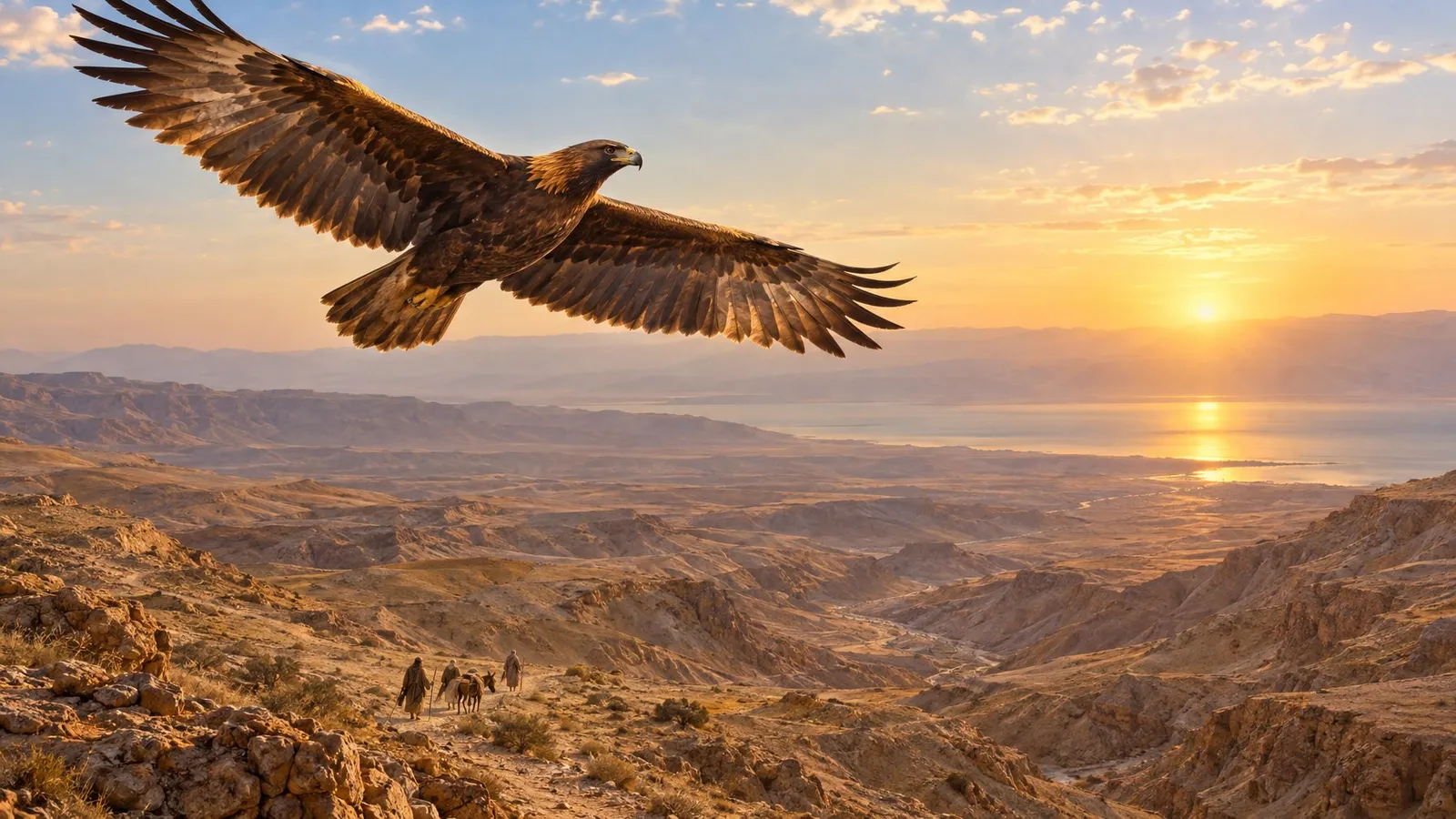
"But they who wait for the LORD shall renew their strength; they shall mount up with wings like eagles; they shall run and not be weary; they shall walk and not faint." (Isaiah 40:31)
Isaiah 40:31 has been painted on hospital walls, sung in hymns and printed on posters of soaring eagles. It speaks to anyone who is worn out: the caregiver who has not slept, the worker at the end of a long shift, the believer who has prayed for years and is still waiting.
It was first spoken to people who were tired in a deeper way. Under the burden of exile, they had slid toward despair and felt God had forgotten them. The verse is God's answer, and this Bible study walks through it phrase by phrase.
What Does Isaiah 40:31 Mean?
Isaiah 40:31 means that people who put their hope in the LORD and wait for him will receive new strength from him, strength to rise above their circumstances, to keep going in hard seasons, and to remain faithful day after day.
The promise is not that God's people will never be tired. Verse 30 says that "even youths shall faint and be weary." The promise is that God gives his strength to those who wait for him.
The Setting: God's Comfort for a Weary People
Isaiah 40 marks a turning point in the book of Isaiah. Chapters 1–39 are filled with warnings of judgment. Chapter 40 opens with some of the most tender words in the Old Testament:
"Comfort, comfort my people, says your God. Speak tenderly to Jerusalem, and cry to her that her warfare is ended, that her iniquity is pardoned." (Isaiah 40:1–2)
From here on, the prophet Isaiah speaks to God's people as exiles in Babylon, the same exile that Jeremiah wrote to in Jeremiah 29. Isaiah prophesied in the eighth century BC. Traditional Jewish and Christian readers hold that he foresaw the exile long before it happened. Many modern scholars think chapters 40–66 come from a later prophet in Isaiah's tradition, writing during the exile itself. Either way, the message was for people far from home who wondered whether God still cared.
The Great Isaiah Scroll, found among the Dead Sea Scrolls at Qumran and copied around the second century BC, contains all 66 chapters of Isaiah, including this one. It is one of the oldest complete books of the Bible ever found.
The Complaint: "My Way Is Hidden From the LORD"
Just before our verse, Isaiah voices what the people were saying:
"Why do you say, O Jacob, and speak, O Israel, 'My way is hidden from the LORD, and my right is disregarded by my God'?" (Isaiah 40:27)
They believed God had lost track of them. Isaiah answers with a series of questions:
"Have you not known? Have you not heard? The LORD is the everlasting God, the Creator of the ends of the earth. He does not faint or grow weary; his understanding is unsearchable. He gives power to the faint, and to him who has no might he increases strength. Even youths shall faint and be weary, and young men shall fall exhausted." (Isaiah 40:28–30)
The argument is simple. The God who made the stars and calls each one by name (40:26) has not forgotten you. He never grows tired. And he gives his strength to people who have none.
What the Hebrew Words Mean
"Wait" (qavah)
The KJV says "they that wait upon the LORD." The ESV says "wait for." The NIV says "hope in." All three are trying to capture the Hebrew qavah.
Qavah means to wait with expectation, to look eagerly for someone. It is related to the noun qav, a cord or measuring line, and to tikvah, "hope," the word used in Jeremiah 29:11's "a future and a hope." The picture is of a rope pulled tight, stretched toward what is coming.
Biblical waiting is not passive or bored. It is like a family at the window waiting for someone they love to come home. (See our study of Jeremiah 29:11 for more on tikvah.)
"Renew" (chalaph)
The Hebrew chalaph means to change, exchange or renew, like changing clothes or replacing something worn out. Those who wait for the LORD exchange their exhausted strength for his. The same phrase appears again a few lines later: "let the peoples renew their strength" (Isaiah 41:1).
"Eagles" (nesher): What It Means to Soar Like an Eagle
The Hebrew nesher is usually translated "eagle," though it could also refer to the great griffon vulture of the Middle East. Both are huge birds that rise on columns of warm air, called thermals, and can soar for hours with barely a beat of their wings. They do not rise by effort but by resting on a power that lifts them.
Eagles appear in other promises of God's care. God told Israel at Sinai, "I bore you on eagles' wings and brought you to myself" (Exodus 19:4). Psalm 103:5 says God satisfies you with good "so that your youth is renewed like the eagle's." And Psalm 91 pictures God covering his people "under his wings" (see our study of Psalm 91).
Soar, Run, Walk: Renewed Strength for Every Season
The verse ends with three pictures of strength:
- "They shall mount up with wings like eagles." Moments of soaring, when God lifts us above our circumstances.
- "They shall run and not be weary." Seasons of hard, fast effort that God sustains.
- "They shall walk and not faint." The long, ordinary road of daily faithfulness.
You might expect the list to build upward, from walking to running to flying. Instead it moves the other way. Many readers see wisdom in that. Soaring moments are rare. Most of life is walking. The greatest strength may be the strength to keep walking without giving up, to get up again tomorrow and be faithful in small things. That kind of endurance in a long trial is exactly what God promises to sustain. He enables ordinary people to endure, to overcome weariness and to regain their strength.
Isaiah 40:31 in the KJV, NIV and Other Translations
| Version | Isaiah 40:31 |
|---|---|
| King James Version (KJV) | "But they that wait upon the LORD shall renew their strength; they shall mount up with wings as eagles; they shall run, and not be weary; and they shall walk, and not faint." |
| English Standard Version | "But they who wait for the LORD shall renew their strength; they shall mount up with wings like eagles; they shall run and not be weary; they shall walk and not faint." |
| New International Version | "But those who hope in the LORD will renew their strength. They will soar on wings like eagles; they will run and not grow weary, they will walk and not be faint." |
The Highway and the Shepherd: The Rest of Isaiah 40
Isaiah 40 contains other famous lines that frame verse 31:
- "A voice cries: 'In the wilderness prepare the way of the LORD; make straight in the desert a highway for our God'" (40:3). All four Gospels apply this to John the Baptist (Matthew 3:3; Mark 1:3; Luke 3:4; John 1:23).
- "The grass withers, the flower fades, but the word of our God will stand forever" (40:8). Peter quotes it in 1 Peter 1:24–25.
- "He will tend his flock like a shepherd; he will gather the lambs in his arms" (40:11).
- "Who has measured the waters in the hollow of his hand?" (40:12).
The chapter begins with a road home through the desert and ends with tired travelers given strength to walk it. For another verse about God making paths straight, see our study of Proverbs 3:5-6.
God's Timing: "Though It Tarry, Wait for It"
Waiting is hard because God's timing is rarely ours. The exiles waited decades. The prophet Habakkuk was told something similar about God's promises: "though it tarry, wait for it; because it will surely come, it will not tarry" (Habakkuk 2:3, KJV). The waiting is not wasted. It is where faith grows. God's timing is perfect, even when it feels slow, and faith trusts him in the meantime.
Isaiah's very next chapter repeats the promise in words many believers know by heart: "Fear not, for I am with you; be not dismayed, for I am your God; I will strengthen you, I will help you, I will uphold you with my righteous right hand" (Isaiah 41:10). See our study of Isaiah 41:10.
Renewed Strength in the New Testament
The New Testament picks up the same hope. Paul writes, "So we do not lose heart. Though our outer self is wasting away, our inner self is being renewed day by day" (2 Corinthians 4:16). He prays that believers would be "strengthened with power through his Spirit in your inner being" (Ephesians 3:16). For Christians, the strength promised in Isaiah 40:31 comes through the Holy Spirit, who renews the weary from the inside.
Jesus offered the same rest to every tired follower: "Come to me, all who labor and are heavy laden, and I will give you rest" (Matthew 11:28; see our study of Matthew 11:28).
How to Wait on the Lord Today: A Short Devotional
- Admit you are tired. The promise is for "the faint" and those with "no might" (40:29). You do not have to pretend to be strong.
- Look up. Isaiah tells the weary to "lift up your eyes on high and see" the God who made the stars (40:26). Worship and praise him, and spend time remembering how great God is.
- Wait with expectation. Pray, read Scripture and keep watch for what God will do, the way qavah pictures a cord stretched toward the future.
- Take the next step. Not every day is a day for soaring. Ask God for strength to walk and not faint today.
- Remember who never tires. "He does not faint or grow weary" (40:28). Your strength runs out. His does not.
Whatever difficulty you face, physically, emotionally or spiritually, let this verse be your encouragement: God's word promises renewed strength to all who wait for him.
If you read Spanish, see our study of Isaías 40:31.
Frequently Asked Questions About Isaiah 40:31
It means that those who put their hope in the LORD and wait for him will receive new strength from him: strength to rise above hard circumstances, to keep going, and to stay faithful day after day.
The Hebrew word qavah means to wait with eager expectation, like a cord stretched toward something. It is active trust and hope in God, not passive or idle waiting.
Eagles rise by spreading their wings on rising currents of warm air rather than by constant flapping. The picture is of being lifted by God's strength instead of our own effort.
'But they that wait upon the LORD shall renew their strength; they shall mount up with wings as eagles; they shall run, and not be weary; and they shall walk, and not faint.'
To God's people facing or living in exile in Babylon, who complained that 'my way is hidden from the LORD' (Isaiah 40:27). Verse 31 is God's answer: he has not forgotten them and will give them strength.
The order moves from soaring to running to walking. Many readers see it as a reminder that most of life is ordinary walking, and the strength to keep going without fainting is one of God's greatest gifts.
Scripture quotations are from the English Standard Version (ESV) unless otherwise noted.
Categories:
Related Articles

Biblically Accurate Angels: What Angels Look Like in the Bible
Wheels full of eyes, six-winged seraphim, four-faced cherubim, or ordinary-looking men? See what the Bible actually says angels look like, verse by verse, with the Hebrew behind each name.
Hallelujah Meaning: What Does Hallelujah Mean in the Bible?
Hallelujah means 'Praise Yah,' a Hebrew command to praise the LORD. See where it appears in the Psalms and Revelation, how it differs from Alleluia, and why the Bible kept it untranslated.
Isaiah 41:10 Meaning: 'Fear Not, for I Am With You'
Isaiah 41:10 gives two reasons not to fear and three promises: God will strengthen, help and uphold you. Here is what it meant to Israel, what 'dismayed' and 'righteous right hand' mean in Hebrew, and how to hold on to it.
Jehovah Jireh Meaning: What 'The LORD Will Provide' Means in Genesis 22, Verse 14
Jehovah Jireh means 'the LORD will provide,' but the Hebrew literally says 'the LORD will see.' Explore Genesis 22, where the name came from, why it says 'Jehovah,' and the other compound names of God.