Isaiah 41:10 Meaning: 'Fear Not, for I Am With You'
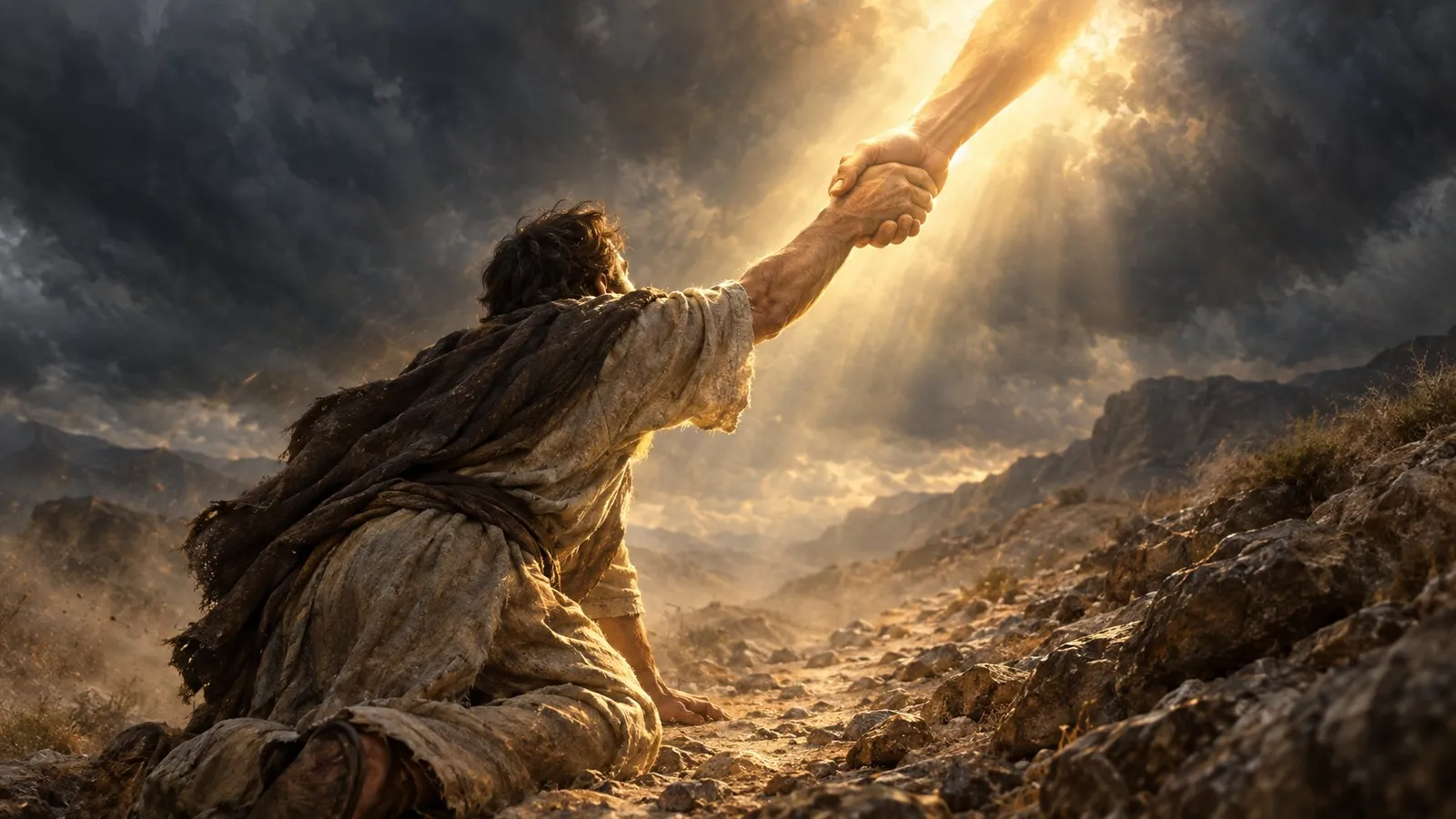
"Fear not, for I am with you; be not dismayed, for I am your God; I will strengthen you, I will help you, I will uphold you with my righteous right hand." (Isaiah 41:10)
Isaiah 41:10 may be the most comforting single verse on fear in the whole Bible. It is shared in texts to friends facing surgery, written on cards for the grieving, and prayed by people lying awake at night.
Its power is in how much it packs into one sentence: two commands, two reasons and three promises. It is a promise from God that has given assurance to believers for thousands of years. And it was spoken to a people who had every reason to be afraid.
What Does Isaiah 41:10 Mean?
Isaiah 41:10 means that God's people do not need to be ruled by fear, because God is present with them and belongs to them, and he promises to strengthen them, help them and hold them up with his own faithful power.
Two Commands, Two Reasons, Three Promises
The structure is worth seeing:
| Part | Words |
|---|---|
| Command 1 | "Fear not" |
| Reason 1 | "for I am with you" |
| Command 2 | "be not dismayed" |
| Reason 2 | "for I am your God" |
| Promise 1 | "I will strengthen you" |
| Promise 2 | "I will help you" |
| Promise 3 | "I will uphold you with my righteous right hand" |
Every reason and every promise begins with God: "I am," "I will." The verse does not tell us to find courage inside ourselves. It points us to who God is and what he will do.
The Setting: Nations Trembling, Idols Nailed Down
Isaiah 41 is set like a courtroom. God summons the nations: "Listen to me in silence, O coastlands; let the peoples renew their strength; let them approach, then let them speak" (41:1). He announces that he has stirred up a conqueror "from the east" (41:2), whom Isaiah later names as Cyrus of Persia (44:28; 45:1).
The nations panic. And how do they respond? They make idols:
"The craftsman strengthens the goldsmith, and he who smooths with the hammer him who strikes the anvil, saying of the soldering, 'It is good'; and they strengthen it with nails so that it cannot be moved." (Isaiah 41:7)
In verse 7 the picture is almost funny. The nations try to calm their fear by building gods, then have to nail them down so they will not fall over.
Then comes the contrast:
"But you, Israel, my servant, Jacob, whom I have chosen, the offspring of Abraham, my friend; you whom I took from the ends of the earth... saying to you, 'You are my servant, I have chosen you and not cast you off.'" (Isaiah 41:8–9)
The nations have to hold up their gods. Israel's God holds up his people. That is the point of verse 10.
Like Isaiah 40, this chapter speaks to God's people in or facing exile in Babylon, when they felt small, scattered and forgotten. (See our study of Isaiah 40:31 for that setting.)
What the Hebrew Words Mean
"Fear Not" (al tira)
Al tira is one of the most common reassurances God gives in the Bible. He said it to Abraham ("Fear not, Abram, I am your shield," Genesis 15:1), to Joshua (Joshua 8:1), and through angels to Mary and the shepherds (Luke 1:30; 2:10). A popular claim says "fear not" appears 365 times in the Bible, one for every day. The real count depends on the translation and on which phrases you include, and the exact phrase appears far less often. But the message is everywhere.
"Be Not Dismayed" (al tishta)
The verb sha'ah means to look around anxiously, to gaze about in alarm. It is the nervous glance of someone who senses danger and keeps scanning for it. God's answer to that restless looking around is: look at me. "For I am your God."
"I Will Uphold You" (tamakh)
Tamakh means to grasp, take hold of, support. It is a firm grip. A few verses later God says it even more personally: "For I, the LORD your God, hold your right hand; it is I who say to you, 'Fear not, I am the one who helps you'" (41:13).
"My Righteous Right Hand"
In the Bible, the right hand stands for strength and skill. After the Red Sea, Moses sang, "Your right hand, O LORD, glorious in power, your right hand, O LORD, shatters the enemy" (Exodus 15:6).
"Righteous" (tsedeq) here does not mean only moral purity. It means God's faithfulness to do what is right and keep his promises. His right hand is not just strong but trustworthy. It will not drop what it holds.
Isaiah 41:10 in the KJV, NIV and Other Translations
| Version | Isaiah 41:10 |
|---|---|
| King James Version (KJV) | "Fear thou not; for I am with thee: be not dismayed; for I am thy God: I will strengthen thee; yea, I will help thee; yea, I will uphold thee with the right hand of my righteousness." |
| English Standard Version | "Fear not, for I am with you; be not dismayed, for I am your God; I will strengthen you, I will help you, I will uphold you with my righteous right hand." |
| New International Version | "So do not fear, for I am with you; do not be dismayed, for I am your God. I will strengthen you and help you; I will uphold you with my righteous right hand." |
What God Promises: Isaiah 41:11-16
The promises continue:
- Your enemies will not last: "Behold, all who are incensed against you shall be put to shame and confounded" (41:11).
- God holds your hand: "For I, the LORD your God, hold your right hand" (41:13).
- Even when you feel tiny: "Fear not, you worm Jacob, you men of Israel! I am the one who helps you, declares the LORD; your Redeemer is the Holy One of Israel" (41:14).
That last verse is startling. God calls his people a "worm," not to insult them but to name how small and helpless they felt. And to that worm he says, I am your Redeemer. Then he promises to turn that worm into "a threshing sledge, new, sharp, and having teeth" that will "make the hills like chaff" (41:15). The weak will prevail, not by their own power but by God's.
The psalms speak the same assurance: "Nevertheless, I am continually with you; you hold my right hand" (Psalm 73:23), and "God is our refuge and strength, a very present help in trouble" (Psalm 46:1).
Isaiah 41:10 and the New Testament
The same promise runs through the New Testament:
- God with us: Jesus is called "Immanuel (which means, God with us)" (Matthew 1:23).
- God for us: "If God is for us, who can be against us?" (Romans 8:31). (See our study of Romans 8:28.)
- God holding us: "No one will snatch them out of my hand," Jesus said of his sheep (John 10:28).
- God's strength in weakness: "My grace is sufficient for you, for my power is made perfect in weakness" (2 Corinthians 12:9). For Christians, God's presence comes through the Holy Spirit living in them (John 14:16–17).
- God strengthening us: "I can do all things through him who strengthens me" (Philippians 4:13). (See our study of Philippians 4:13.)
How to Hold On to Isaiah 41:10 in Life Today
- Stop scanning, start looking up. When anxiety has you looking around for the next danger, look to God: "for I am your God."
- Say the reasons out loud. "God is with me. God is my God." Fear loses force when it is answered with truth.
- Receive the three promises. Ask God specifically to strengthen you, help you and hold you up today.
- Let him hold your hand. Isaiah 41:13 says he holds your right hand. You do not have to hold yourself together.
- Remember the nailed-down idols. Whatever you have been leaning on to feel safe, ask whether you are holding it up, or it is holding you.
For a similar command to courage, see our study of Joshua 1:9. If you read Spanish, see our study of Isaías 41:10.
Frequently Asked Questions About Isaiah 41:10
It means God's people do not have to be ruled by fear, because God is with them and is their God. He promises to strengthen them, help them and hold them up with his faithful power.
To Israel, God's chosen servant, at a time when the nations were trembling at a coming conqueror and God's people felt small and scattered (Isaiah 41:1–9).
'Fear thou not; for I am with thee: be not dismayed; for I am thy God: I will strengthen thee; yea, I will help thee; yea, I will uphold thee with the right hand of my righteousness.'
The right hand stands for strength in the Bible (Exodus 15:6). 'Righteous' means faithful to keep promises. God's righteous right hand is power you can trust.
That is a popular claim, but the count depends on the translation and which phrases are included, and the exact phrase appears far less often. What is true is that God's command not to fear runs throughout Scripture.
Scripture quotations are from the English Standard Version (ESV) unless otherwise noted.
Categories:
Related Articles

Biblically Accurate Angels: What Angels Look Like in the Bible
Wheels full of eyes, six-winged seraphim, four-faced cherubim, or ordinary-looking men? See what the Bible actually says angels look like, verse by verse, with the Hebrew behind each name.
Hallelujah Meaning: What Does Hallelujah Mean in the Bible?
Hallelujah means 'Praise Yah,' a Hebrew command to praise the LORD. See where it appears in the Psalms and Revelation, how it differs from Alleluia, and why the Bible kept it untranslated.

Isaiah 40:31 Meaning: 'They Shall Mount Up With Wings Like Eagles'
Isaiah 40:31 promises that those who wait for the LORD will renew their strength and mount up with wings like eagles. Here is what 'wait' means in Hebrew, who first heard it, and why walking comes last.

Jehovah Jireh Meaning: What 'The LORD Will Provide' Means in Genesis 22, Verse 14
Jehovah Jireh means 'the LORD will provide,' but the Hebrew literally says 'the LORD will see.' Explore Genesis 22, where the name came from, why it says 'Jehovah,' and the other compound names of God.