
Jehovah Jireh Meaning: What 'The LORD Will Provide' Means in Genesis 22, Verse 14
Few names of God are sung more often today than Jehovah Jireh. It is on worship playlists, church banners and coffee mugs, usually translated "the LORD will provide." That translation is right. But the Hebrew behind it says something even more striking, and the story it comes from is one of the hardest in the Bible.
What Does Jehovah Jireh Mean?
Jehovah Jireh means "the LORD will provide." It is the English form of the Hebrew YHWH Yir'eh (יְהוָה יִרְאֶה), the name Abraham gave to the mountain where God spared his son Isaac (Genesis 22:14). The King James Version runs the words together as Jehovahjireh, and many writers hyphenate it as Jehovah-Jireh.
- Jehovah is an older English rendering of YHWH, the personal name of the God of Israel (the four letters called the Tetragrammaton), usually printed "the LORD" in English Bibles.
- Jireh (yir'eh) comes from the Hebrew verb ra'ah, which means "to see."
So in the Hebrew language the most literal translation is "the LORD will see." The God who sees is the God who provides: the LORD sees, and the LORD sees to it. In Hebrew, to "see to" something means to take care of it, the same way we say in English, "I'll see to it." God does not only notice the need. He sees it, and he acts.
The Greek Septuagint took the sight meaning at face value and translated the name "The Lord has seen." The King James Version (KJV) keeps the idea of sight in the second half of the verse:
"And Abraham called the name of that place Jehovahjireh: as it is said to this day, In the mount of the LORD it shall be seen." (Genesis 22:14, KJV)
Most modern versions, like the ESV, bring out the meaning of provision instead.
Abraham and Isaac: The Story Behind the Name in Genesis 22
The name comes at the end of the chapter Jewish tradition calls the Akedah, "the binding" of Isaac.
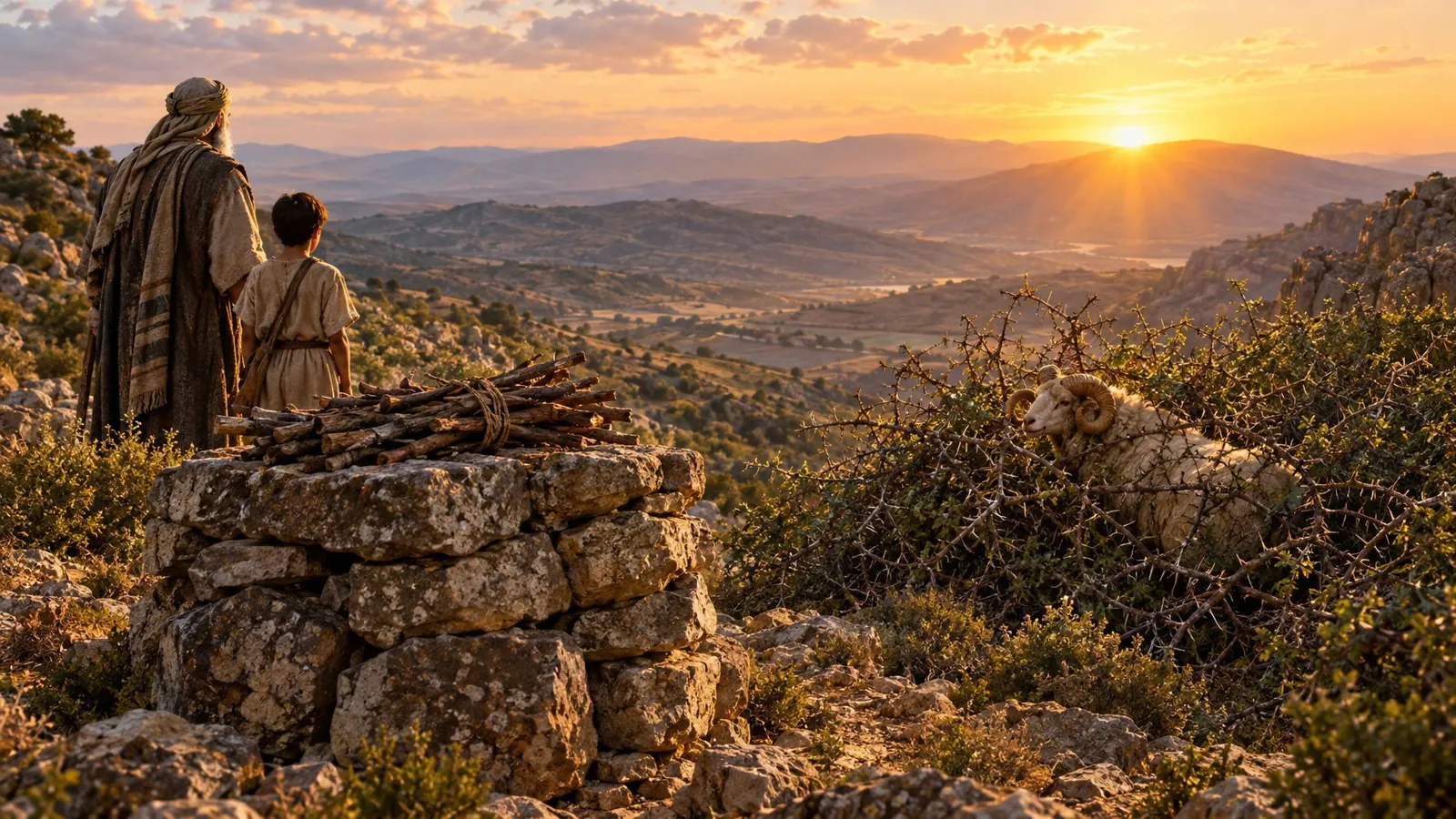
God tells Abraham to take "your son, your only son Isaac, whom you love," to the land of Moriah and offer him there as a burnt offering (Genesis 22:2). Abraham rises early, saddles his donkey, travels three days, and climbs the mountain with Isaac carrying the wood (Genesis 22:3–6).
Then Isaac asks the question that makes every reader wince: "Behold, the fire and the wood, but where is the lamb for a burnt offering?" (Genesis 22:7).
Abraham answers, "God will provide for himself the lamb for a burnt offering, my son" (Genesis 22:8). The Hebrew is literally "God will see for himself the lamb." It is the first appearance of the word that will become the name.
On the mountaintop Abraham "bound Isaac his son and laid him on the altar, on top of the wood," and "reached out his hand and took the knife" (Genesis 22:9–10). At the last moment, the angel of the LORD stops Abraham's hand. Abraham looks up and sees a ram caught in a thicket by its horns, and offers it instead of his son (Genesis 22:11–13). Then:
"So Abraham called the name of that place, 'The LORD will provide'; as it is said to this day, 'On the mount of the LORD it shall be provided.'" (Genesis 22:14)
Notice the play on seeing. Abraham lifts up his eyes and sees the ram. He names the place the LORD will see. The proverb that grew from it says that on the LORD's mountain, it will be seen or provided. Human sight and divine sight meet on the same hilltop.
Is Jireh a Name for God?
Strictly speaking, Jehovah Jireh is the name of a place, not a title God gives himself. Abraham named the mountain to remember what God had done there, just as Moses later named an altar "The LORD Is My Banner" (Exodus 17:15) and Gideon named one "The LORD Is Peace" (Judges 6:24).
But the names describe God himself, and believers have always used them that way. When Christians sing "Jehovah Jireh," they are doing what Abraham did: naming God by what he has shown himself to be.
Why "Jehovah"? The Actual Name of God in the Hebrew Bible
The word Jehovah does not appear in ancient Hebrew. It comes from how Jewish scribes wrote God's name.
Out of reverence, Jewish readers stopped pronouncing YHWH aloud and said Adonai, "Lord," instead. Many today say HaShem, "the Name." To remind readers, medieval scribes added the vowel marks of Adonai to the four consonants YHWH. Christian scholars who read those combined letters literally produced a hybrid: Jehovah, a word that comes from Latin. The form appears in Latin by the 1200s, and William Tyndale used "Iehouah" in his English translation of 1530.
Most scholars think the original pronunciation was closer to Yahweh, which is why you will also see this name written Yahweh Yireh. Both refer to the same God and the same verse.
Where Does "Jehovah" Appear in the King James Version?
The King James Version usually prints "the LORD." It uses "JEHOVAH" alone only four times (Exodus 6:3; Psalm 83:18; Isaiah 12:2; 26:4), and as part of three place names: Jehovahjireh (Genesis 22:14), Jehovahnissi (Exodus 17:15) and Jehovahshalom (Judges 6:24).
Other "Jehovah" Names of God
Genesis 22 is the first of several passages that pair God's name with a description. Many of these "compound names" are well known today:
| Name | Meaning | Where it comes from |
|---|---|---|
| Jehovah Jireh | The LORD will provide (will see) | Genesis 22:14 |
| Jehovah Rapha | The LORD who heals | Exodus 15:26, "I am the LORD, your healer" |
| Jehovah Nissi | The LORD is my banner | Exodus 17:15 |
| Jehovah Shalom | The LORD is peace | Judges 6:24 |
| Jehovah Rohi | The LORD is my shepherd | Psalm 23:1 |
| Jehovah Tsidkenu | The LORD is our righteousness | Jeremiah 23:6 |
| Jehovah Shammah | The LORD is there | Ezekiel 48:35 |
Only some of these are formal names in the text. Jireh, Nissi and Shalom name places or altars; Shammah names the restored city. Rapha, Rohi and Tsidkenu are phrases describing God that later teachers turned into names. All of them say true things about him.
The Lamb on Mount Moriah: From Isaac to the Cross
The mountain itself has a future in Scripture. Centuries later, Solomon built the temple "on Mount Moriah" (2 Chronicles 3:1). The proverb "On the mount of the LORD it shall be provided" turned out to be true for generations. On that hill, sacrifices were offered for Israel's sins day after day.
Christians have long read Genesis 22 as pointing further still.
- The beloved son. God tells Abraham to take "your only son... whom you love" (Genesis 22:2). At Jesus' baptism, the Father calls him "my beloved Son" (Matthew 3:17).
- The wood. Isaac carries the wood up the hill (Genesis 22:6). Jesus goes out "bearing his own cross" (John 19:17).
- The lamb. Isaac asks, "Where is the lamb?" John the Baptist answers centuries later: "Behold, the Lamb of God, who takes away the sin of the world!" (John 1:29).
- The son not withheld. The angel praises Abraham because "you have not withheld your son, your only son, from me" (Genesis 22:12). Paul uses almost the same words of God: "He who did not spare his own Son but gave him up for us all, how will he not also with him graciously give us all things?" (Romans 8:32).
Hebrews adds that Abraham "considered that God was able even to raise him from the dead" (Hebrews 11:17–19). Abraham climbed the mountain trusting God to see to what he could not.
Our study of the covenant line from Isaac to Jesus traces how the promise to Isaac runs all the way to Christ. And the Hebrew name Jesus himself carried, Yeshua, means "the LORD saves," the same God who provided the ram.
What Jehovah Jireh Means for You Today
It is easy to treat "Jehovah Jireh" as a promise that God will provide whatever we want. Genesis 22 will not let us read it that way. Abraham received provision at the top of the mountain, after a long walk of obedience, and what God provided was a substitute for a sacrifice, not a reward.
Three honest takeaways from the story of Abraham:
- God sees before he provides. Your need is not hidden from him. The name begins with sight.
- Provision often comes on the mountain, not before it. Abraham did not see the ram from the bottom of the hill.
- God's greatest provision is himself. As the apostle Paul says, "my God will supply every need of yours according to his riches in glory in Christ Jesus" (Philippians 4:19). That promise rests on what God has already given in his Son.
Frequently Asked Questions About Jehovah Jireh
Jehovah Jireh means 'the LORD will provide.' The Hebrew, YHWH Yir'eh, literally means 'the LORD will see,' in the sense of 'the LORD will see to it.' Abraham gave this name to the mountain where God provided a ram in place of Isaac (Genesis 22:14).
Jireh (yir'eh) comes from the Hebrew verb ra'ah, 'to see.' It means 'he will see.' In Genesis 22 the seeing implies providing, so English Bibles translate it 'will provide.'
Genesis 22:14. Abraham named the place on Mount Moriah 'The LORD will provide' after God provided a ram as a substitute for his son Isaac. The King James Version spells it 'Jehovahjireh.'
Both refer to the same Hebrew name. Jehovah is an older English form that combines the letters YHWH with the vowels of Adonai. Most scholars think the original pronunciation was closer to Yahweh, so some Bibles and songs say Yahweh Yireh.
There is no fixed list in Scripture. The main names are Elohim (God), YHWH or Yahweh (the LORD), Adonai (Lord) and El Shaddai (God Almighty), along with descriptive titles such as Jehovah Jireh, Jehovah Nissi, Jehovah Shalom and Jehovah Rapha.
Out of reverence, Jewish readers do not pronounce God's name. In prayer and Scripture reading they say Adonai, 'Lord,' and in ordinary conversation many say HaShem, 'the Name.'
Scripture quotations are from the English Standard Version (ESV) unless otherwise noted.
Categories:
Related Articles

Biblically Accurate Angels: What Angels Look Like in the Bible
Wheels full of eyes, six-winged seraphim, four-faced cherubim, or ordinary-looking men? See what the Bible actually says angels look like, verse by verse, with the Hebrew behind each name.
Hallelujah Meaning: What Does Hallelujah Mean in the Bible?
Hallelujah means 'Praise Yah,' a Hebrew command to praise the LORD. See where it appears in the Psalms and Revelation, how it differs from Alleluia, and why the Bible kept it untranslated.
Isaiah 40:31 Meaning: 'They Shall Mount Up With Wings Like Eagles'
Isaiah 40:31 promises that those who wait for the LORD will renew their strength and mount up with wings like eagles. Here is what 'wait' means in Hebrew, who first heard it, and why walking comes last.
Isaiah 41:10 Meaning: 'Fear Not, for I Am With You'
Isaiah 41:10 gives two reasons not to fear and three promises: God will strengthen, help and uphold you. Here is what it meant to Israel, what 'dismayed' and 'righteous right hand' mean in Hebrew, and how to hold on to it.