
Jeremiah 33:3 Meaning: 'Call to Me and I Will Answer You'
"Call to me and I will answer you, and will tell you great and hidden things that you have not known." (Jeremiah 33:3)
Jeremiah 33:3 is sometimes called "God's phone number," because the reference looks like one: JER-333. It is a favorite Bible verse for prayer meetings, prayer journals and anyone waiting for direction.
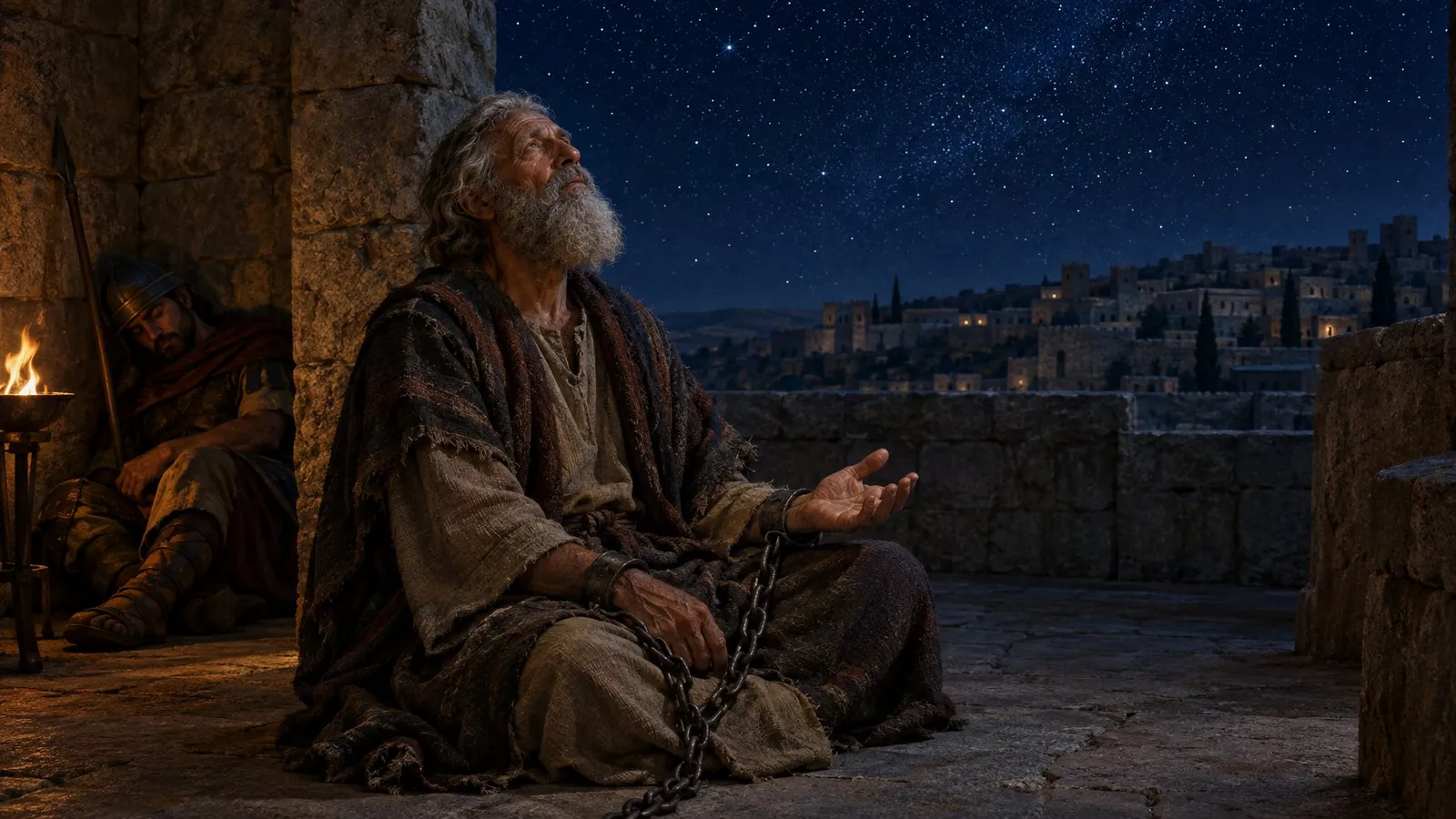
But the first person to hear it was not sitting in a quiet room. He was a prisoner, in a city under siege, about to fall. That setting is what gives the promise its power.
What Does Jeremiah 33:3 Mean?
Jeremiah 33:3 means that God invites his people to call on him in prayer and promises to answer, revealing purposes far greater than anything they could see or figure out on their own.
For Jeremiah, the "great and hidden things" (the KJV's "great and mighty things") were not secret knowledge or private predictions. They were God's plans to heal and restore Jerusalem after its destruction, and to raise up a righteous King from David's line. The rest of chapter 33 spells them out.
The Setting: A Prophet Under Guard, a City Under Siege
The chapter begins:
"The word of the LORD came to Jeremiah a second time, while he was still shut up in the court of the guard." (Jeremiah 33:1)
It was around 587 BC, "the tenth year of Zedekiah king of Judah" (Jeremiah 32:1). In the tenth year of King Zedekiah, the book of Jeremiah's long warnings were coming true. The Babylonian army had surrounded Jerusalem. King Zedekiah had Jeremiah confined because the prophet kept saying the city would fall (32:3–5). Houses were being torn down to strengthen the walls against the siege ramps (33:4).
The Field at Anathoth
Just before this, God told Jeremiah to do something that looked foolish. He was to buy a field from his cousin Hanamel in his hometown of Anathoth, territory the Babylonians already controlled (32:6–15). Jeremiah paid, signed the deed in front of witnesses and had it sealed in a clay jar "that they may last for a long time" (32:14).
The purchase was a sign: "Houses and fields and vineyards shall again be bought in this land" (32:15). Then Jeremiah prayed, "Ah, Lord GOD! It is you who have made the heavens and the earth by your great power and by your outstretched arm! Nothing is too hard for you" (32:17). God answered with his own question: "Behold, I am the LORD, the God of all flesh. Is anything too hard for me?" (32:27).
Jeremiah 33:3 comes right after that conversation. Jeremiah had acted in faith. Now God invited him to keep asking.
Jeremiah's troubles were not over. Later he would be lowered into a muddy cistern and left to sink (Jeremiah 38:6). The promise of God came to a man whose circumstances were getting worse, not better.
From "Do Not Pray" to "Call to Me"
This invitation is even more striking given what came before in the book of Jeremiah. Three times God had told the prophet not to pray for the people, because they refused to turn from their sin: "As for you, do not pray for this people" (Jeremiah 7:16; see also 11:14; 14:11). Judgment was coming, and it could not be stopped.
Now, with judgment at the gates, God says the opposite: "Call to me." The door to prayer, which had seemed closed, is thrown open. God had not stopped listening. He was about to reveal what lay beyond the judgment.
What the Hebrew Words Mean
"Call" (qara) and "Answer" (anah)
The Hebrew qara means to call out, cry aloud, summon. It is the language of a person shouting for help. Anah means to answer or respond. The promise is direct: if you call, I will respond.
"Great and Hidden Things"
The ESV says "great and hidden things." The KJV says "great and mighty things." The NIV says "great and unsearchable things." The Hebrew is gedolot u-vetsurot.
Betsurot comes from a root meaning "fortified" or "cut off." It is the word used for fortified cities with walls no one could break through. These are things inaccessible to human understanding, walled off until God opens them. Some translators connect the word with a similar Hebrew form, netsurot, "guarded" or "hidden," which appears in Isaiah 48:6: "hidden things that you have not known." That is why the ESV says "hidden."
The image is striking. Jeremiah was inside a city with walls under attack. God promised to show him things behind a wall no army could breach: the wall of the future.
Jeremiah 33:3 in the KJV, NIV and Other Translations
In the King James Version, verses 2 and 3 read together: "Thus saith the LORD the maker thereof, the LORD that formed it, to establish it; the LORD is his name; Call unto me, and I will answer thee, and shew thee great and mighty things, which thou knowest not." The God who invites the call is the Creator. That is why he can show "great and mighty things" no one else knows.
| Version | Jeremiah 33:3 |
|---|---|
| King James Version (KJV) | "Call unto me, and I will answer thee, and shew thee great and mighty things, which thou knowest not." |
| English Standard Version | "Call to me and I will answer you, and will tell you great and hidden things that you have not known." |
| New International Version | "Call to me and I will answer you and tell you great and unsearchable things you do not know." |
What Were the "Great and Hidden Things"? Jeremiah 33:4-26
God did not leave the promise vague. The rest of the chapter reveals what he meant:
- Healing: "Behold, I will bring to it health and healing, and I will heal them and reveal to them abundance of prosperity and security" (33:6).
- Return from exile: "I will restore the fortunes of Judah and the fortunes of Israel, and rebuild them as they were at first" (33:7). The people would return from Babylon to a land that had become a desolation.
- Forgiveness: "I will cleanse them from all the guilt of their sin against me" (33:8).
- Joy restored: In the desolation of Jerusalem, a city the people described as "a waste without man or beast" (33:10), about to go silent, God promised "the voice of mirth and the voice of gladness, the voice of the bridegroom and the voice of the bride," and the song, "Give thanks to the LORD of hosts, for the LORD is good, for his steadfast love endures forever!" (33:11).
- A righteous King: "In those days and at that time I will cause a righteous Branch to spring up for David, and he shall execute justice and righteousness in the land" (33:15).
- A new name: "And this is the name by which it will be called: 'The LORD is our righteousness'" (33:16).
- An unbreakable covenant: God's promise to David was as fixed as his covenant "with day and night" (33:20–21, 25–26).
"Branch" was a title for the coming Messiah, the anointed King (Isaiah 11:1; Zechariah 3:8). Christians read the "righteous Branch" as a prophecy of Jesus, the Son of David. The title "The LORD is our righteousness," in Hebrew YHWH Tsidkenu, is one of the compound names of God, like Jehovah Jireh. (See our study of what Jehovah Jireh means for more of these names.)
So the "great and hidden things" were nothing less than the hope of the gospel, revealed to a man in chains while his city burned.
Does Jeremiah 33:3 Promise Secret Revelations?
Some teachers use this verse to promise special, private knowledge to anyone who prays hard enough. That is not what the passage shows. God answered Jeremiah by revealing his plan of salvation, and he wrote it down for everyone. The "hidden things" are hidden from human reasoning, not from God's people.
Moses said it this way: "The secret things belong to the LORD our God, but the things that are revealed belong to us and to our children forever" (Deuteronomy 29:29). Today, the great things God has revealed are found in Scripture, above all in Christ, "in whom are hidden all the treasures of wisdom and knowledge" (Colossians 2:3).
That does not mean God never gives his people wisdom for their lives. James writes, "If any of you lacks wisdom, let him ask God, who gives generously to all without reproach, and it will be given him" (James 1:5). But the deepest answer to prayer is not information. It is God himself and his promises. The apostle Paul praised the God "who is able to do far more abundantly than all that we ask or think" (Ephesians 3:20), and he wrote that "all the promises of God find their Yes" in Christ Jesus (2 Corinthians 1:20).
Jeremiah 33:3 and Jeremiah 29:11-13
Jeremiah 33:3 echoes the letter Jeremiah had sent to the exiles in Babylon a few years earlier:
"Then you will call upon me and come and pray to me, and I will hear you. You will seek me and find me, when you seek me with all your heart." (Jeremiah 29:12–13)
Both passages tie God's good plans to prayer. God does not only announce his purposes; he invites his people to call on him and be part of what he is doing. (See our study of Jeremiah 29:11.)
Other Bible Verses That Echo Jeremiah 33:3
The promise that God answers those who call on him runs throughout Scripture:
- "Call upon me in the day of trouble; I will deliver you, and you shall glorify me" (Psalm 50:15).
- "When he calls to me, I will answer him; I will be with him in trouble" (Psalm 91:15). (See our study of Psalm 91.)
- "Before they call I will answer; while they are yet speaking I will hear" (Isaiah 65:24).
- "Ask, and it will be given to you; seek, and you will find; knock, and it will be opened to you" (Matthew 7:7).
- "And this is the confidence that we have toward him, that if we ask anything according to his will he hears us" (1 John 5:14).
These verses make Jeremiah 33:3 a good one to add to a daily Bible reading plan on prayer.
How to Pray Jeremiah 33:3 Today
Approaching God in prayer does not require perfect circumstances or perfect words.
- Call, even from confinement. Jeremiah prayed from a guarded courtyard. You can pray from a hospital bed, a hard job or a lonely apartment.
- Act in faith, then ask. Jeremiah bought the field before he understood how God would keep his word. Obey what you know, and ask God for what you do not.
- Expect God's answer, not your script. The answer Jeremiah received was bigger than rescue from the siege. It was a promise for generations to come.
- Look for the answer in Scripture. God's "great and hidden things" are revealed in his word. Read it as part of your prayer.
- Remember the question. "Is anything too hard for me?" (32:27). Bring God the things that look impossible.
A Short Prayer Based on Jeremiah 33:3
LORD, you made the heavens and the earth. Nothing is too hard for you. I call to you now. Answer me, and show me what I cannot see. Heal what is broken, forgive what is wrong, and teach me to trust your plans through Jesus Christ, the righteous Branch. Amen.
Frequently Asked Questions About Jeremiah 33:3
It means God invites his people to call on him in prayer and promises to answer, revealing purposes greater than anything they could figure out on their own. For Jeremiah, those purposes were the healing of Jerusalem and the coming of a righteous King from David's line.
Jeremiah was confined in the court of the guard while the Babylonian army besieged Jerusalem, around 587 BC (Jeremiah 32:1–2; 33:1). He had just bought a field as a sign that the land would one day be restored.
'Call unto me, and I will answer thee, and shew thee great and mighty things, which thou knowest not.'
The rest of Jeremiah 33 explains them: healing and forgiveness for the people, joy restored to Jerusalem, and a righteous Branch from David who would be called 'The LORD is our righteousness' (33:6–16).
It is a popular nickname because the reference, Jer 33:3, looks like a phone number and the verse invites us to call God. It is a memorable way to remember that God hears prayer.
Scripture quotations are from the English Standard Version (ESV) unless otherwise noted.
Categories:
Related Articles

Biblically Accurate Angels: What Angels Look Like in the Bible
Wheels full of eyes, six-winged seraphim, four-faced cherubim, or ordinary-looking men? See what the Bible actually says angels look like, verse by verse, with the Hebrew behind each name.
Hallelujah Meaning: What Does Hallelujah Mean in the Bible?
Hallelujah means 'Praise Yah,' a Hebrew command to praise the LORD. See where it appears in the Psalms and Revelation, how it differs from Alleluia, and why the Bible kept it untranslated.

Isaiah 40:31 Meaning: 'They Shall Mount Up With Wings Like Eagles'
Isaiah 40:31 promises that those who wait for the LORD will renew their strength and mount up with wings like eagles. Here is what 'wait' means in Hebrew, who first heard it, and why walking comes last.
Isaiah 41:10 Meaning: 'Fear Not, for I Am With You'
Isaiah 41:10 gives two reasons not to fear and three promises: God will strengthen, help and uphold you. Here is what it meant to Israel, what 'dismayed' and 'righteous right hand' mean in Hebrew, and how to hold on to it.