
John 3:16 Meaning: 'For God So Loved the World' Explained Word by Word
"For God so loved the world, that he gave his only Son, that whoever believes in him should not perish but have eternal life." (John 3:16)
It may be the most famous verse in the entire Bible. It is held up on signs at football games, printed on the bottom of fast-food cups, and memorized by children before almost any other verse. John 3:16 is often called "the gospel in miniature," a phrase commonly attributed to Martin Luther. In one sentence it tells who God is, what he did, why he did it, and what it means for anyone who believes.
Because it is so familiar, it is easy to read past it. This study slows down and looks at the verse phrase by phrase: where Jesus said it, what the Greek words mean, and what the verses around it add.
What Does John 3:16 Mean?
John 3:16 means that God loved the world, a world turned away from him, so much that he gave his one and only Son, so that everyone who trusts in Jesus will be rescued from eternal death and receive eternal life.
The verse has four movements:
- The source: "God so loved."
- The object: "the world."
- The gift: "he gave his only Son."
- The purpose: "that whoever believes in him should not perish but have eternal life."
Salvation starts with the love of God, not human effort. It reaches the whole world, not one nation. It cost God dearly: God gave his Son. And it is received by believing. That is the way of salvation in a single Bible verse.
The Setting: Nicodemus Comes at Night
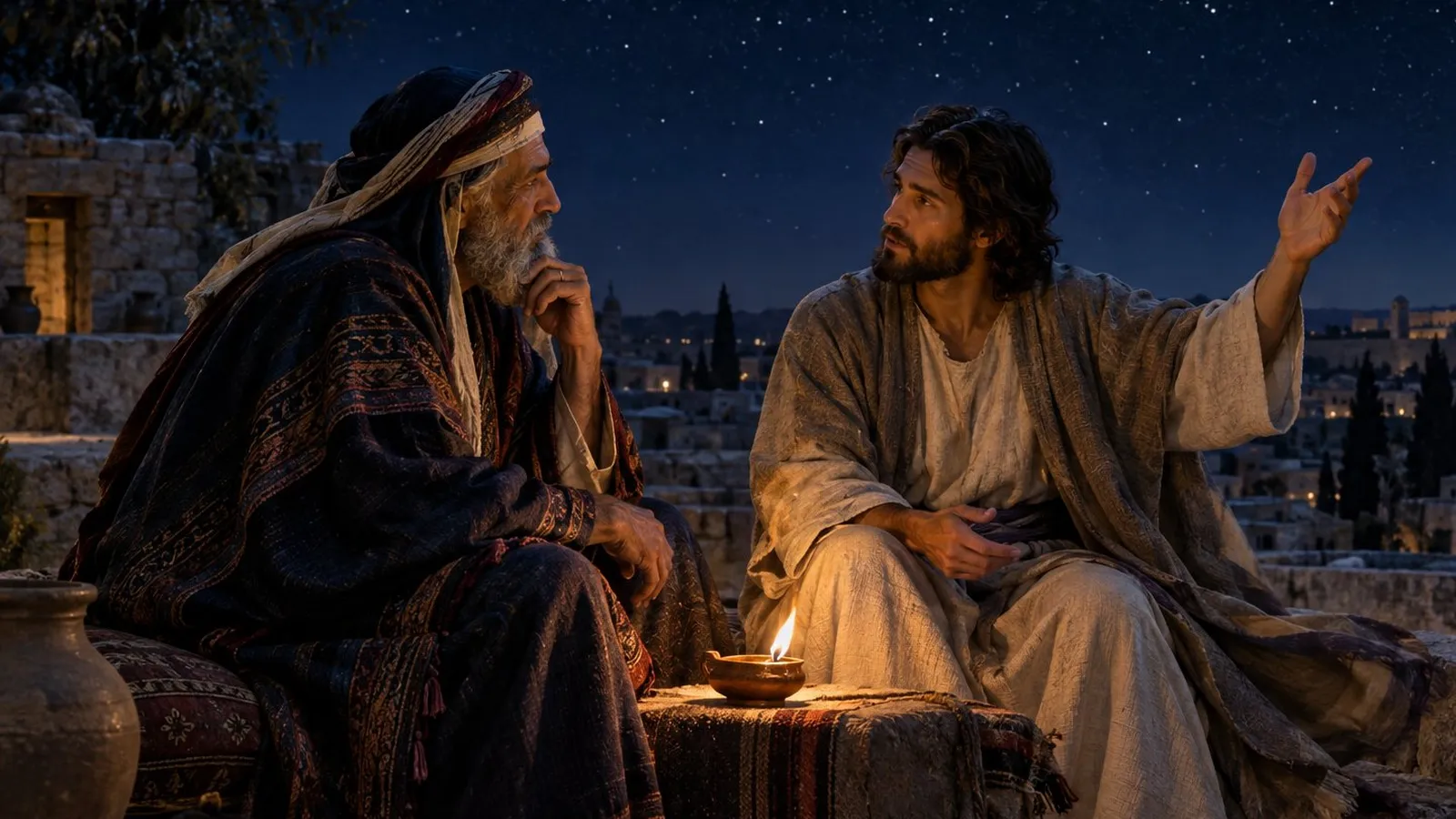
John 3:16 is part of a conversation. "Now there was a man of the Pharisees named Nicodemus, a ruler of the Jews. This man came to Jesus by night" (John 3:1–2). He was a respected teacher, "the teacher of Israel" (3:10), and he came in the dark, perhaps so that no one would see him.
Jesus told him, "Unless one is born again he cannot see the kingdom of God" (3:3). The Greek word anōthen can mean both "again" and "from above." Nicodemus took it in the first sense and asked how a grown man could enter his mother's womb a second time (3:4). Jesus meant the second: a new birth that comes from God, "of water and the Spirit" (3:5). Like the wind, which no one can see or control, "so it is with everyone who is born of the Spirit" (3:8).
Then, in verse 14, Jesus pointed Nicodemus to a story he knew well:
"And as Moses lifted up the serpent in the wilderness, so must the Son of Man be lifted up, that whoever believes in him may have eternal life." (John 3:14–15)
In Numbers 21, when venomous snakes struck Israel in the wilderness, God told Moses to set a bronze serpent on a pole, and "if a serpent bit anyone, he would look at the bronze serpent and live" (Numbers 21:9). Healing came not by effort but by looking in trust at what God provided. Jesus would be "lifted up" in the same way, in his death on the cross (John 12:32–33).
John 3:16 explains why. "For God so loved the world..." The verse begins with "for" because it gives the reason behind the cross.
Whose Words Are These?
The Greek New Testament has no quotation marks. Some scholars think Jesus' words end at verse 15 and that verses 16–21 are the apostle John's own reflection on them. Others read the whole passage as Jesus speaking, which is why many red-letter Bibles print verse 16 in red. Either way, it is part of the inspired Gospel of John, and its meaning does not change.
"For God So Loved the World": The Greek of John 3:16, Word by Word
The Greek of John 3:16 begins: houtōs gar ēgapēsen ho theos ton kosmon, "for God so loved the world."
| English | Greek | Meaning |
|---|---|---|
| so | houtōs | "in this way," "like this" |
| loved | ēgapēsen | from agapaō, self-giving, sacrificial love |
| world | kosmos | humanity, often in rebellion against God |
| only | monogenēs | one of a kind, unique |
| believes | pisteuōn | keeps on trusting |
| perish | apolētai | be destroyed, lost |
| eternal life | zōē aiōnios | the life of the age to come |
"So Loved": How Much, or in What Way?
In English, "so loved" sounds like "loved so much." The Greek houtōs usually means "in this way" or "like this." John is not only saying how much God loved the world, but how he showed it: by giving his Son. Both are true. The love was immense, and the proof was the gift. The love God has shown is for sinners, not for the deserving. Paul makes the same point: "God shows his love for us in that while we were still sinners, Christ died for us" (Romans 5:8).
"The World": Who God Loved
In John's Gospel, kosmos often means not just the planet or all people, but humanity in its rebellion against God. "He was in the world, and the world was made through him, yet the world did not know him" (John 1:10). That makes the verse more startling, not less. God did not love a world that was lovable. He loved a world that had turned its back on him.
It also means the love is not limited to one nation. Nicodemus was a Jewish leader who expected God's kingdom to come to Israel. Jesus told him that God's love reached the world.
"Only Begotten Son" or "One and Only Son"?
The King James Version says "his only begotten Son." The ESV says "his only Son," and the NIV says "his one and only Son." The Greek word is monogenēs.
For centuries it was read as monos ("only") + gennaō ("to beget"). Many scholars now connect the second part with genos, "kind," giving the sense "one of a kind," "unique." The book of Hebrews uses the same word for Isaac, calling him Abraham's monogenēs son (Hebrews 11:17), even though Abraham had another son, Ishmael. Isaac was the unique son of promise.
That echo is deliberate. In Genesis 22, God said to Abraham, "Take your son, your only son Isaac, whom you love" (Genesis 22:2). Abraham was spared from giving up his son; God provided a ram instead. At the cross, God did not spare his own. For more on that story, see our study of what Jehovah Jireh means.
Whichever English word a Bible uses, the point is the same: Jesus is not one son among many. He is the Son, unique in his relationship to God the Father (John 1:14, 18).
"Whoever Believes": The Only Condition
The word pisteuōn is a present participle: "the one who is believing." Faith in John's Gospel is not a single moment of agreement but ongoing trust. And it is open to "whoever," with no exceptions for background, past or nationality.
To believe in him (Greek eis auton, literally "into him") is more than believing facts about Jesus. It is putting your whole weight on him, as the Israelites looked to the bronze serpent and lived. Faith in Jesus is the only condition: everyone who believes receives the promise.
The Promise of Eternal Life: "Should Not Perish"
The verse gives two outcomes. To perish (apollymi) means to be lost or destroyed, the end of a life cut off from God. The alternative is eternal life (zōē aiōnios).
Eternal life is not only life that lasts forever. It is a new kind of life that begins now. Jesus defines it later in John: "And this is eternal life, that they know you, the only true God, and Jesus Christ whom you have sent" (John 17:3). At its heart, eternal life is a relationship, living in the presence of God now and forever.
John 3:16 in the KJV, NIV and Other Versions
| Version | John 3:16 |
|---|---|
| King James Version (KJV) | "For God so loved the world, that he gave his only begotten Son, that whosoever believeth in him should not perish, but have everlasting life." |
| English Standard Version | "For God so loved the world, that he gave his only Son, that whoever believes in him should not perish but have eternal life." |
| New International Version | "For God so loved the world that he gave his one and only Son, that whoever believes in him shall not perish but have eternal life." |
| New American Standard Bible (1995) | "For God so loved the world, that He gave His only begotten Son, that whoever believes in Him shall not perish, but have eternal life." |
Read the Next Verses: John 3:17–18
Many people stop at verse 16. The next two verses are just as important:
"For God did not send his Son into the world to condemn the world, but in order that the world might be saved through him. Whoever believes in him is not condemned, but whoever does not believe is condemned already, because he has not believed in the name of the only Son of God." (John 3:17–18)
Verse 17 makes it plain: Jesus did not come to condemn people. He came to rescue them. Verse 18 explains why: the condemnation was already there, and Jesus came as the way out. The chapter ends with the same two outcomes: "Whoever believes in the Son has eternal life; whoever does not obey the Son shall not see life, but the wrath of God remains on him" (John 3:36). The name Jesus itself means "the LORD saves" (see our study of what Yeshua means).
Verses 19–21 then return to the image of the night Nicodemus came in: "the light has come into the world, and people loved the darkness rather than the light" (3:19). But "whoever does what is true comes to the light" (3:21). The question John 3 leaves with every reader is whether we will come into the light.
What Happened to Nicodemus?
John does not tell us how Nicodemus responded that night. But he appears twice more:
- When the religious leaders wanted Jesus arrested, Nicodemus spoke up for him: "Does our law judge a man without first giving him a hearing?" (John 7:50–51).
- After the crucifixion, he came with Joseph of Arimathea, "bringing a mixture of myrrh and aloes, about seventy-five pounds in weight," to bury Jesus' body (John 19:39).
The man who came in the dark ended by standing openly with Jesus when it was most dangerous. He had seen the Son of Man lifted up.
The Other 3:16: 1 John 3:16
John wrote another "3:16" that completes this one:
"By this we know love, that he laid down his life for us, and we ought to lay down our lives for the brothers." (1 John 3:16)
Jesus had said the same of himself: "I lay down my life for the sheep" (John 10:15). John 3:16 tells what God's love gave. First John 3:16 tells what that love asks of us in return: to love others with the same self-giving love. John says it again: "In this is love, not that we have loved God but that he loved us and sent his Son to be the propitiation for our sins" (1 John 4:10).
How to Live John 3:16 Today
- Receive it personally. "Whoever" includes you. Put your own name in the verse and read it slowly.
- Believe in Jesus, not just about him. Trust him the way the Israelites looked to the serpent on the pole, with nothing else to rely on.
- Start eternal life now. Get to know God through prayer, Scripture and his people (John 17:3).
- Pass the love on. Let 1 John 3:16 follow John 3:16. God's love for the world becomes visible through people who love like him.
For another great promise of God's love, read our study of Romans 8:28, where Paul writes that God "did not spare his own Son but gave him up for us all" (Romans 8:32).
Frequently Asked Questions About John 3:16
God loves the whole world so much that he gave his only Son, Jesus, so that anyone who trusts in him will not be lost but will have eternal life.
Nicodemus, a Pharisee and member of the Jewish ruling council, who came to Jesus at night (John 3:1–2). Some scholars think verse 16 begins John's own commentary on the conversation rather than Jesus' direct words.
It translates the Greek monogenēs, which means 'one of a kind' or 'unique.' It does not mean Jesus had a beginning. It means he is the Father's unique Son, in a relationship no one else shares.
'For God so loved the world, that he gave his only begotten Son, that whosoever believeth in him should not perish, but have everlasting life.'
It summarizes the whole message of the Bible in one sentence: God's love, the gift of his Son, salvation by faith, and eternal life. That is why it is often called 'the gospel in miniature.'
John 3:17: 'For God did not send his Son into the world to condemn the world, but in order that the world might be saved through him.'
Scripture quotations are from the English Standard Version (ESV) unless otherwise noted.
Categories:
Related Articles

Biblically Accurate Angels: What Angels Look Like in the Bible
Wheels full of eyes, six-winged seraphim, four-faced cherubim, or ordinary-looking men? See what the Bible actually says angels look like, verse by verse, with the Hebrew behind each name.
Hallelujah Meaning: What Does Hallelujah Mean in the Bible?
Hallelujah means 'Praise Yah,' a Hebrew command to praise the LORD. See where it appears in the Psalms and Revelation, how it differs from Alleluia, and why the Bible kept it untranslated.

Isaiah 40:31 Meaning: 'They Shall Mount Up With Wings Like Eagles'
Isaiah 40:31 promises that those who wait for the LORD will renew their strength and mount up with wings like eagles. Here is what 'wait' means in Hebrew, who first heard it, and why walking comes last.

Isaiah 41:10 Meaning: 'Fear Not, for I Am With You'
Isaiah 41:10 gives two reasons not to fear and three promises: God will strengthen, help and uphold you. Here is what it meant to Israel, what 'dismayed' and 'righteous right hand' mean in Hebrew, and how to hold on to it.