
Se'irim and Wilderness Spirits: Biblical Beings in Desolate Places
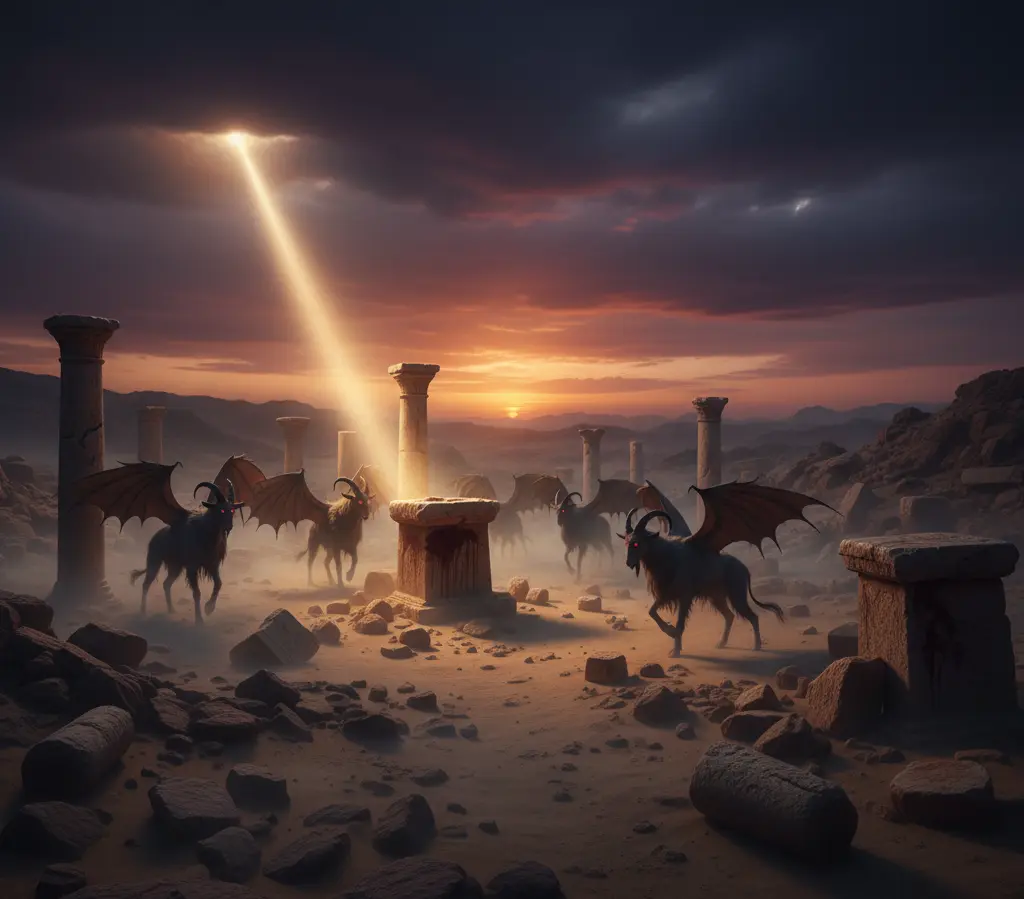
Throughout Scripture, a mysterious pattern emerges: certain beings—neither fully human nor clearly animal—consistently appear in desolate wilderness regions. The Hebrew Bible calls them se'irim (שְׂעִירִים), often translated as "satyrs," "wild goats," or "hairy ones." But what are these creatures? Are they literal beings, symbolic language, or something in between?
Understanding the biblical pattern of wilderness dwellers provides crucial context for comprehending God's judgment, the nature of spiritual corruption, and why certain beings are exiled to desolate places rather than destroyed outright.
The Hebrew Term: Se'irim (שְׂעִירִים)
Etymology and Usage
Root meaning:
- From sa'ir (שָׂעִיר) meaning "hairy" or "shaggy"
- Can refer to male goats (which are hairy)
- Also used for supernatural beings
- Context determines whether literal or supernatural
Three categories of biblical usage:
1. Literal goats (animals for sacrifice) 2. Demons or false gods (objects of forbidden worship) 3. Wilderness beings (creatures inhabiting desolate places)
Leviticus 17:7 - Sacrifices to Demons
"And they shall no more offer their sacrifices unto devils [se'irim], after whom they have gone a whoring. This shall be a statute for ever unto them throughout their generations."
Context:
- Israel forbidden from sacrificing to se'irim
- Described as spiritual adultery ("whoring")
- Clearly demonic entities, not mere animals
- Associated with idolatrous worship
Ancient Jewish understanding:
- These were demons appearing as goat-like beings
- Wilderness spirits Israel encountered in Egypt
- Forbidden worship practices from pagan neighbors
- Spiritual entities, not symbolic language
Modern translations vary:
- KJV: "devils"
- NIV: "goat idols"
- ESV: "goat demons"
- NASB: "goat demons"
The translation "goat demons" captures both the appearance (se'irim = hairy/goat-like) and nature (demonic entities).
2 Chronicles 11:15 - Jeroboam's Apostasy
"And he ordained him priests for the high places, and for the devils [se'irim], and for the calves which he had made."
Context:
- Jeroboam set up false worship in northern Israel
- Priests appointed for se'irim worship alongside calf idols
- Parallels to pagan Canaanite religion
- Direct violation of Leviticus 17:7
Significance:
- Se'irim worship was real spiritual practice
- Not merely symbolic or poetic language
- Required priests (formal religious structure)
- Grouped with golden calf idolatry
This establishes se'irim as recognized spiritual entities in ancient Israelite understanding, not merely literary devices.
Isaiah's Wilderness Se'irim
Isaiah 13:19-22 - Judgment on Babylon
"And Babylon, the glory of kingdoms, the beauty of the Chaldees' excellency, shall be as when God overthrew Sodom and Gomorrah. It shall never be inhabited, neither shall it be dwelt in from generation to generation... But wild beasts of the desert shall lie there; and their houses shall be full of doleful creatures; and owls shall dwell there, and satyrs [se'irim] shall dance there. And the wild beasts of the islands shall cry in their desolate houses, and dragons in their pleasant palaces."
The pattern of desolation:
Before judgment:
- "Glory of kingdoms"
- "Beauty of the Chaldees' excellency"
- Inhabited, thriving civilization
After judgment:
- "Never be inhabited"
- Compared to Sodom and Gomorrah's destruction
- Complete desolation
Who/what inhabits it:
- Wild beasts of the desert
- Doleful creatures (Hebrew: ochim, uncertain meaning)
- Owls (bath ya'anah, daughter of greediness)
- Se'irim dancing
- Wild beasts of the islands
- Dragons (tannim, possibly jackals or serpents)
Key observations about se'irim here:
1. They "dance":
- Active, celebratory behavior
- Not merely existing, but reveling
- Dancing often associated with worship or ritual
- Suggests conscious, purposeful activity
2. They're grouped with mysterious creatures:
- Not clearly identified animals
- Some translations uncertain
- Mixture of natural and possibly supernatural beings
- Pattern of ambiguous wilderness entities
3. They inhabit ruins specifically:
- Not virgin wilderness
- Formerly civilized places now judged
- Divine judgment creates their habitat
- Desolation attracts them
4. This is prophetic certainty:
- Isaiah declares this WILL happen
- Not hypothetical or symbolic only
- Actual future state of Babylon
- Fulfilled historically (Babylon became ruins)
Isaiah 34:11-15 - Judgment on Edom
"But the cormorant and the bittern shall possess it; the owl also and the raven shall dwell in it... And thorns shall come up in her palaces, nettles and brambles in the fortresses thereof: and it shall be an habitation of dragons, and a court for owls. The wild beasts of the desert shall also meet with the wild beasts of the island, and the satyr [se'ir] shall cry to his fellow; the screech owl also shall rest there, and find for herself a place of rest. There shall the great owl make her nest, and lay, and hatch, and gather under her shadow: there shall the vultures also be gathered, every one with her mate."
Edom's judgment parallels Babylon:
Similar inhabitants:
- Various birds (owls, ravens, cormorants)
- Dragons/serpents (tannim)
- Wild beasts
- Se'irim
- Creatures finding "rest" in ruins
Unique detail: "The satyr shall cry to his fellow":
This phrase reveals:
- Se'irim communicate with each other
- They have some form of social interaction
- "Cry to his fellow" suggests language or calls
- Not solitary but group-dwelling
Hebrew: sa'ir 'al-re'ehu yiqra'
- Literally: "hairy one to his companion shall call"
- Implies ongoing relationship/community
- Not random animals crossing paths
- Organized presence in desolate places
Comparison to Mark 5:1-5 (Gerasene demoniac):
- Demon-possessed man in tombs (desolate place)
- "Crying" in mountains and tombs
- Away from human habitation
- Supernatural strength and behavior
Could se'irim be similar entities—not possessed humans, but beings existing in desolate places, calling to each other?
The Lilith Question: Isaiah 34:14
Some translations include "Lilith" in Isaiah 34:14:
Hebrew text: lilit (לִילִית) KJV: "screech owl" NASB: "night monster" ESV footnote: "Lilith" NIV: "night creatures"
What is Lilith?
In Jewish tradition:
- A female night demon
- Associated with wilderness and desolation
- Ancient Mesopotamian origins
- Mentioned in various Jewish texts (but only once in canonical Scripture)
In medieval Jewish folklore:
- Adam's alleged first wife who became a demon
- Dangerous to children and pregnant women
- Dwells in desolate ruins
- Nocturnal wilderness spirit
Biblical occurrence:
- Only in Isaiah 34:14
- In context of Edom's judgment
- Listed among wilderness creatures
- Associated with desolate ruins
Textual uncertainty:
- Could be an owl species
- Could be a supernatural entity
- Ancient translators uncertain
- Modern scholars debate
What we know for certain:
- Lilit appears in a judgment passage
- Associated with desolate wilderness
- Grouped with mysterious creatures including se'irim
- Finds "rest" in ruins (like demons seeking rest in Matthew 12:43)
Conservative interpretation:
- Probably a nocturnal creature (owl or night bird)
- But ancient Jewish understanding included demonic associations
- Context suggests supernatural elements
Regardless of Lilith's exact nature, the pattern holds:
- Mysterious beings
- Wilderness/ruins habitat
- Associated with divine judgment
- Grouped with se'irim and other entities
- Finding "rest" in desolation
The Scapegoat Ritual: Azazel and Wilderness Exile
Leviticus 16 - The Day of Atonement
The ritual involved two goats:
Goat 1 - For the LORD:
"And Aaron shall bring the goat upon which the LORD's lot fell, and offer him for a sin offering." (Leviticus 16:9)
- Sacrificed at the altar
- Blood sprinkled in the Holy of Holies
- Atonement for Israel's sins
- Standard sacrificial procedure
Goat 2 - For Azazel:
"But the goat, on which the lot fell to be the scapegoat [Azazel], shall be presented alive before the LORD, to make an atonement with him, and to let him go for a scapegoat [Azazel] into the wilderness." (Leviticus 16:10)
Verses 20-22:
"And when he hath made an end of reconciling the holy place... he shall bring the live goat: And Aaron shall lay both his hands upon the head of the live goat, and confess over him all the iniquities of the children of Israel... putting them upon the head of the goat, and shall send him away by the hand of a fit man into the wilderness: And the goat shall bear upon him all their iniquities unto a land not inhabited: and he shall let go the goat in the wilderness."
The Azazel Question
Is Azazel a place or a person?
Traditional translation: "Scapegoat"
- Hebrew: 'aza'zel (עֲזָאזֵל)
- Could mean "goat that departs"
- Could mean "goat for complete removal"
- Understood as description of ritual purpose
Alternative interpretation: Proper name
- Azazel as a fallen angel
- Goat sent TO Azazel, not AS a scapegoat
- Parallelism: "lot for the LORD" vs. "lot for Azazel"
- Ancient Jewish tradition supports this
1 Enoch 8:1:
"And Azazel taught men to make swords, and knives, and shields, and breastplates... and the metals of the earth and the art of working them... And there arose much godlessness, and they committed fornication, and they were led astray, and became corrupt in all their ways."
1 Enoch 10:4-6:
"And again the Lord said to Raphael: 'Bind Azazel hand and foot, and cast him into the darkness: and make an opening in the desert, which is in Dudael, and cast him therein. And place upon him rough and jagged rocks, and cover him with darkness, and let him abide there for ever, and cover his face that he may not see light.'"
Key details:
- Azazel was a chief fallen angel (one of the Watchers)
- Taught forbidden knowledge to humanity
- Bound in the wilderness/desert as punishment
- Cast into darkness in a desolate place
- Specifically associated with wilderness judgment
Theological Implications
If Azazel is a fallen angel:
The ritual symbolism becomes:
- One goat to the LORD (sacrifice, death, atonement)
- One goat to Azazel (exile, wilderness, carrying sin away)
This means:
- Sin offerings go to God (holy, altar, temple)
- Sin removal goes to the fallen angel in wilderness (unholy, exile, desolation)
- Symbolic return of sin to its source (Satan/Azazel)
- Wilderness as place of judgment for spiritual corruption
The pattern:
- Holy sacrifices = temple/altar (God's domain)
- Unclean scapegoat = wilderness (fallen angels' domain)
- Clean vs. unclean
- Holy vs. judged
- God's presence vs. God's absence
Why send the goat to wilderness specifically?
If Azazel is merely symbolic:
- Any remote location would work
- Specificity seems unnecessary
If Azazel is a bound fallen angel:
- Wilderness is his prison
- The goat symbolically returns corruption to its source
- Satan and fallen angels exiled to desolate places
- Matches pattern of se'irim, demons, and cursed beings in wilderness
New Testament Wilderness Spirits
Matthew 12:43-45 - Unclean Spirits in Dry Places
"When the unclean spirit is gone out of a man, he walketh through dry places, seeking rest, and findeth none. Then he saith, I will return into my house from whence I came out; and when he is come, he findeth it empty, swept, and garnished. Then goeth he, and taketh with himself seven other spirits more wicked than himself, and they enter in and dwell there: and the last state of that man is worse than the first."
Key observations:
"Walketh through dry places":
- Greek: anudros (ἄνυδρος) = waterless, desert, desolate
- Same concept as Hebrew wilderness
- Demons naturally inhabit barren regions
- Not cities, not populated areas
"Seeking rest, and findeth none":
- Demons prefer inhabiting bodies
- Wilderness wandering is undesirable to them
- They "seek rest" but wilderness provides none
- Matches se'irim and Lilith "finding rest" in ruins (Isaiah 34:14)
The theology:
- Disembodied demons are restless
- They wander desolate places when not possessing humans
- Wilderness is their default habitat
- They actively seek to return to human hosts
Luke 8:26-33 - The Gerasene Demoniac
"And they arrived at the country of the Gadarenes... And when he went forth to land, there met him out of the city a certain man, which had devils long time, and ware no clothes, neither abode in any house, but in the tombs... And Jesus asked him, saying, What is thy name? And he said, Legion: because many devils were entered into him. And they besought him that he would not command them to go out into the deep [abyss]."
The pattern:
- Severely demon-possessed man
- Lives in tombs (desolate, unclean place)
- In mountains (wilderness)
- Away from human civilization
- "Crying" day and night (compare to se'irim "crying to his fellow")
- Supernatural strength
The demons' request:
- Don't send us to the abyss (deep, prison)
- Instead, let us enter the pigs
- Shows demons fear ultimate judgment but prefer temporary embodiment
Wilderness association:
- Tombs were outside city limits
- Mountains were uninhabited
- Desolate places = demon habitat
- Exactly matches Old Testament pattern
Revelation 18:2 - Babylon's Fall (Future Judgment)
"And he cried mightily with a strong voice, saying, Babylon the great is fallen, is fallen, and is become the habitation of devils, and the hold of every foul spirit, and a cage of every unclean and hateful bird."
End-times Babylon:
- Becomes dwelling place of demons
- Every foul spirit
- Unclean birds
Echoes Isaiah 13 & 34:
- Babylon's historical judgment (Isaiah 13)
- Becomes se'irim habitat
- Future Babylon follows same pattern
- Desolate, demon-inhabited ruins
The consistency:
- Old Testament prophecy: Ruins → se'irim, demons, unclean creatures
- New Testament: Demon-possessed → wilderness dwelling
- Revelation: Future judgment → demon habitation
The Theological Pattern: Why Wilderness?
Wilderness as Place of Judgment and Exile
Biblical wilderness serves multiple purposes:
1. Testing and trial:
- Israel wandered 40 years (Deuteronomy 8:2)
- Jesus tempted 40 days (Matthew 4:1-11)
- Place of spiritual battle
2. Divine encounter:
- Moses at burning bush (Exodus 3)
- Elijah at Horeb (1 Kings 19)
- John the Baptist's ministry (Matthew 3:1)
3. Preparation:
- David hiding from Saul
- Paul in Arabia (Galatians 1:17)
- Isolation for calling
4. Judgment and exile:
- Scapegoat sent to wilderness
- Se'irim inhabit desolate ruins
- Demons wander waterless places
- Cursed beings exiled from civilization
The wilderness represents:
- Absence of God's blessing (no water, no fruit)
- Separation from covenant community (away from temple, city)
- Place of chaos (before God's ordering)
- Domain of the unholy (unclean spirits, demons, judged beings)
Wilderness vs. Promised Land
Promised Land:
- Flowing with milk and honey
- God's presence in temple
- Covenant blessings
- Civilization, order, life
Wilderness:
- Dry, barren, desolate
- God's judgment manifest
- Curses and exile
- Chaos, disorder, death
The spiritual geography:
- Eden = Perfect order, God's presence
- Wilderness = Curse, chaos, exile
- Promised Land = Partial restoration
- New Jerusalem = Ultimate restoration (Revelation 21-22)
Beings exiled to wilderness:
- Fallen angels (Azazel)
- Se'irim (demons)
- Cursed entities
- Those under judgment
Not coincidental. Wilderness exile IS a form of judgment.
Se'irim, Elioud, and the Wilderness Connection
Could Se'irim Include Degraded Hybrid Beings?
This section explores potential connections between biblical wilderness beings and the Elioud. This is theoretical, not doctrinal.
If the Elioud survived the flood in cursed form:
They would logically:
- Be exiled to wilderness (judgment pattern)
- Become increasingly feral (degradation)
- Be grouped with se'irim in prophecy (wilderness inhabitants)
- Cry to each other in desolate places (Isaiah 34:14)
- Seek but not find rest (cursed state)
The term se'irim could encompass:
- Demons (Leviticus 17:7, 2 Chronicles 11:15)
- Literal goats (various sacrificial passages)
- Mysterious wilderness beings (Isaiah 13, 34)
- Possibly degraded Elioud (if they survived)
Biblical support for mixed categories:
Many Hebrew terms cover multiple realities:
- Nephilim = fallen ones, but also giants
- Rephaim = giants, but also shades/spirits of the dead
- Elohim = God, but also gods/angels/judges
- Se'irim = goats, demons, wilderness beings
Could se'irim similarly include:
- Demonic entities (clearly established)
- Unknown wilderness creatures
- Degraded hybrid beings (theoretical)
The characteristics match:
- Wilderness dwelling (curse of exile)
- Hairy appearance (degraded from human form)
- Social/communicative ("cry to his fellow")
- Associated with judgment and ruins
- Finding "rest" in desolation (seeking but not finding peace)
- Grouped with other mysterious entities
The "Hairy Ones" Description
Why "hairy"?
If describing degraded hybrids:
- Loss of human civilization
- Adaptation to wilderness survival
- Physical transformation under curse
- Devolution from civilized to feral
Biblical precedent - Esau:
Genesis 25:25:
"And the first came out red, all over like an hairy garment; and they called his name Esau."
Genesis 27:11:
"Behold, Esau my brother is a hairy man, and I am a smooth man."
Hebrew for Esau's hairiness: se'ir (שֵׂעִיר)
- Same root as se'irim
- Esau is called "hairy"
- Edom/Seir named after him
Esau's descendants inhabited:
- Mount Seir (literally "Mount Hairy")
- Edom (the red one)
- Wilderness regions
Interesting connection:
- Esau was "hairy" (se'ir)
- Wilderness beings are se'irim (hairy ones)
- Edom's judgment includes se'irim inhabiting it (Isaiah 34)
- Linguistic and geographic connections
Not suggesting Esau was a hybrid being, but noting:
- Se'ir describes hairiness
- Associated with wilderness/wildness
- Contrast to civilized Jacob
- Pattern of "hairy" = wild/uncivilized
If Elioud degraded:
- Would become increasingly hairy (wilderness adaptation)
- Would lose grooming/civilization
- Would appear "hairy ones"
- Would fit se'irim description
Practical Applications
1. The Reality of Spiritual Realms
Whether se'irim are:
- Purely demons
- Mysterious creatures
- Degraded hybrids
- Symbolic language
The reality remains:
- Spiritual forces exist
- Wilderness represents judgment
- Desolate places associated with unclean spirits
- Biblical cosmology includes unseen realities
Ephesians 6:12:
"For we wrestle not against flesh and blood, but against principalities, against powers, against the rulers of the darkness of this world, against spiritual wickedness in high places."
Practical impact:
- Take spiritual warfare seriously
- Recognize unseen realities
- Don't dismiss biblical testimony
- Trust Scripture over naturalistic explanations
2. God's Comprehensive Judgment
The wilderness pattern shows:
- God judges all corruption
- Various forms of judgment exist (death, exile, transformation)
- Nothing escapes divine justice
- Separation from God's presence is itself judgment
Hell described as:
- "Outer darkness" (Matthew 8:12)
- "Lake of fire" (Revelation 20:15)
- "Where their worm dieth not" (Mark 9:48)
- Ultimate separation from God
Wilderness exile foreshadows:
- Eternal judgment
- Separation from blessing
- Restless wandering
- Seeking but not finding peace
Practical impact:
- Take sin seriously
- Accept Christ's atonement
- Don't presume on God's patience
- Recognize consequences of rebellion
3. Christ Entered the Wilderness for Us
Jesus' wilderness temptation (Matthew 4:1-11):
He went where:
- Adam failed (temptation)
- Israel failed (40 years wandering)
- Demons inhabit (dry places)
- Azazel is bound (wilderness judgment)
He faced:
- Satan directly
- 40 days of testing
- Hunger, weakness, isolation
- Temptation to sin
He conquered:
- Where we fail
- For our sake
- To redeem wilderness
- To defeat Satan
Isaiah 35:1-2:
"The wilderness and the solitary place shall be glad for them; and the desert shall rejoice, and blossom as the rose. It shall blossom abundantly, and rejoice even with joy and singing."
Christ's victory transforms:
- Wilderness → Garden
- Death → Life
- Curse → Blessing
- Exile → Homecoming
Practical impact:
- Trust Christ's wilderness victory
- He conquered where we couldn't
- His obedience covers our disobedience
- Redemption includes all creation
4. Discernment in Mysterious Matters
The se'irim passages teach:
- Some biblical realities are mysterious
- Ancient peoples understood things we've forgotten
- Modern translations can obscure meanings
- Humility required in interpretation
We hold in tension:
- What Scripture clearly teaches (hold firmly)
- What Scripture implies (hold thoughtfully)
- What remains unclear (hold humbly)
Se'irim fall into "implies" category:
- Clearly more than mere goats in some passages
- Clearly associated with demons in Leviticus
- Unclear whether literal beings or spiritual entities
- Possibly both
Practical impact:
- Study Scripture carefully
- Consult ancient Jewish understanding
- Avoid dogmatism on unclear points
- Focus on what matters most (the gospel)
Conclusion: The Wilderness Pattern Matters
Whether se'irim are:
- Purely demonic entities
- Mysterious wilderness creatures
- Degraded hybrid beings
- Symbolic representations
- All of the above in different contexts
The pattern is consistent and clear:
Beings under divine judgment inhabit wilderness/desolate places:
- Azazel bound in desert
- Scapegoat sent to wilderness
- Se'irim in Babylon and Edom's ruins
- Demons in dry/waterless regions
- Gerasene demoniac in tombs and mountains
This pattern reveals:
- Spiritual geography is real
- Separation from God = exile to desolation
- Judgment takes various forms
- Wilderness represents curse and chaos
- God's presence brings order and life
For believers today:
We face wilderness seasons:
- Testing and trial
- Spiritual dryness
- Isolation and struggle
- Confrontation with evil
But we have hope:
- Christ conquered the wilderness
- He defeated Satan there
- He transforms deserts into gardens
- He brings us through to Promised Land
The ultimate promise - Revelation 21:1-4:
"And I saw a new heaven and a new earth... And God shall wipe away all tears from their eyes; and there shall be no more death, neither sorrow, nor crying, neither shall there be any more pain: for the former things are passed away."
No more wilderness. No more exile. No more se'irim crying in desolate ruins. Only God's presence, forever.
Until then, we navigate the wilderness with Christ as our guide, trusting His victory, exercising His authority, and anticipating the day when all desolation becomes paradise.
The se'irim remind us: judgment is real, exile is real, but redemption is greater still.
Related Articles
Categories:
Related Articles
Nephilim Daughters: What Genesis and the Book of Enoch Actually Say
Did the Watchers have daughters? Here's what Genesis, the Book of Enoch, and biblical scholarship actually say about female Nephilim — and where popular theories go beyond the text.

Nephilim and Giants Across Ancient Texts: A Side-by-Side Comparison
Genesis gives the Nephilim four verses. Here's what 1 Enoch, the Book of Giants, Numbers, and Josephus actually say — laid side by side, without blending the accounts.

Why Did Human Lifespans Decline After the Flood? What Scripture Doesn't Say — And What Scholars Have Proposed
Genesis 5 records lifespans over 900 years. By Psalm 90, it's 70-80. Scripture never explains why. Here's what rabbinic, patristic, and modern scholarship have proposed instead.
Are Nephilim Descendants Alive Today? Six Fingers, Giant DNA, and What the Evidence Actually Shows
Scripture describes six-fingered giant descendants surviving well after the Flood. Modern folklore claims the same. Here's what the biblical text actually says — and why the Lovelock Cave and Kandahar stories don't hold up as evidence.