What Does Selah Mean in the Bible? The Meaning of Selah in the Psalms
You are reading a psalm, the words are building, and then a single strange word interrupts the line: Selah. Most English Bibles leave it untranslated. Some put it in the margin. A few drop it altogether.
Selah appears 74 times in the Bible: 71 times in the Psalms and three times in the prayer of Habakkuk. It is one of the most familiar words in Scripture, and also one of the least understood. Even the scholars who translated the Bible into Greek more than two thousand years ago were not sure what it meant, and there is still a great deal of uncertainty about the meaning today.
Here is what we do know, the three leading explanations of what selah means, and a simple way to let it shape how you read the Psalms.
What Does Selah Actually Mean?
The short answer: no one knows for certain, but the best evidence points to a pause. Selah (Hebrew סֶלָה, pronounced SEH-lah in Hebrew and often SEE-lah in English) is most likely a musical or liturgical marker telling singers or readers to stop, lift up, or reflect before the psalm continues.
That is why the Amplified Bible renders it "pause, and calmly think of that." The King James Version (KJV), like most translations, simply keeps the Hebrew word Selah. If you want a one-line Selah definition, it is this: a musical direction to pause, lift up and reflect. It is not a word you are meant to read past. It is a word that asks you to stop.
Where Selah Appears in the Bible
The word selah is found in only two books of the Bible. It appears 71 times in the book of Psalms, spread across 39 of the 150 psalms, and three times in the third chapter of Habakkuk (verses 3, 9 and 13). Many of the selah psalms are David's, and others belong to the temple singers, such as the psalms of Asaph (Psalms 50, 75, 76 and 77) and the sons of Korah (Psalm 46). It never appears in the narrative books, the prophets' sermons or the New Testament. That pattern matters. It shows up only in texts that were sung.
A few examples show how it works on the page:
- Psalm 3:2. "Many are saying of my soul, 'There is no salvation for him in God.' Selah." The word lands right after a painful accusation, giving it room to sink in before David answers in verse 3: "But you, O Lord, are a shield about me."
- Psalm 32:5. "I acknowledged my sin to you... and you forgave the iniquity of my sin. Selah." Here it follows relief, not distress.
- Psalm 46. Selah appears three times (verses 3, 7 and 11). Twice it follows the refrain, "The Lord of hosts is with us; the God of Jacob is our fortress."
- Psalm 24:10. The psalm ends on "He is the King of glory! Selah."
Notice where it falls: at the end of a thought, after a refrain, at a turn in the psalm. Wherever selah appears, something important has just been said.
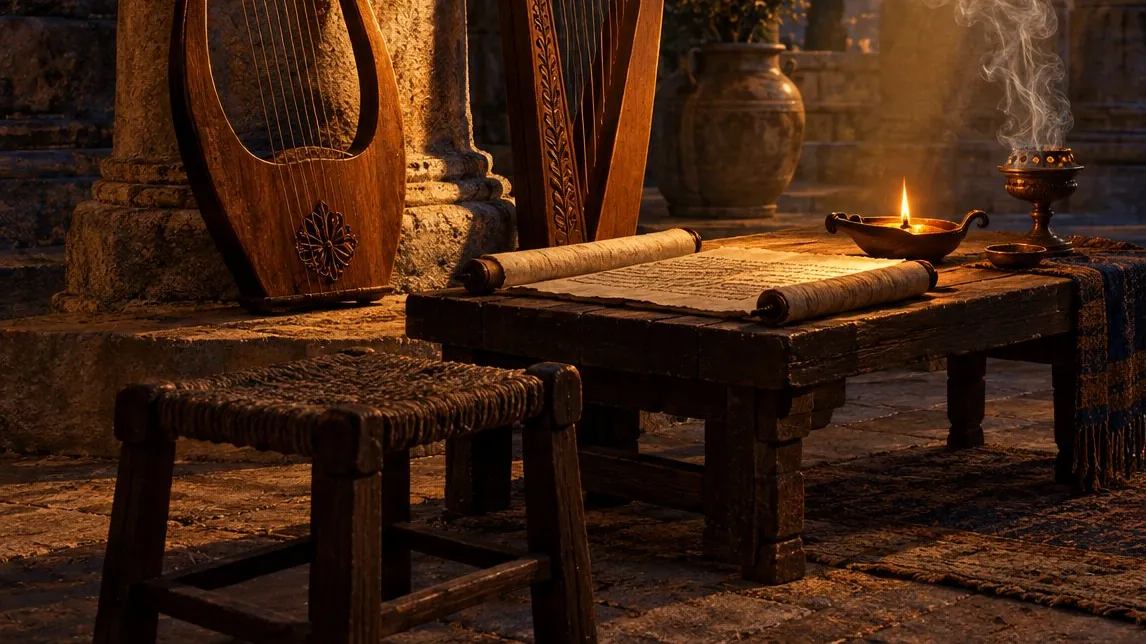
Many of these psalms also carry musical notes in their headings, such as "To the choirmaster" or "with stringed instruments." Habakkuk's prayer opens "according to Shigionoth," a musical term, and closes with the line "To the choirmaster: with stringed instruments" (Habakkuk 3:1, 19). Selah belongs to that same world of temple worship, where trained musicians or singers led Israel's songs before God.
The Three Leading Explanations
1. A Pause or Musical Interlude
The oldest translation we have, the Greek Septuagint (from roughly the third to second centuries BC), renders selah as diapsalma, which most scholars understand as "an interlude" or "a pause in the singing." On this reading, selah marked a break where the voices stopped and the instruments played, or where the congregation paused to take a breath before the next stanza.
This is the most widely accepted view, and it fits where the word appears.
2. "Lift Up": A Crescendo or Raised Voice
Many scholars connect selah to the Hebrew root salal, "to lift up" or "to raise," as in building up a highway (Isaiah 62:10). On this view, selah told the musicians to lift their voices or their instruments, a crescendo, or told the worshipers to lift their hands or their praise.
The two ideas are not far apart. A pause in the words can be the moment the music swells.
3. "Forever"
Ancient Jewish tradition read selah very differently. The Aramaic Targums and the Talmud treat it as meaning "forever," listing it alongside the Hebrew words netzach and va'ed as words for eternity (Babylonian Talmud, Eruvin 54a). The second-century Greek translator Aquila rendered it aei, "always," and Jerome's Latin translation from the Hebrew followed him with semper.
You can test this reading in Psalm 46: "The God of Jacob is our fortress, forever." It reads well, which is part of why the tradition lasted.
A Fourth Suggestion: "Weigh This"
A smaller group of interpreters connects selah with a Hebrew verb meaning "to weigh" or "to value," that is, to properly value something, the word used in Job 28:16 when wisdom "cannot be valued in the gold of Ophir." On this reading, selah means something like "weigh these words." Most scholars treat this as possible but less likely.
What Selah Is Not
It is not the same as "amen." Amen means "truly" or "so be it" and is a word of agreement. Selah is a marker of pause or emphasis. They can both close a line, but they do different jobs.
It is not "Sela," the rock city. The Bible also mentions a place called Sela (2 Kings 14:7; Isaiah 16:1), often identified with the rock fortress region of Edom. In Hebrew that is a different word, sela' (סֶלַע), meaning "rock," spelled with a final letter that selah does not have.
It is not the Arabic salah. The Islamic word for prayer sounds similar but is a different word with a different history.
You will sometimes hear "Amen, Selah" at the end of a prayer. It is a modern pairing that combines both ideas: so be it, and pause and take that in.
How to Read the Psalms With Selah
Whichever explanation is right, they all point the same way: selah is an invitation to stop. Modern readers rush. The psalms were sung slowly, often by a whole congregation, and selah built silence into the song.
Here is a simple practice the next time you meet the word:
- Stop reading. Do not let your eyes slide to the next verse.
- Read the line before it again, slowly. That line is the one the psalm wants you to hold.
- Answer it. If the psalmist has just named a fear (Psalm 3:2), name yours. If he has just received forgiveness (Psalm 32:5), give thanks for yours. If he has just declared that God is a fortress (Psalm 46:7), say it back.
- Then go on. Selah is a pause, not an ending.
That is the heart of the word for a reader today. God's Word is not only to be read but to be weighed, prayed and lifted up. Many worship leaders still use a "selah moment" in services, a planned silence after a Scripture reading or song, for exactly this reason. Selah builds that response right into the text.
Selah in Habakkuk
The three selahs in Habakkuk 3 come in a prayer that the prophet himself sets to music. He recalls how God came "from Teman, and the Holy One from Mount Paran. Selah" (Habakkuk 3:3), then describes God's power over mountains and seas. The prayer ends with one of the most moving confessions of faith in the Bible: even if the fig tree does not blossom and the fields yield no food, "yet I will rejoice in the Lord; I will take joy in the God of my salvation" (Habakkuk 3:17–18).
The pauses are part of how he gets there. Remember what God has done, stop and take it in, and then trust him with what you cannot see.
Selah Today
Selah has moved well beyond the Bible. It is now a popular name for girls in the United States, a word in worship songs and hip-hop lyrics, and a one-word caption for "let that sink in." Those uses are not wrong. They have simply kept the most basic sense of the word: stop, and pay attention.
For more Hebrew words from the Psalms, see our study of what Hallelujah means, a word found in many of the same songs. And if you want to see how the Bible uses patterns of pause and completion elsewhere, our study of the number 7 in the Bible traces the Sabbath rest from creation onward.
Frequently Asked Questions About Selah
Its exact meaning is uncertain. Most scholars think it was a musical or liturgical marker meaning 'pause' or 'interlude,' possibly with the sense of 'lift up.' Ancient Jewish tradition read it as 'forever.' Either way, it marks a moment to stop and reflect on what was just said.
Selah appears 74 times: 71 times in 39 of the Psalms and 3 times in Habakkuk 3 (verses 3, 9 and 13). It does not appear in the New Testament.
In Hebrew it is pronounced SEH-lah. In English it is often said SEE-lah. Both are common in churches today.
No. Amen means 'truly' or 'so be it' and expresses agreement. Selah is most likely a marker for a pause, interlude or lifting up in the music.
The Hebrew word is סֶלָה. It may come from the root salal, 'to lift up,' and the Greek Septuagint translated it diapsalma, 'interlude.' The Talmud and Targums treat it as meaning 'forever.'
Scripture quotations are from the English Standard Version (ESV) unless otherwise noted.
Categories:
Related Articles

Biblically Accurate Angels: What Angels Look Like in the Bible
Wheels full of eyes, six-winged seraphim, four-faced cherubim, or ordinary-looking men? See what the Bible actually says angels look like, verse by verse, with the Hebrew behind each name.
Hallelujah Meaning: What Does Hallelujah Mean in the Bible?
Hallelujah means 'Praise Yah,' a Hebrew command to praise the LORD. See where it appears in the Psalms and Revelation, how it differs from Alleluia, and why the Bible kept it untranslated.

Isaiah 40:31 Meaning: 'They Shall Mount Up With Wings Like Eagles'
Isaiah 40:31 promises that those who wait for the LORD will renew their strength and mount up with wings like eagles. Here is what 'wait' means in Hebrew, who first heard it, and why walking comes last.
Isaiah 41:10 Meaning: 'Fear Not, for I Am With You'
Isaiah 41:10 gives two reasons not to fear and three promises: God will strengthen, help and uphold you. Here is what it meant to Israel, what 'dismayed' and 'righteous right hand' mean in Hebrew, and how to hold on to it.