
Who Is the Alpha and Omega? Why Revelation Gives God's Title to Jesus
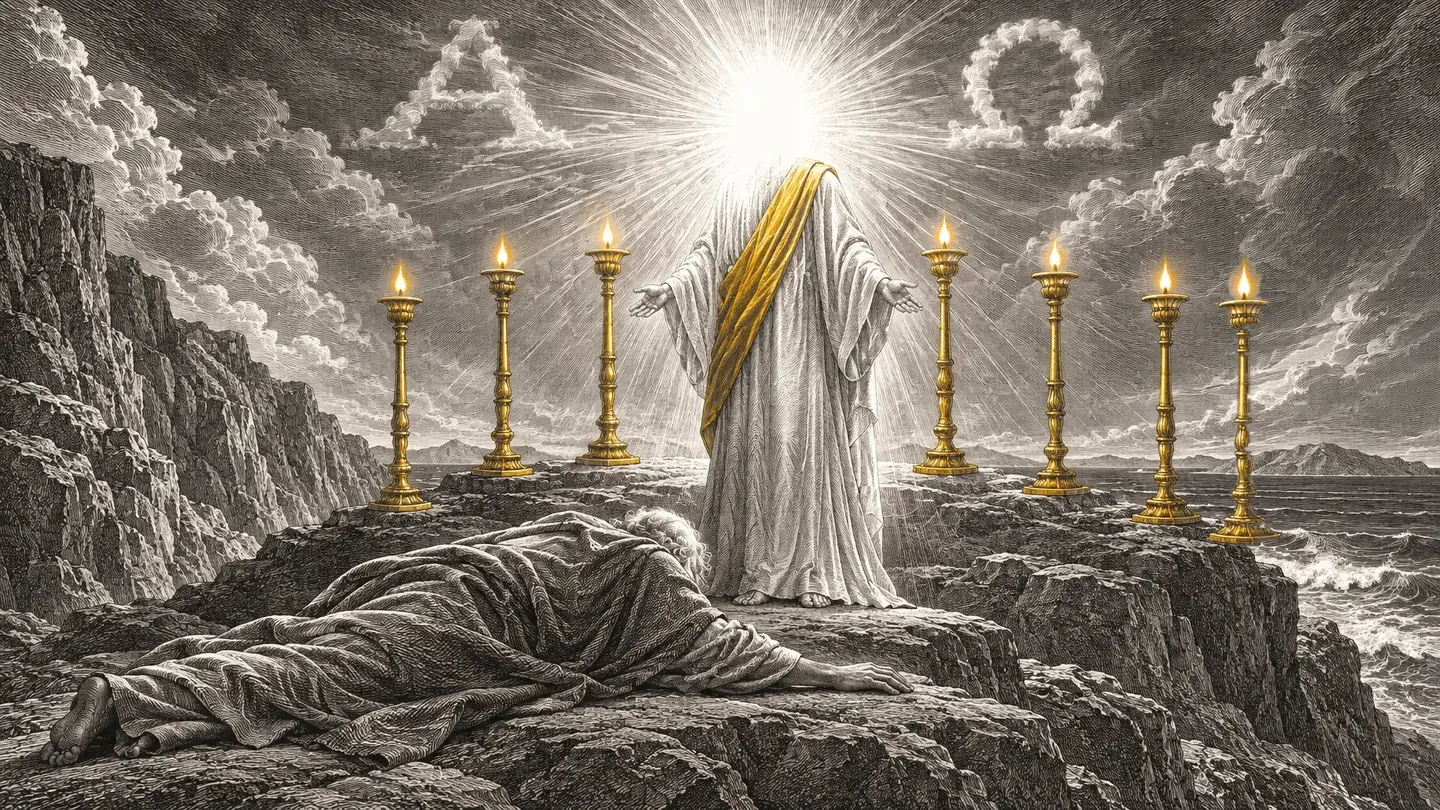
"Jesus never called himself the Alpha and Omega. That was God talking." You'll find that answer near the top of Google when you ask who the Alpha and Omega is, and you'll find the opposite answer right next to it. Both sides quote Revelation. Usually neither one reads the verses around the quotation.
This article does. We'll start where the title begins, in Isaiah, then go through every place Revelation uses it and look at who is actually speaking. You can test yourself along the way. Then we'll look at the strongest objections, because a case that can't survive them isn't worth making.
What Does Alpha and Omega Mean?
Alpha (Α) is the first letter of the Greek alphabet and omega (Ω) is the last letter. "I am the Alpha and the Omega" is a way of saying "I am the A and the Z": the everlasting one who was there before anything began and will still be there when everything ends. In the Book of Revelation it is paired with two other phrases that say the same thing, "the beginning and the end" and "the first and the last."
Using the first and last letters of an alphabet this way wasn't new. Jewish tradition says the seal of God is emet, the Hebrew word for "truth," because it is spelled with the first, middle and last letters of the Hebrew alphabet (Talmud, Shabbat 55a). Revelation was written in Greek, so John's alphabet runs from alpha to omega.
That last phrase is the key to the whole question. John didn't invent it. He took it from Isaiah, where it was one of the boldest claims God makes about himself.
"I Am the First and the Last": Where the Title Starts
In chapters 40 to 48 of Isaiah, God puts the idols of Babylon on trial. Over and over, he challenges them to do what only the true God can do: name the future before it happens, create the heavens, rescue his people. In the middle of this, he gives himself a title three times:
"I the LORD, the first, and with the last; I am he." (Isaiah 41:4)
"Thus saith the LORD the King of Israel, and his redeemer the LORD of hosts; I am the first, and I am the last; and beside me there is no God." (Isaiah 44:6)
"I am he; I am the first, I also am the last. Mine hand also hath laid the foundation of the earth." (Isaiah 48:12-13)
In Hebrew the phrase is ani rishon va-ani acharon: "I am first and I am last." Notice what Isaiah 44:6 attaches to it: "beside me there is no God." The title isn't a compliment that could be shared around. It's how God marks himself off from every other being in the universe. There is one first and one last, and it's him.
So when the Old Testament's title appears in the New Testament, the question isn't just "who is speaking?" It's "who is claiming to be the God of Isaiah?"
Who Says "I Am the Alpha and the Omega"?
The title appears five times in Revelation (six in the King James Version, for a reason we'll come to). Before reading the explanation, try it yourself. Read each verse and decide who you think is speaking.
Try it yourself
Who is speaking?
Isaiah gives God a title no one else can hold. Revelation uses it five times. Read each verse, pick who you think is speaking, then check the evidence from the verses around it.
Where the title starts: Isaiah
Isaiah 41:4 · Speaker: the LORD (YHWH)
“Who hath wrought and done it, calling the generations from the beginning? I the LORD, the first, and with the last; I am he.”
Hebrew: ani YHWH rishon
Isaiah 44:6 · Speaker: the LORD (YHWH)
“Thus saith the LORD the King of Israel, and his redeemer the LORD of hosts; I am the first, and I am the last; and beside me there is no God.”
Hebrew: ani rishon va-ani acharon
Isaiah 48:12 · Speaker: the LORD (YHWH)
“Hearken unto me, O Jacob and Israel, my called; I am he; I am the first, I also am the last.”
Hebrew: ani rishon af ani acharon
1.Revelation 1:8
Alpha and Omega
“I am Alpha and Omega, the beginning and the ending, saith the Lord, which is, and which was, and which is to come, the Almighty.”
Show the answer
Speaker: God the Father
- The speaker is "the Lord" (the oldest Greek manuscripts read "the Lord God") and "the Almighty," a title Revelation gives to the one on the throne (4:8, 11:17).
- "Which is, and which was, and which is to come" is how John names the Father in 1:4, before he greets the churches separately "from Jesus Christ" in 1:5.
Worth knowing: A minority of interpreters hear Christ speaking here, since he appears in the next verses. Modern translations such as the ESV and NIV leave out "the beginning and the ending" here, because the editors of the Greek text judge it a later addition.
2.Revelation 1:17-18
The first and the last
“Fear not; I am the first and the last: I am he that liveth, and was dead; and, behold, I am alive for evermore, Amen; and have the keys of hell and of death.”
Show the answer
Speaker: Jesus
- The speaker is "one like unto the Son of man" standing among the lampstands (1:13).
- He "was dead" and is "alive for evermore." Only the risen Jesus fits.
3.Revelation 2:8
The first and the last
“And unto the angel of the church in Smyrna write; These things saith the first and the last, which was dead, and is alive;”
Show the answer
Speaker: Jesus
- Each of the seven letters opens with a description of the risen Christ from chapter 1. This one repeats 1:17-18 almost word for word.
- "Which was dead, and is alive" again rules out anyone but Jesus.
4.Revelation 21:6
Alpha and Omega · The beginning and the end
“It is done. I am Alpha and Omega, the beginning and the end. I will give unto him that is athirst of the fountain of the water of life freely.”
Show the answer
Speaker: God the Father
- The speaker is "he that sat upon the throne" (21:5).
- He goes on: "I will be his God, and he shall be my son" (21:7).
Worth knowing: By the next chapter the throne is called "the throne of God and of the Lamb" (22:1, 22:3), so the line between the two is not as sharp as it first looks.
5.Revelation 22:13
Alpha and Omega · The beginning and the end · The first and the last
“I am Alpha and Omega, the beginning and the end, the first and the last.”
Show the answer
Speaker: Jesus
- The verse before reads, "Behold, I come quickly; and my reward is with me" (22:12). At the end of the chapter the one who says "Surely I come quickly" is answered, "Even so, come, Lord Jesus" (22:20).
- Three verses later the same voice says, "I Jesus have sent mine angel" (22:16), with no change of speaker marked in between.
- Giving "every man according as his work shall be" (22:12) echoes the Son of God in 2:23: "I will give unto every one of you according to your works."
Worth knowing: Some readers, including Jehovah's Witnesses, take 22:12-15 as God speaking and 22:16 as a change of speaker. The text marks no such change.
Here is what the five verses show, in order.
Revelation 1:8 and 21:6: God on the throne
"I am Alpha and Omega, the beginning and the ending, saith the Lord, which is, and which was, and which is to come, the Almighty." (Revelation 1:8)
The oldest Greek manuscripts read "says the Lord God," and the speaker is "the Almighty." John has just greeted the churches "from him which is, and which was, and which is to come" (1:4) and, separately, "from Jesus Christ" (1:5). So most interpreters read 1:8 as God the Father speaking.
Revelation 21:6 is clearer still. The speaker is "he that sat upon the throne" (21:5), and he says, "I am Alpha and Omega, the beginning and the end... I will be his God, and he shall be my son" (21:6-7).
So far there's no surprise. The God of Isaiah, speaking in Revelation, uses Isaiah's title.
Revelation 1:17-18 and 2:8: the one who was dead
Then John turns and sees "one like unto the Son of man" (1:13), falls at his feet, and hears this:
"Fear not; I am the first and the last: I am he that liveth, and was dead; and, behold, I am alive for evermore." (Revelation 1:17-18)
No one else in the Bible "was dead" and is "alive for evermore." This is Jesus, and he takes the exact title of Isaiah 44:6, "the first and the last," for himself. The letter to Smyrna repeats it: "These things saith the first and the last, which was dead, and is alive" (2:8).
Revelation 22:13: all three titles at once
The last time the title appears, all three forms come together:
"And, behold, I come quickly; and my reward is with me, to give every man according as his work shall be. I am Alpha and Omega, the beginning and the end, the first and the last." (Revelation 22:12-13)
Who is speaking? Keep reading:
"I Jesus have sent mine angel to testify unto you these things in the churches." (Revelation 22:16)
"He which testifieth these things saith, Surely I come quickly. Amen. Even so, come, Lord Jesus." (Revelation 22:20)
The one who says "I come quickly" in 22:12 is the one who says "I come quickly" in 22:20, and the church answers him: "come, Lord Jesus." The promise to "give every man according as his work shall be" echoes what the Son of God told the church at Thyatira: "I will give unto every one of you according to your works" (2:23).
So Revelation 22:13 is Jesus speaking, and he claims every form of the title God claimed for himself in 1:8 and 21:6.
What the Pattern Shows
Put the verses side by side and the pattern is hard to miss:
- In Isaiah, "the first and the last" belongs to the LORD alone. Beside him there is no God.
- In Revelation, the Father calls himself "Alpha and Omega" (1:8, 21:6).
- In Revelation, Jesus calls himself "the first and the last" (1:17, 2:8) and "Alpha and Omega, the beginning and the end, the first and the last" (22:13).
There are only two ways to read this. Either there are two "first and lasts," which is exactly what Isaiah 44:6 rules out, or the Father and the Son share the one identity of the God of Israel while remaining distinct persons.
Revelation backs the second reading in other ways. The Lamb is worshipped together with "him that sitteth upon the throne" (5:13-14), while an angel twice refuses worship from John: "See thou do it not... worship God" (19:10, 22:9). And by the last chapter there aren't two thrones but one, "the throne of God and of the Lamb" (22:1, 22:3).
Two Verses to Use Carefully
If you share this argument, avoid two weak spots that critics will spot quickly.
Revelation 1:11. In the King James Version, the voice John hears says, "I am Alpha and Omega, the first and the last." That sentence is not in the oldest Greek manuscripts. Modern translations such as the ESV and NIV leave it out. Don't build on it. The case is stronger without it, because 1:17 says the same thing on secure ground. (For how scholars sort out differences between manuscripts, see our article on whether the Bible has been changed.)
Revelation 1:8. It's tempting to count this verse as Jesus speaking, and some interpreters do. But the speaker is "the Lord God... the Almighty," and the verse is most naturally read as the Father. That doesn't hurt the argument. It is the argument: the Father says it in 1:8, and the Son says it in 22:13.
Does This Prove the Trinity?
Not on its own. These verses are about the Father and the Son. The Holy Spirit doesn't speak in any of them. What they show directly is that Jesus shares the identity of the one God of Isaiah. The doctrine of the Trinity draws on more of the Bible than this one title.
There are pointers in the same chapters, though.
Isaiah 48:16. Four verses after "I am the first, I also am the last," the speaker says:
"Come ye near unto me, hear ye this; I have not spoken in secret from the beginning; from the time that it was, there am I: and now the Lord GOD, and his Spirit, hath sent me." (Isaiah 48:16)
Who is "me"? Jewish readers and many scholars take it to be the prophet himself, or the servant of the LORD who speaks in the next chapter (49:1-6). Many Christians read it as the Son, who was there "from the beginning" and is sent by the Lord GOD and his Spirit. The Hebrew can even be read as the Spirit being sent along with the speaker. It is a suggestive verse rather than a proof, but it's remarkable to find the Lord, his Spirit and a sent one in a single sentence, right beside the first-and-last title.
Isaiah 44:6. "The LORD the King of Israel, and his redeemer the LORD of hosts." Most translators read this as one person with two titles. Some Christian readers see two figures, each called LORD. Either way, the Redeemer of Israel is the one speaking as "the first and the last," and the New Testament calls Jesus the Redeemer.
Revelation 1:4-5. Revelation opens with a greeting from three sources: "from him which is, and which was, and which is to come; and from the seven Spirits which are before his throne; and from Jesus Christ." The "seven Spirits" are widely understood as the Holy Spirit in his fullness. Grace and peace come equally from all three.
So the honest summary is this: the Alpha and Omega passages make a strong case that Jesus is God. Together with passages like Isaiah 48:16 and Revelation 1:4-5, they point toward the Trinity, but they don't spell it out.
The Strongest Objections
People who disagree have thought hard about these verses. Here are the four objections you're most likely to meet, and how the text answers them.
"A title can be shared. An agent can speak with his sender's authority."
Biblical unitarians and others point out that in the ancient world an agent could carry his master's name and authority. God tells Moses, "I have made thee a god to Pharaoh" (Exodus 7:1), and the angel of the LORD speaks in God's name.
The response: many titles can be shared. "Lord," "son of God," even "god" in a lower sense are used of humans and angels. But Isaiah chose this one precisely because it can't be shared: "I am the first, and I am the last; and beside me there is no God." A second "first and last" is exactly what the title was coined to exclude.
"Jesus is 'first and last' because of his resurrection, not because he is eternal."
Jehovah's Witness literature explains Revelation 1:17 and 2:8 this way: Jesus was the first raised to immortal life and the last raised directly by God. Both verses do mention his death and resurrection.
The response: the resurrection is the proof of the title, not its meaning. And this reading can't stretch to 22:13, where the same speaker adds "Alpha and Omega, the beginning and the end." That's why Witnesses assign 22:12-15 to God and say the speaker changes at 22:16. But nothing in the text marks a change, and the one who says "I come quickly" in 22:12 is answered "come, Lord Jesus" in 22:20.
"Revelation 3:14 calls Jesus 'the beginning of the creation of God.'"
If Jesus is the first thing God created, he can't be the eternal first and last.
The response: the Greek word archē can mean "beginning," but also "origin," "source" or "ruler." It's the same word in "the beginning and the end" in 21:6 and 22:13, where nobody takes it to mean God was created. John 1:3 says of the Word, "All things were made by him; and without him was not any thing made that was made." That makes him the source of creation, not its first product.
"Isaiah teaches there is one God. Two persons sharing the title is still two gods."
This is the Jewish objection, and it deserves respect. Isaiah 40-48 is the strongest statement of monotheism in Scripture.
The response: the Christian claim isn't two gods but one God in more than one person. And the idea of a second divine figure who shares the name of the LORD isn't foreign to the Hebrew Bible. Michael Heiser's The Unseen Realm and Alan Segal's Two Powers in Heaven trace a Jewish tradition, based on passages like the angel of the LORD and the "son of man" coming with the clouds in Daniel 7, of two holy "powers" in heaven. Heiser argues that the Old Testament already shows a Godhead: one Yahweh who is invisible and a second Yahweh who appears in human form, the figure Christians later recognised as the Son before he became incarnate. Segal documents how the rabbis came to reject the idea as heresy in the second century AD, once Christians were using it to explain Jesus.
So, Who Is the Alpha and Omega?
Both, and that is the point. In Revelation the title belongs to God on the throne and to the Lamb who was slain, and in Isaiah it belongs to the one God beside whom there is no other. Revelation doesn't solve that puzzle with a creed. It simply puts the Father and the Son on one throne and lets the reader see that the voice saying "I am the first and the last" is the same voice that says "I am he that liveth, and was dead; and, behold, I am alive for evermore."
For Christians, that's not abstract theology. The one who began everything is the one who promises to finish it, and he has already walked through death and come out the other side. "Fear not," he tells John. "I am the first and the last."
If you'd like to go further, read our articles on what the name Yeshua means and on Jehovah Jireh, another name of God that Christians see fulfilled in Jesus, or browse the Bible by the numbers to see how often "God" and "Lord" appear across Scripture.
Categories:
Related Articles
Has the Bible Been Changed? What the Dead Sea Scrolls Reveal About Its Accuracy
Copies of the Bible do differ. Here's exactly where, how much, and what the 2,100-year-old Great Isaiah Scroll shows about whether the text was changed.

Biblically Accurate Angels: What Angels Look Like in the Bible
Wheels full of eyes, six-winged seraphim, four-faced cherubim, or ordinary-looking men? See what the Bible actually says angels look like, verse by verse, with the Hebrew behind each name.
Hallelujah Meaning: What Does Hallelujah Mean in the Bible?
Hallelujah means 'Praise Yah,' a Hebrew command to praise the LORD. See where it appears in the Psalms and Revelation, how it differs from Alleluia, and why the Bible kept it untranslated.

Isaiah 40:31 Meaning: 'They Shall Mount Up With Wings Like Eagles'
Isaiah 40:31 promises that those who wait for the LORD will renew their strength and mount up with wings like eagles. Here is what 'wait' means in Hebrew, who first heard it, and why walking comes last.