
Leviathan and Behemoth in the Bible: The Two Great Beasts God Showed Job
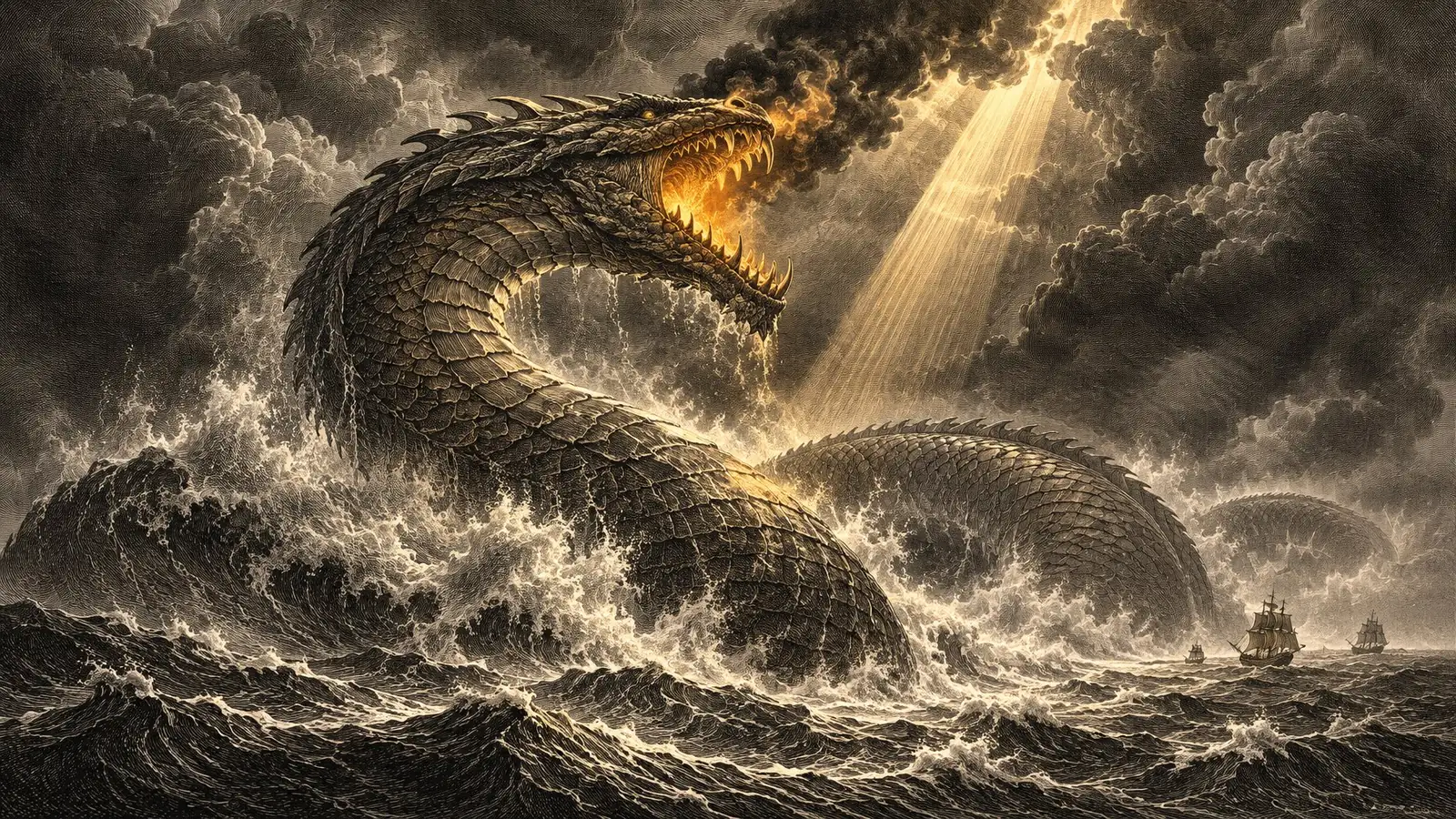
When God finally answers Job out of the whirlwind, he doesn't explain Job's suffering. He talks about the sea, the stars, wild goats and horses. And then, at the very end, he describes two creatures in more detail than anything else in the speech: Behemoth and Leviathan.
Who were they? Real animals, extinct giants, or something stranger? Let's start with what the text actually says, then look at how readers have explained it.
What Is Leviathan?
The Hebrew name liwyatan comes from a root meaning "to twist" or "to coil." Leviathan is named six times in the Old Testament, and every time it's connected with the sea and with God's power over it:
- Job 3:8: Job curses the day of his birth and calls on those "who are ready to raise up" Leviathan. (The King James reads "their mourning," but the Hebrew word is liwyatan, and most modern translations have "rouse Leviathan.")
- Job 41:1: "Canst thou draw out leviathan with an hook?"
- Psalm 74:14: "Thou brakest the heads of leviathan in pieces, and gavest him to be meat to the people inhabiting the wilderness."
- Psalm 104:26: "There go the ships: there is that leviathan, whom thou hast made to play therein."
- Isaiah 27:1 (twice): "In that day the LORD with his sore and great and strong sword shall punish leviathan the piercing serpent, even leviathan that crooked serpent; and he shall slay the dragon that is in the sea."
Notice the plural in Psalm 74. Leviathan has heads.
Leviathan in Job 41
Job 41 is the longest description of any creature in the Bible. Read it slowly:
Its armor. "His scales are his pride, shut up together as with a close seal. One is so near to another, that no air can come between them" (41:15-16).
Its fire. "By his neesings [sneezing] a light doth shine... Out of his mouth go burning lamps, and sparks of fire leap out. Out of his nostrils goeth smoke, as out of a seething pot or caldron. His breath kindleth coals, and a flame goeth out of his mouth" (41:18-21).
Weapons are useless. "The sword of him that layeth at him cannot hold: the spear, the dart, nor the habergeon. He esteemeth iron as straw, and brass as rotten wood... he laugheth at the shaking of a spear" (41:26-29).
It churns the sea. "He maketh the deep to boil like a pot... He maketh a path to shine after him; one would think the deep to be hoary" (41:31-32).
Nothing compares to it. "Upon earth there is not his like, who is made without fear. He beholdeth all high things: he is a king over all the children of pride" (41:33-34).
And in the middle, God makes his point:
"None is so fierce that dare stir him up: who then is able to stand before me?" (Job 41:10)
If no one dares to wake Leviathan, who could stand before the God who made it?
What Is Behemoth?
Behemoth gets one passage, Job 40:15-24, but it's a striking one. The name is the plural of behemah, the ordinary Hebrew word for "beast" or "cattle." Used for one creature, it means something like "the beast of beasts."
"Behold now behemoth, which I made with thee; he eateth grass as an ox. Lo now, his strength is in his loins, and his force is in the navel of his belly. He moveth his tail like a cedar... His bones are as strong pieces of brass; his bones are like bars of iron. He is the chief of the ways of God: he that made him can make his sword to approach unto him." (Job 40:15-19)
It lives among the reeds and willows, and "he drinketh up a river, and hasteth not: he trusteth that he can draw up Jordan into his mouth" (40:23).
Two phrases stand out. Behemoth is "the chief of the ways of God," the first or greatest of God's works. And only "he that made him" can bring a sword against him.
Were They a Hippo and a Crocodile?
Many study Bibles identify Behemoth as a hippopotamus (or an elephant) and Leviathan as a crocodile. The idea is that God points Job to the two most dangerous animals he might know of, along the Nile.
The trouble is the text itself.
- The tail. Behemoth "moveth his tail like a cedar" (40:17). A cedar is one of the largest trees in the Bible. A hippo's tail is short and thin, and an elephant's is a small rope.
- "The chief of the ways of God." That's a strange title for a hippo.
- The fire. No crocodile has "burning lamps" coming out of its mouth or smoke from its nostrils (41:19-21).
- The weapons. Job 41 asks, "Canst thou fill his skin with barbed irons? or his head with fish spears?" (41:7), expecting the answer no. But the Egyptians hunted both hippos and crocodiles with harpoons and spears, and their tomb paintings show it. An ordinary river animal doesn't fit the challenge.
- "Upon earth there is not his like" (41:33). A crocodile has plenty of relatives.
Supporters of the animal view answer that this is poetry. Job's world described real creatures in exaggerated, larger-than-life language, so the fire could be a picture of spray glinting from a crocodile's nostrils in the sun. But that requires reading almost every distinctive detail as exaggeration, and the details are what God chose to emphasise.
Were They Dinosaurs?
Some readers, especially young-earth creationists, see Behemoth as a sauropod, one of the long-necked dinosaurs with tails as thick as tree trunks. "He moveth his tail like a cedar" fits that picture far better than a hippo, and "he drinketh up a river" fits a creature of enormous size.
Leviathan is harder to match to any known fossil, mostly because of the fire. Some suggest a large marine reptile, with the fire as a poetic description of breath or spray. Others take the fire literally and leave the creature unidentified.
The text itself doesn't name a species. What it does make clear is that these were creatures beyond anything Job had seen, made by God and mastered only by him.
The Dragon in the Sea: Leviathan Beyond Job
Outside Job, Leviathan belongs to a larger family of sea monsters in the Old Testament.
The tanninim. On the fifth day of creation, "God created great whales" (Genesis 1:21). The Hebrew word translated "whales" is tanninim, the same word translated "dragons" elsewhere ("Praise the LORD from the earth, ye dragons, and all deeps," Psalm 148:7) and "serpent" when Aaron's rod is transformed (Exodus 7:10). Genesis says plainly that God made these creatures, and that they were "good."
Rahab. Not the woman of Jericho, but a sea monster: "He divideth the sea with his power, and by his understanding he smiteth through the proud... his hand hath formed the crooked serpent" (Job 26:12-13). Isaiah asks the arm of the LORD, "Art thou not it that hath cut Rahab, and wounded the dragon?" (Isaiah 51:9). And "Thou hast broken Rahab in pieces" (Psalm 89:10).
Pharaoh the dragon. Ezekiel calls the king of Egypt "the great dragon that lieth in the midst of his rivers" (Ezekiel 29:3).
The Canaanite connection
In 1929, archaeologists began recovering clay tablets from Ugarit, an ancient city on the Syrian coast. In the Baal Cycle, the storm god Baal is told that he struck down Lotan, "the twisting serpent," the one with seven heads. The name Lotan matches the Hebrew liwyatan, and the phrases match Isaiah 27:1 almost word for word: "leviathan the piercing serpent, even leviathan that crooked serpent."
So Israel's neighbours told stories of a storm god fighting a many-headed sea serpent. The Bible uses the same language, and Psalm 74 even has God breaking Leviathan's heads, but with a difference. In the Bible, Leviathan isn't a rival god. It's a creature: "whom thou hast made to play therein" (Psalm 104:26). God doesn't fight it to become king. He already is.
Leviathan in Revelation
The sea monster appears again at the end of the Bible.
- "Behold a great red dragon, having seven heads and ten horns" (Revelation 12:3), identified as "that old serpent, called the Devil, and Satan" (12:9).
- A beast rises "up out of the sea, having seven heads and ten horns" (Revelation 13:1).
- The dragon is bound (20:2), and in the new creation "there was no more sea" (21:1).
Isaiah 27:1 promised that "in that day" the LORD would slay "the dragon that is in the sea." Revelation shows that day. (We look at the beast from the sea in Is AI the Antichrist? The Beast of Revelation.)
What the Book of Enoch Says
Jewish writings outside the Bible take Leviathan and Behemoth further. The Book of Enoch describes them being separated:
"And on that day were two monsters parted, a female monster named Leviathan, to dwell in the abysses of the ocean over the fountains of the waters. But the male is named Behemoth, who occupied with his breast a waste wilderness named Dûidâin, on the east of the garden where the elect and righteous dwell, where my grandfather was taken up." (1 Enoch 60:7-8, Charles translation)
Two later Jewish books written around the end of the first century, 4 Ezra and 2 Baruch, say the same two creatures were made on the fifth day of creation and set apart, Behemoth on land "where there are a thousand mountains" and Leviathan in the sea, and that they're being kept until the end. 2 Baruch even says what happens then:
"And Behemoth shall be revealed from his place and Leviathan shall ascend from the sea, those two great monsters which I created on the fifth day of creation, and have kept until that time; and then they shall be for food for all that are left." (2 Baruch 29:4, Charles translation)
That idea of a final feast may grow out of Psalm 74:14, where God gives Leviathan "to be meat to the people inhabiting the wilderness." The Talmud (Bava Batra 74b-75a) later describes a banquet of Leviathan for the righteous in the age to come. These books aren't Scripture, but they show how seriously ancient Jewish readers took these creatures.
Four Ways to Read Leviathan and Behemoth
| Reading | Behemoth | Leviathan | Strongest point | Biggest problem |
|---|---|---|---|---|
| Known animals | Hippo or elephant | Crocodile | Job's world knew these animals | Tail like a cedar; fire; "not his like" |
| Extinct creatures | Sauropod dinosaur | Marine reptile | Fits the tail and the size | The fire; no species is named |
| Symbols of chaos | The beast of the land | The sea serpent | Isaiah 27:1 and the Ugarit parallel | Job 40:15 says God "made" Behemoth with Job |
| Real creatures beyond our knowledge | A unique land beast | A unique sea dragon | Takes every detail as written | Can't be checked against anything known |
Many readers combine the last three. Real creatures made by God can also stand for the forces of chaos he alone controls, which is how Isaiah, the Psalms and Revelation use Leviathan.
Why God Showed Them to Job
Job had demanded that God answer him in court. God's reply ends with two creatures no human could tame:
"Who hath prevented me, that I should repay him? whatsoever is under the whole heaven is mine." (Job 41:11)
The lesson isn't that Job should be afraid of monsters. It's that the creatures which terrify everyone else are God's own works. Behemoth is "the chief of the ways of God." Leviathan is "a king over all the children of pride." And both answer to the one who made them.
Job's response is the only fitting one: "I know that thou canst do every thing" (Job 42:2).
If you want to go deeper into the strange world of the early chapters of Genesis, read Who Were the Nephilim? and Who Are the Watchers?
Bible quotations are from the King James Version. 1 Enoch and 2 Baruch are quoted from R. H. Charles's translations.
Categories:
Related Articles
Divination in the Bible: What It Is, Why God Forbids It, and What About Remote Viewing?
What is divination in the Bible? The nine forbidden practices of Deuteronomy 18 in Hebrew, the spirit of divination in Acts 16, and how remote viewing and astral projection compare.
Psalm 2 Meaning: A Verse-by-Verse Guide to the Psalm of God's Son
What does Psalm 2 mean? Read the full KJV text, find out who speaks each stanza, what 'this day have I begotten thee' and 'Kiss the Son' mean, and every New Testament use.
Is the Trinity in the Old Testament? The Passages, Ranked From Strongest to Weakest
Is the Trinity in the Old Testament? Check every passage in your own Bible: two LORDs in one verse, the Angel who is God, Psalm 2's Son, and the arguments that don't hold up.
Why Did Noah Build an Altar After the Flood? Genesis 8:20-22 Explained
Noah saved the animals, then sacrificed some of them. Why? Genesis 8:20-22 explained: the first altar in the Bible, the 'sweet savour', and God's surprising reason for mercy.