Psalm 2 Meaning: A Verse-by-Verse Guide to the Psalm of God's Son
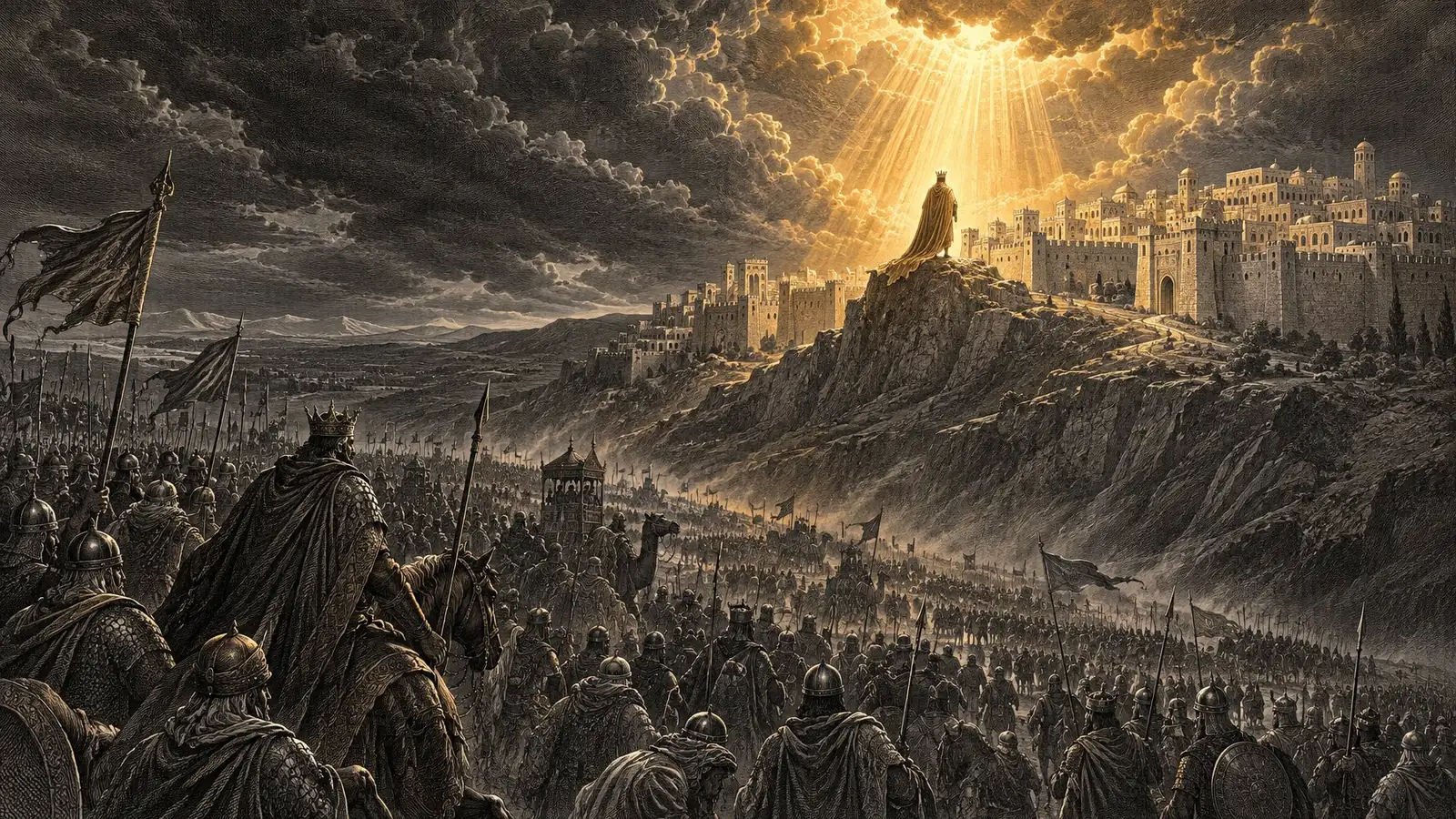
Psalm 2 is only twelve verses long, but the New Testament quotes it more than almost any other psalm. It's where Scripture first puts three words together that run through the rest of the Bible: the LORD, his anointed (in Hebrew, mashiach, Messiah), and his Son.
This guide gives you the full King James text, shows who is speaking in each part, explains the key verses, and collects every place the New Testament uses it. You can check all of it in your own Bible.
Psalm 2 (KJV)
1 Why do the heathen rage, and the people imagine a vain thing?
2 The kings of the earth set themselves, and the rulers take counsel together, against the LORD, and against his anointed, saying,
3 Let us break their bands asunder, and cast away their cords from us.
4 He that sitteth in the heavens shall laugh: the LORD shall have them in derision.
5 Then shall he speak unto them in his wrath, and vex them in his sore displeasure.
6 Yet have I set my king upon my holy hill of Zion.
7 I will declare the decree: the LORD hath said unto me, Thou art my Son; this day have I begotten thee.
8 Ask of me, and I shall give thee the heathen for thine inheritance, and the uttermost parts of the earth for thy possession.
9 Thou shalt break them with a rod of iron; thou shalt dash them in pieces like a potter's vessel.
10 Be wise now therefore, O ye kings: be instructed, ye judges of the earth.
11 Serve the LORD with fear, and rejoice with trembling.
12 Kiss the Son, lest he be angry, and ye perish from the way, when his wrath is kindled but a little. Blessed are all they that put their trust in him.
Who Is Speaking? The Four Voices of Psalm 2
Psalm 2 reads like a short drama. Four voices speak in four stanzas of three verses each. Try to name them before you read on:
Try it yourself
Psalm 2 has four voices. Who is speaking?
Psalm 2 reads like a scene in a play. Four different voices speak in its four stanzas. Read each one, pick who you think is speaking, then check the clues in the text.
1.Psalm 2:3
3Let us break their bands asunder, and cast away their cords from us.
Show the answer
Speaker: The rebel nations
- Verse 2 ends with "saying," and verse 3 is what they say: the kings and rulers who "take counsel together, against the LORD, and against his anointed."
- "Their bands" is plural. The rebels want to throw off the rule of both the LORD and his anointed together.
Worth knowing: Verses 1-2 are the psalmist asking "Why?" and describing the plot. Verse 3 is the first quotation in the psalm.
2.Psalm 2:6
6Yet have I set my king upon my holy hill of Zion.
Show the answer
Speaker: The LORD
- Verses 4-5 describe "He that sitteth in the heavens," who "shall laugh" and "speak unto them in his wrath." Verse 6 is what he says.
- "My king" and "my holy hill" can only be spoken by God, who installs the king.
3.Psalm 2:7-9
7I will declare the decree: the LORD hath said unto me, Thou art my Son; this day have I begotten thee.
8Ask of me, and I shall give thee the heathen for thine inheritance, and the uttermost parts of the earth for thy possession.
9Thou shalt break them with a rod of iron; thou shalt dash them in pieces like a potter’s vessel.
Show the answer
Speaker: The anointed King
- "The LORD hath said unto me" shows the speaker is not the LORD himself. It is the king the LORD has just installed, announcing what God told him.
- Inside his words he quotes God: "Thou art my Son... Ask of me." So this stanza holds two voices, the King speaking and the LORD quoted.
Worth knowing: This is the only place in the psalm where the King speaks. The New Testament quotes his words more than any other part of Psalm 2.
4.Psalm 2:10-12
10Be wise now therefore, O ye kings: be instructed, ye judges of the earth.
11Serve the LORD with fear, and rejoice with trembling.
12Kiss the Son, lest he be angry, and ye perish from the way, when his wrath is kindled but a little. Blessed are all they that put their trust in him.
Show the answer
Speaker: The psalmist
- The speaker talks about the LORD and the Son in the third person ("Serve the LORD... Kiss the Son"), so it is neither of them.
- He addresses the same kings who were plotting in verses 1-3, turning the psalm’s opening "Why?" into a warning.
Worth knowing: The psalm ends where Psalm 1 begins, with "Blessed." Some ancient Jewish readers counted Psalms 1 and 2 as one psalm.
Psalm 2 Meaning, Verse by Verse
Verses 1-3: the nations rebel
"Why do the heathen rage, and the people imagine a vain thing?"
The word translated "imagine" is the Hebrew hagah, the same verb Psalm 1 uses for the blessed man who meditates on God's law "day and night" (Psalm 1:2). The two psalms are a pair. In Psalm 1 one man meditates on God's word; in Psalm 2 the nations meditate on rebellion.
Their target has two parts: "against the LORD, and against his anointed." The rebels don't separate them. To reject God's king is to reject God. And their goal is freedom: "Let us break their bands asunder." Rebellion against God always sounds like liberation to the rebels.
Verses 4-6: God laughs
"He that sitteth in the heavens shall laugh." The scene moves from the noisy earth to the throne room of heaven, and God isn't threatened. He isn't even sitting up. The combined armies of the world are, to him, a "vain thing," a plan that comes to nothing.
Then he speaks one line, and it settles everything: "Yet have I set my king upon my holy hill of Zion." The plot is already over. The king is already installed.
Verses 7-9: the King announces God's decree
Now the King himself speaks, reading out the decree God gave him:
"I will declare the decree: the LORD hath said unto me, Thou art my Son; this day have I begotten thee." (Psalm 2:7)
"Thou art my Son." This echoes God's promise to David about his heir: "I will be his father, and he shall be my son" (2 Samuel 7:14). Psalm 89 says the same of David's line: "I will make him my firstborn, higher than the kings of the earth" (Psalm 89:27).
"This day have I begotten thee." In its first setting, "this day" is coronation day. When God installed the king on Zion, he declared him his son. "Begotten" describes a new status, not a birth.
The New Testament takes that further. Paul says God fulfilled this verse "in that he hath raised up Jesus again; as it is also written in the second psalm, Thou art my Son, this day have I begotten thee" (Acts 13:33). Jesus was "declared to be the Son of God with power... by the resurrection from the dead" (Romans 1:4). The resurrection was his coronation day.
"Ask of me, and I shall give thee the heathen for thine inheritance, and the uttermost parts of the earth for thy possession" (2:8). No king of Israel ever ruled "the uttermost parts of the earth." David's kingdom was a small country. The promise is bigger than any king who first sang this psalm. The Talmud applies these very verses to the Messiah, son of David (Sukkah 52a), and the risen Jesus says, "All power is given unto me in heaven and in earth" (Matthew 28:18).
"Thou shalt break them with a rod of iron; thou shalt dash them in pieces like a potter's vessel" (2:9). A shepherd-king's rod that cannot be broken, against nations as fragile as clay pots. Revelation quotes this line three times (2:27; 12:5; 19:15).
Verses 10-12: the warning to the kings
The psalm ends not with destruction but with an invitation. The psalmist turns to the same kings who were plotting: "Be wise now therefore, O ye kings."
"Serve the LORD with fear, and rejoice with trembling. Kiss the Son, lest he be angry." The way of escape is submission to the King, and the psalm ends with a blessing: "Blessed are all they that put their trust in him." The Hebrew word for "trust" here means to take refuge, to shelter in someone.
Psalm 1 begins "Blessed is the man" (1:1); Psalm 2 ends "Blessed are all they" (2:12). Together they frame the whole Psalter: blessing for those who meditate on God's word, and for those who take refuge in his Son.
"Kiss the Son": What Psalm 2:12 Means
To "kiss" a king was an act of homage. When Samuel anointed Saul, he "poured it upon his head, and kissed him" (1 Samuel 10:1). Idolaters "kissed" Baal (1 Kings 19:18). To kiss the Son means to submit to him as your king.
But this verse has a well-known translation question. In verse 7, "my Son" is the ordinary Hebrew word ben. In verse 12, "Son" is bar, the Aramaic word for son. Bar also exists in Hebrew with a different meaning: "pure" or "clean," as in "a pure heart" (Psalm 24:4).
That gives two readings:
- "Kiss the Son." Supporters point out that Hebrew poetry sometimes uses bar for son: Proverbs 31:2 does it three times ("the son of my womb... the son of my vows"). The sonship theme runs through the whole psalm, and bar may have been chosen because the warning is addressed to foreign kings.
- "Do homage purely" or "worship in purity." Supporters point out that verse 7 already uses ben, so a switch to Aramaic is odd, and bar as "pure" is good Hebrew.
How translations render Psalm 2:12
| Translation | Psalm 2:12 opens |
|---|---|
| Septuagint (Greek, before Christ) | "Accept correction" / "Lay hold of instruction" |
| Jerome's Psalter from the Hebrew (c. AD 400) | "Worship purely" (adorate pure) |
| King James Version (1611) | "Kiss the Son" |
| Darby | "Kiss the Son" |
| JPS Tanakh (1917) | "Do homage in purity" |
| Young's Literal | "Kiss the chosen one" |
| RSV and NRSV | "kiss his feet" (rearranging verses 11-12) |
| NASB 1995 | "Do homage to the Son" |
| NKJV and ESV | "Kiss the Son" |
| NIV | "Kiss his son" |
| CSB | "Pay homage to the Son" |
| NET | "Give sincere homage!" |
| NLT | "Submit to God's royal son" |
Notice that even the translations that don't say "Son" still say "homage." Every reading agrees on the main point: the kings of the earth must submit to God and his King.
Psalm 2 in the New Testament
Here is every New Testament quotation of Psalm 2 and its clearest echoes.
| Psalm 2 | New Testament | Type | How it's used |
|---|---|---|---|
| 2:1-2 | Acts 4:25-27 | Quotation | Herod, Pilate, the Gentiles and Israel "gathered together" against Jesus, God's anointed |
| 2:1 | Revelation 11:18 | Echo | "The nations were angry" as God's kingdom comes |
| 2:2 | Revelation 11:15 | Echo | "The kingdoms of this world are become the kingdoms of our Lord, and of his Christ" |
| 2:7 | Matthew 3:17; Mark 1:11; Luke 3:22 | Echo | The voice at Jesus' baptism: "Thou art my beloved Son" |
| 2:7 | Matthew 17:5 | Echo | The voice at the transfiguration |
| 2:7 | Acts 13:33 | Quotation | Fulfilled in the resurrection |
| 2:7 | Romans 1:4 | Echo | "Declared to be the Son of God with power... by the resurrection" |
| 2:7 | Hebrews 1:5 | Quotation | No angel was ever called God's Son this way |
| 2:7 | Hebrews 5:5 | Quotation | The one called Son is also appointed high priest |
| 2:8 | Hebrews 1:2 | Echo | The Son is "appointed heir of all things" |
| 2:8 | Matthew 28:18 | Echo | "All power is given unto me in heaven and in earth" |
| 2:8-9 | Revelation 2:26-27 | Quotation | Christ shares his rule with those who overcome |
| 2:9 | Revelation 12:5 | Quotation | The male child who will "rule all nations with a rod of iron" |
| 2:9 | Revelation 19:15 | Quotation | The rider on the white horse |
You can download this table as a CSV file for your own study.
Key Hebrew Words in Psalm 2
| Verse | English (KJV) | Hebrew | Meaning |
|---|---|---|---|
| 1 | imagine | hagah | to meditate, mutter, plot; the same verb as Psalm 1:2 |
| 2 | anointed | mashiach | anointed one; the source of the word "Messiah" |
| 6 | holy hill | har qodshi | "my holy mountain," Zion |
| 7 | decree | choq | a fixed, binding statute |
| 7 | Son | ben | the ordinary Hebrew word for son |
| 7 | begotten | yalad | to beget or bring forth; here, to declare as son |
| 12 | kiss | nashaq | to kiss, as an act of homage |
| 12 | Son | bar | Aramaic "son," or Hebrew "pure" |
| 12 | trust | chasah | to take refuge, shelter in |
Who Is the Son of Psalm 2?
The king of Israel. Psalm 2 was first sung for the kings in David's line. The language of sonship comes straight from God's promise to David in 2 Samuel 7:14, and many readers take it as a coronation psalm.
The Messiah. But the psalm promises more than any of those kings received: "the uttermost parts of the earth for thy possession." Ancient Jewish readers saw the Messiah here. Among the Dead Sea Scrolls, a commentary from Qumran (4Q174) reads Psalm 2 alongside 2 Samuel 7 and speaks of the coming son of David as God's son. And the Talmud has God say to "the Messiah, the son of David," "Ask of me, and I will give the nations for thine inheritance" (Sukkah 52a). (For more on what the scrolls reveal, see Has the Bible Been Changed?)
Jesus. The apostles were certain: the plot of verses 1-2 was the crucifixion (Acts 4:27), and verse 7 was fulfilled at the resurrection (Acts 13:33). Notice too where the psalm ends. "Blessed are all they that put their trust in him," while elsewhere Scripture warns, "Cursed be the man that trusteth in man" (Jeremiah 17:5) and "Put not your trust in princes" (Psalm 146:3). The Son of Psalm 2 is one in whom it is right to take refuge. That fits a king who is more than a man, and it's one of the passages we look at in Is the Trinity in the Old Testament?
What Psalm 2 Means Today
Psalm 2 was written for a world where kings plotted, nations raged and God's people were small. That world hasn't changed. The psalm's answer hasn't either.
God isn't anxious about the noise of the nations. His King is already on the throne. And the invitation still stands, for rulers and for everyone else: stop resisting him, honour the Son, and take refuge in him. "Blessed are all they that put their trust in him."
Bible quotations are from the King James Version.
Categories:
Related Articles
Divination in the Bible: What It Is, Why God Forbids It, and What About Remote Viewing?
What is divination in the Bible? The nine forbidden practices of Deuteronomy 18 in Hebrew, the spirit of divination in Acts 16, and how remote viewing and astral projection compare.

Leviathan and Behemoth in the Bible: The Two Great Beasts God Showed Job
What is Leviathan? What is Behemoth? Read God's own description in Job 40-41, the fire-breathing sea serpent of Isaiah and the Psalms, and what Enoch says about both.
Is the Trinity in the Old Testament? The Passages, Ranked From Strongest to Weakest
Is the Trinity in the Old Testament? Check every passage in your own Bible: two LORDs in one verse, the Angel who is God, Psalm 2's Son, and the arguments that don't hold up.
Why Did Noah Build an Altar After the Flood? Genesis 8:20-22 Explained
Noah saved the animals, then sacrificed some of them. Why? Genesis 8:20-22 explained: the first altar in the Bible, the 'sweet savour', and God's surprising reason for mercy.