
Why Did Noah Build an Altar After the Flood? Genesis 8:20-22 Explained
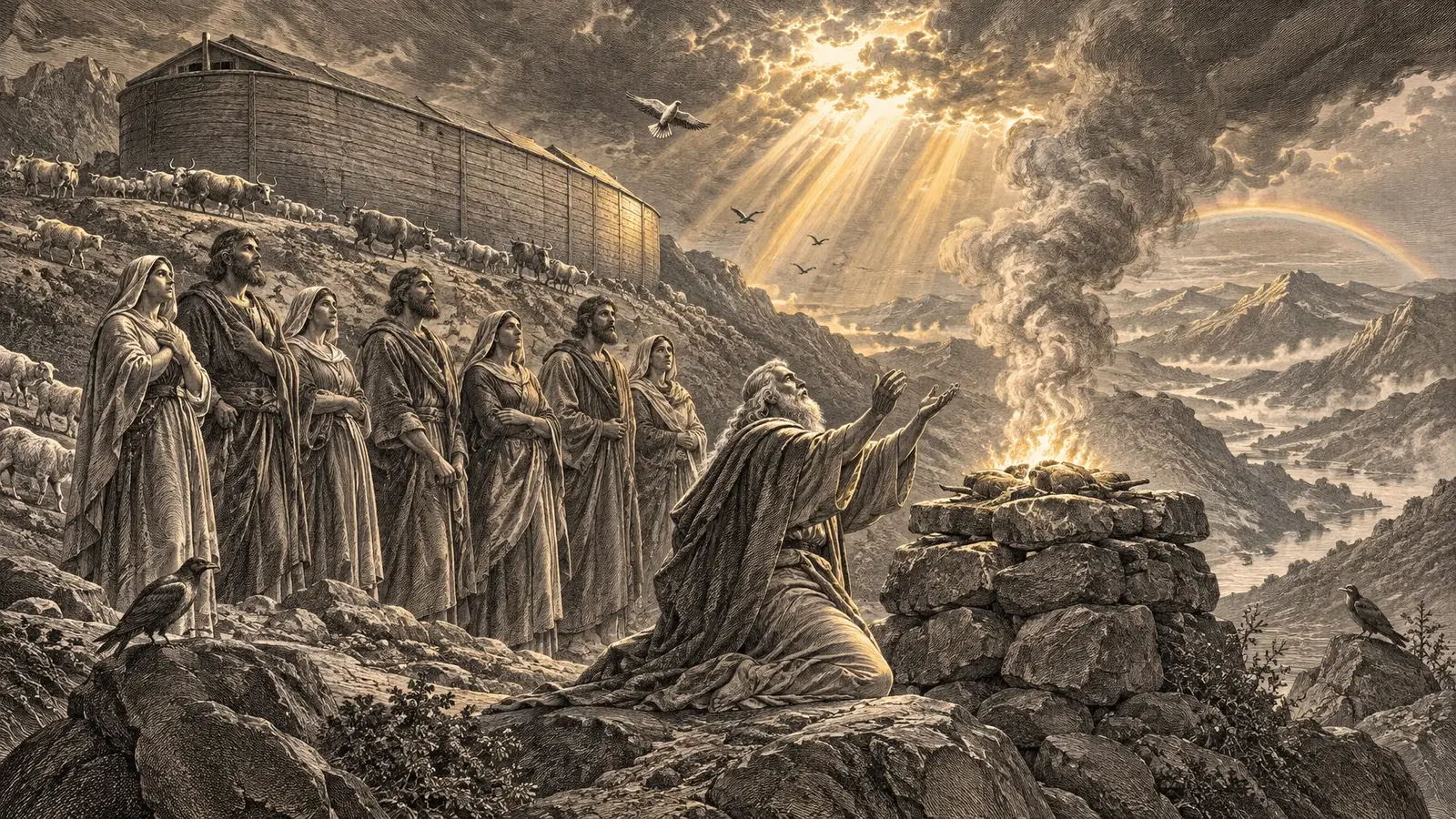
When Noah finally stepped out of the ark, after more than a year on the water, the first thing he did wasn't build a house, plant a field or look for food. Noah built an altar to the LORD and burned some of the clean animals and clean birds he had just spent a year keeping alive.
"And Noah builded an altar unto the LORD; and took of every clean beast, and of every clean fowl, and offered burnt offerings on the altar." (Genesis 8:20)
That verse is easy to read past, but it contains three firsts. It is the first time the word altar appears in the Bible, the first burnt offering, and, in the next verse, the first time God is said to smell a "sweet savour." Everything Israel later did at the tabernacle and temple traces back to this moment on a mountainside after the flood.
So why did Noah do it? And what happened next is even more surprising.
Genesis 8:20-22 in Full
"And Noah builded an altar unto the LORD; and took of every clean beast, and of every clean fowl, and offered burnt offerings on the altar. And the LORD smelled a sweet savour; and the LORD said in his heart, I will not again curse the ground any more for man's sake; for the imagination of man's heart is evil from his youth; neither will I again smite any more every thing living, as I have done. While the earth remaineth, seedtime and harvest, and cold and heat, and summer and winter, and day and night shall not cease." (Genesis 8:20-22)
Notice that God's promise is spoken "in his heart." Noah offers, God responds, and the covenant of Genesis 9 follows.
"Noah Saved the Animals. Why Kill Some?"
It's the first question many readers ask. If two of every kind went into the ark, wouldn't sacrificing one wipe out that species?
The answer is in Genesis 7. The famous "two by two" (Genesis 6:19-20) was the general rule, but God gave Noah a second instruction:
"Of every clean beast thou shalt take to thee by sevens, the male and his female: and of beasts that are not clean by two, the male and his female." (Genesis 7:2)
Noah brought extra clean animals, and Genesis 8:20 says he offered only clean animals and clean birds. The surplus was there for exactly this moment.
Seven, or seven pairs?
The Hebrew literally reads "seven seven, a man and his woman." Translations split:
- Seven of each clean kind: KJV, NKJV and others. Hebrew often repeats a number to mean "of each," as when a giant has "six six" fingers, six on each hand (2 Samuel 21:20). On this reading Noah had three pairs plus one extra animal, possibly the one he offered.
- Seven pairs: ESV, NRSV, the Jewish Publication Society. The phrase "the male and his female" right after the number suggests pairs.
Either way, Noah wasn't risking extinction.
Clean and unclean before Moses
Genesis 7:2 also shows something else: the difference between clean and unclean animals existed long before the Law of Moses laid it out in Leviticus 11. Noah already knew which animals were fit to offer. Worship had rules before Sinai.
Why Did Noah Build an Altar?
Genesis never tells us what Noah was thinking. But the story itself points to several reasons, and they fit together.
1. Thanksgiving for being saved
Noah and his family were the only survivors of a world that had been "filled with violence" (Genesis 6:11, 13). The first response to deliverance is worship. Abel had brought an offering (Genesis 4:4), but Noah is the first person said to build an altar, and he does it before anything else.
2. Giving the new world to God
The flood account is written as a new creation. The waters cover the earth as in Genesis 1:2; "God made a wind to pass over the earth" (Genesis 8:1), as his Spirit moved over the waters; dry land appears; and God repeats Adam's blessing, "Be fruitful, and multiply, and replenish the earth" (Genesis 9:1). Noah is a new Adam, and his first act in the new world is to offer it back to the one who made it.
3. Rest for a cursed ground
Noah's father had given him his name with a hope:
"And he called his name Noah, saying, This same shall comfort us concerning our work and toil of our hands, because of the ground which the LORD hath cursed." (Genesis 5:29)
Look at what God says after the sacrifice: "I will not again curse the ground any more for man's sake" (8:21). The ground Lamech grieved over is exactly what God promises not to curse again. The answer to Lamech's prayer arrives through Noah's altar.
4. Atonement for a defiled earth
The Book of Jubilees, a Jewish retelling of Genesis from the second century BC, reads the sacrifice as atonement:
"And he made atonement for the earth, and took a kid and made atonement by its blood for all the guilt of the earth; for everything that had been on it had been destroyed, save those that were in the ark with Noah." (Jubilees 6:2, Charles translation)
Jubilees isn't Scripture, but it shows how Jews before Christ understood the scene. In their reading, the flood had swept away the violence of the Watchers and their children, the Nephilim, and Noah's offering cleansed the land for a fresh start. (For that background, see Who Are the Watchers?)
The "Sweet Savour": A Play on Noah's Name
"And the LORD smelled a sweet savour." The Hebrew is reach hannichoach, literally "a smell of rest" or "a soothing smell."
Nichoach comes from the root nuach, "to rest," the same root as Noah's name (Noach). The chapter is full of it: the ark "rested" on the mountains of Ararat (8:4), the dove found "no rest for the sole of her foot" (8:9), and now the offering is a "restful" smell. Noah, whose name means rest, brings rest to God's anger through his offering.
The phrase becomes standard language for the sacrifices of Israel, "a burnt sacrifice, an offering made by fire, of a sweet savour unto the LORD" (Leviticus 1:9), and Paul uses it of Jesus:
"And walk in love, as Christ also hath loved us, and hath given himself for us an offering and a sacrifice to God for a sweetsmelling savour." (Ephesians 5:2)
The Twist in Genesis 8:21
Read God's reason for his promise slowly:
"I will not again curse the ground any more for man's sake; for the imagination of man's heart is evil from his youth." (Genesis 8:21)
Now compare the reason he gave for the flood:
"And God saw that the wickedness of man was great in the earth, and that every imagination of the thoughts of his heart was only evil continually." (Genesis 6:5)
It's almost the same diagnosis. Humanity hasn't changed. The flood didn't fix the human heart. What changed is God's response: the same corruption that once brought judgement now becomes the reason for patience. God isn't saying people are better than he thought. He is saying they won't get better on their own, so he will bear with them.
That is grace, given in response to a sacrifice, and the rest of the Bible builds on that pattern.
How Genesis Differs From the Babylonian Flood Stories
Noah's altar has a parallel in older Mesopotamian flood stories, and the differences are striking.
In the Epic of Gilgamesh (Tablet XI), the flood hero Utnapishtim also makes an offering when he leaves his boat. The gods smell it and gather around it "like flies." In the older Atrahasis epic, the reason is spelled out: with humans gone, no one had been feeding the gods, and they had gone hungry and thirsty through the flood.
Genesis tells the story very differently:
| Babylonian accounts | Genesis 8 | |
|---|---|---|
| Why the flood came | Human noise disturbed the gods' sleep (Atrahasis) | "The earth was filled with violence" (6:11) |
| The gods during the flood | Frightened, hungry and thirsty | God "remembered Noah, and every living thing" (8:1) |
| Response to the offering | The gods swarm "like flies" | "The LORD said in his heart" (8:21) |
| What follows | Quarrels between the gods | A covenant with "every living creature" (9:10) |
The God of Genesis doesn't need Noah's food. He isn't hungry and he isn't afraid. He accepts the offering and responds with a promise made freely, from his own heart.
The Covenant That Follows
Noah's altar leads straight into the first covenant in the Bible (Genesis 9:1-17):
- Blessing renewed: "Be fruitful, and multiply, and replenish the earth" (9:1).
- Meat permitted, blood forbidden: "Every moving thing that liveth shall be meat for you... But flesh with the life thereof, which is the blood thereof, shall ye not eat" (9:3-4).
- A promise to all life: God makes the covenant "with every living creature that is with you, of the fowl, of the cattle, and of every beast of the earth" (9:10).
- A sign in the sky: "I do set my bow in the cloud, and it shall be for a token of a covenant between me and the earth" (9:13).
Jubilees connects this covenant with Noah's sacrifice and with the Feast of Weeks (Shavuot), which it says Noah's family kept every year after the flood.
Noah as the First Priest
There was no priesthood yet, no Aaron and no tabernacle, but Noah does what priests would later do: he builds an altar, chooses clean animals and offers them whole to God. He stands between God and the new world as its first worshipper.
He also starts a pattern the rest of Genesis follows:
- Noah builds the first altar after the flood (Genesis 8:20).
- Abram builds an altar when God promises him the land: "there builded he an altar unto the LORD, who appeared unto him" (Genesis 12:7).
- Abraham is told to offer Isaac "for a burnt offering upon one of the mountains which I will tell thee of" (Genesis 22:2), and God provides a ram in his place.
Each new beginning in Genesis starts at an altar. The New Testament remembers Noah for the same faith: "By faith Noah... prepared an ark to the saving of his house... and became heir of the righteousness which is by faith" (Hebrews 11:7), and calls him "a preacher of righteousness" (2 Peter 2:5).
Where Did Noah Build the Altar?
Genesis doesn't say. It tells us only that "the ark rested... upon the mountains of Ararat" (8:4), a region rather than a single peak, and later that Noah came out of the ark. Jubilees fills the gap, saying Noah "went forth from the ark, and built an altar on that mountain" (Jubilees 6:1). Many readers assume the same, but Genesis itself leaves the place unnamed.
What Noah's Altar Means Today
Noah's first act teaches something simple. When God brings you through something, start with worship. Noah didn't wait until the world was rebuilt. He gave thanks with the world still empty and the mud still wet.
It also shows the shape of grace. God didn't promise patience because people had improved; Genesis 8:21 says plainly that they hadn't. He promised it in response to a sacrifice, and Christians see in that "sweet savour" a picture of the sacrifice of Christ, the offering that finally deals with the human heart itself.
If you want to go further into the world before the flood, read Why Did Human Lifespans Decline After the Flood?, The Number 7 in the Bible and The Book of Enoch.
Bible quotations are from the King James Version. Jubilees is quoted from R. H. Charles's translation (1913).
Categories:
Related Articles
Divination in the Bible: What It Is, Why God Forbids It, and What About Remote Viewing?
What is divination in the Bible? The nine forbidden practices of Deuteronomy 18 in Hebrew, the spirit of divination in Acts 16, and how remote viewing and astral projection compare.
Psalm 2 Meaning: A Verse-by-Verse Guide to the Psalm of God's Son
What does Psalm 2 mean? Read the full KJV text, find out who speaks each stanza, what 'this day have I begotten thee' and 'Kiss the Son' mean, and every New Testament use.
Leviathan and Behemoth in the Bible: The Two Great Beasts God Showed Job
What is Leviathan? What is Behemoth? Read God's own description in Job 40-41, the fire-breathing sea serpent of Isaiah and the Psalms, and what Enoch says about both.
Is the Trinity in the Old Testament? The Passages, Ranked From Strongest to Weakest
Is the Trinity in the Old Testament? Check every passage in your own Bible: two LORDs in one verse, the Angel who is God, Psalm 2's Son, and the arguments that don't hold up.