
Divination in the Bible: What It Is, Why God Forbids It, and What About Remote Viewing?
Between 1972 and 1995 the United States government spent millions of dollars testing whether trained people could see distant places with their minds. The program ended with a report saying it had never produced intelligence anyone could use.
The Bible had already addressed the question three thousand years earlier. It describes people who knew things they had no natural way of knowing, and it draws a sharp line between two ways that can happen. One it calls prophecy. The other it calls divination.
Divination in the Bible is the attempt to gain hidden knowledge, usually about the future, through means God has not given: reading omens, consulting spirits or the dead, casting arrows, reading animal livers, or watching the stars. Deuteronomy 18:10-12 lists it among practices that are "an abomination unto the LORD." The Bible's line is not between true and false information. It's between knowledge God gives and knowledge people reach for through other powers.
What Is Divination in the Bible?
The main Hebrew word is qesem (Strong's H7081), with its verb qasam (H7080). Deuteronomy 18:10 uses both together: qosem qesamim, "one who divines divinations." The King James renders it "useth divination."
The same word describes Balaam, the hired seer of Moab: "Balaam also the son of Beor, the soothsayer" (Joshua 13:22). It describes the king of Babylon working out which city to attack (Ezekiel 21:21). And it describes Israel's false prophets: "They have seen vanity and lying divination, saying, The LORD saith: and the LORD hath not sent them" (Ezekiel 13:6).
What ties these together is the direction of travel. Divination starts with a person who wants to know something and uses a method to find it out: a cup, an arrow, a liver, a spirit, a star chart. That direction is exactly what the Bible reverses.
The Nine Forbidden Practices of Deuteronomy 18
The fullest list in Scripture comes as Israel is about to enter Canaan:
"When thou art come into the land which the LORD thy God giveth thee, thou shalt not learn to do after the abominations of those nations. There shall not be found among you any one that maketh his son or his daughter to pass through the fire, or that useth divination, or an observer of times, or an enchanter, or a witch. Or a charmer, or a consulter with familiar spirits, or a wizard, or a necromancer. For all that do these things are an abomination unto the LORD." (Deuteronomy 18:9-12)
The KJV's English terms are old and sometimes vague. The Hebrew is more specific. Here are all nine, with what each word means:
| KJV term | Hebrew | Strong's | Literal sense | Also found in |
|---|---|---|---|---|
| maketh his son or his daughter to pass through the fire | ma'avir beno ubitto ba'esh | H5674 | "causes to cross over in the fire" | 2 Kings 21:6, the rites of Molech in the Valley of Hinnom |
| useth divination | qosem qesamim | H7080, H7081 | "divines divinations" | Joshua 13:22 (Balaam); Ezekiel 21:21 |
| an observer of times | me'onen | H6049 | Uncertain; possibly linked to anan, "cloud." Modern versions: "soothsayer," "interprets omens" | Isaiah 2:6; Micah 5:12 ("soothsayers") |
| an enchanter | menachesh | H5172 | "one who reads omens" | Genesis 44:5, Joseph's cup ("divineth") |
| a witch | mekhashshef | H3784 | "sorcerer," one who works spells | Exodus 7:11 (Pharaoh's sorcerers); Exodus 22:18 |
| a charmer | chover chaver | H2266, H2267 | "one who binds bindings," a spell-binder | Psalm 58:5; Isaiah 47:9 |
| a consulter with familiar spirits | sho'el ov | H7592, H178 | "one who asks an ov," a ghost or spirit of the dead | 1 Samuel 28:7, the woman at Endor |
| a wizard | yidde'oni | H3049 | "knowing one," from yada, "to know" | Leviticus 19:31; Isaiah 8:19 |
| a necromancer | doresh el-hammetim | H1875, H4191 | "one who seeks to the dead" | Isaiah 8:19, "for the living to the dead" |
Three things stand out.
The list opens with child sacrifice. Passing children "through the fire" heads a list of fortune-telling practices because, in Canaan, they belonged together. When King Manasseh revived them, he did them all at once: "he caused his children to pass through the fire in the valley of the son of Hinnom: also he observed times, and used enchantments, and used witchcraft, and dealt with a familiar spirit, and with wizards" (2 Chronicles 33:6).
The "wizard" is a "knowing one." Yidde'oni comes from the ordinary Hebrew verb "to know." The practice is defined by what it seeks: knowledge.
The ov may be a pit or a vessel. The same word appears in Job 32:19 for wineskins ("like new bottles"). Many scholars connect it with a ritual pit from which the dead were called up. When the Greek Septuagint translated 1 Samuel 28, it called the woman at Endor an engastrimythos, a "belly-talker," as if the voice came from inside her.
Divination in the Bible: Six Examples
The Bible doesn't only forbid divination. It shows it at work, often with surprising results.
1. Pharaoh's magicians (Exodus 7-8)
When Aaron's rod became a serpent, "the magicians of Egypt, they also did in like manner with their enchantments" (Exodus 7:11). They copied the first two plagues. On the third they failed and told Pharaoh, "This is the finger of God" (Exodus 8:19). The text doesn't treat their power as fake. It treats it as limited.
2. Balaam the soothsayer (Numbers 22-24)
The elders of Moab came to Balaam "with the rewards of divination in their hand" (Numbers 22:7). God overruled him, and he blessed Israel three times instead of cursing it. Even Balaam admitted, "Surely there is no enchantment against Jacob, neither is there any divination against Israel" (Numbers 23:23). Notice what changed: "he went not, as at other times, to seek for enchantments" (Numbers 24:1). Seeking enchantments had been his normal practice.
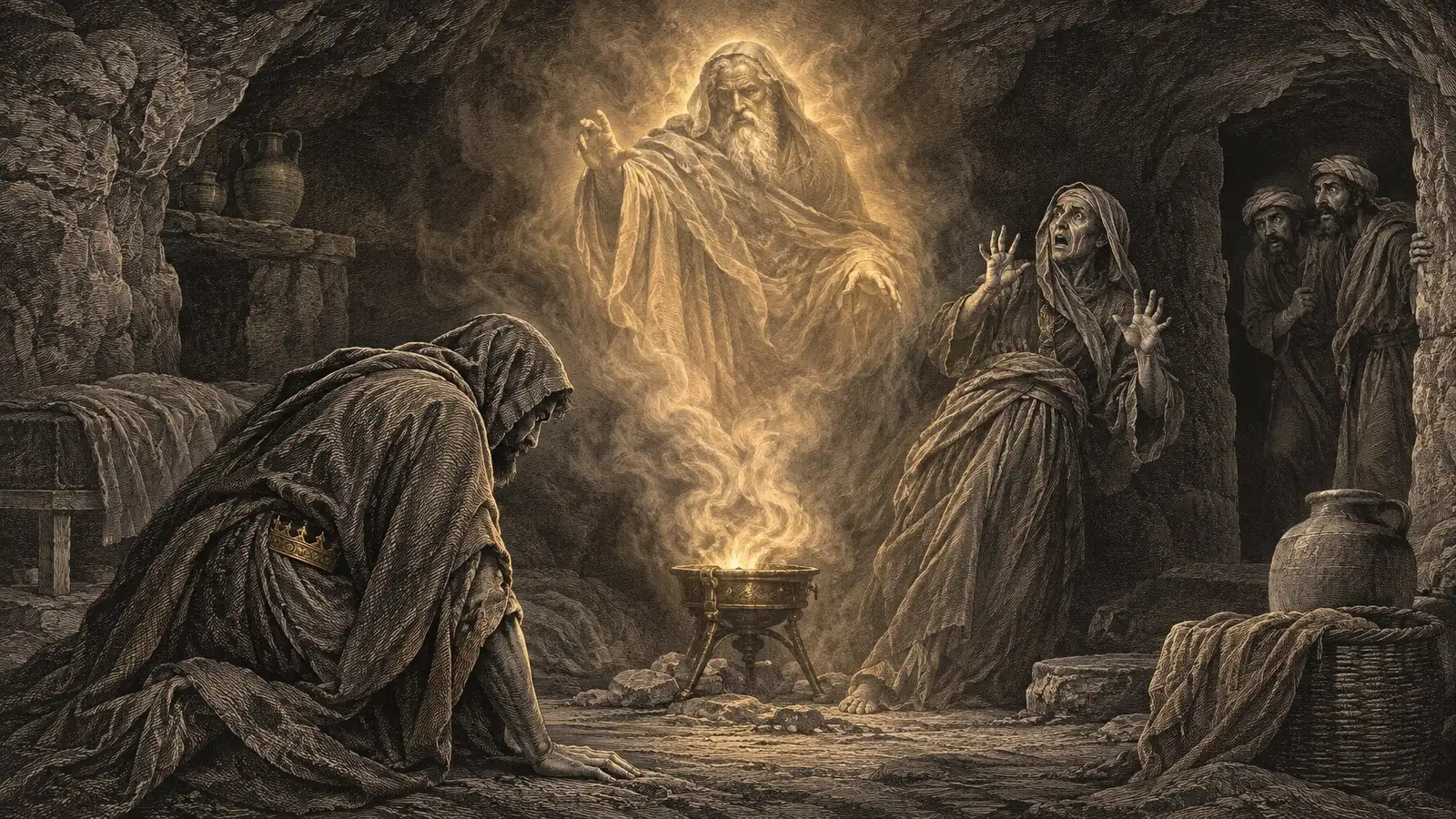
3. Saul and the woman at Endor (1 Samuel 28)
This is the Bible's most famous scene of divination. God had stopped answering Saul, "neither by dreams, nor by Urim, nor by prophets" (1 Samuel 28:6). So the king who had expelled the mediums went to one in disguise:
"Seek me a woman that hath a familiar spirit, that I may go to her, and enquire of her." (1 Samuel 28:7)
Samuel appeared, and his message came true the next day. Saul and his sons died in battle. Yet the Chronicler's verdict is plain: "So Saul died for his transgression... and also for asking counsel of one that had a familiar spirit, to enquire of it; And enquired not of the LORD" (1 Chronicles 10:13-14). The information was accurate. Asking for it was still a sin.
4. The king of Babylon at the fork in the road (Ezekiel 21)
"For the king of Babylon stood at the parting of the way, at the head of the two ways, to use divination: he made his arrows bright, he consulted with images, he looked in the liver." (Ezekiel 21:21)
Three methods in one verse: shaking marked arrows, consulting household idols, and reading the liver of a sacrificed animal. Clay models of sheep livers marked out for this kind of reading have been found in Mesopotamia. The lot fell on Jerusalem, but God had already told Ezekiel to mark out that very road (21:19-20). God used a pagan king's divination without endorsing it.
5. Simon the sorcerer (Acts 8)
Simon of Samaria "used sorcery, and bewitched the people of Samaria, giving out that himself was some great one" (Acts 8:9). The people called him "the great power of God." When he later tried to buy the apostles' power with money, Peter rebuked him sharply (Acts 8:18-23).
6. The burned books of Ephesus (Acts 19)
When the gospel reached Ephesus, "many of them also which used curious arts brought their books together, and burned them before all men: and they counted the price of them, and found it fifty thousand pieces of silver" (Acts 19:19). New believers didn't keep their old methods alongside their new faith. They gave them up, at great cost.
The Spirit of Divination in Acts 16
The clearest New Testament case is in Philippi:
"And it came to pass, as we went to prayer, a certain damsel possessed with a spirit of divination met us, which brought her masters much gain by soothsaying: The same followed Paul and us, and cried, saying, These men are the servants of the most high God, which shew unto us the way of salvation. And this did she many days. But Paul, being grieved, turned and said to the spirit, I command thee in the name of Jesus Christ to come out of her. And he came out the same hour." (Acts 16:16-18)
The Greek for "a spirit of divination" is pneuma pythōna (Strong's G4436), literally "a spirit of python." Python was the serpent of Greek myth linked with Apollo's oracle at Delphi, where a priestess called the Pythia gave prophecies. In Paul's day "python" was also used for fortune-tellers who seemed to speak from their bellies, the same idea the Septuagint used for the woman at Endor.
The surprising thing is what she said. It was all true. Paul and Silas were servants of the most high God, and they were showing the way of salvation. A demon was advertising the gospel.
Paul cast it out anyway. Accurate information did not make the source acceptable. Moses had warned of exactly this:
"If there arise among you a prophet, or a dreamer of dreams, and giveth thee a sign or a wonder, And the sign or the wonder come to pass, whereof he spake unto thee, saying, Let us go after other gods... Thou shalt not hearken unto the words of that prophet." (Deuteronomy 13:1-3)
The sign can come to pass and still not be from God. That principle matters a great deal when we get to remote viewing.
Divination vs Prophecy: What's the Difference?
Deuteronomy 18 doesn't just ban divination. In the very next verse it offers God's alternative:
"For these nations, which thou shalt possess, hearkened unto observers of times, and unto diviners: but as for thee, the LORD thy God hath not suffered thee so to do. The LORD thy God will raise up unto thee a Prophet from the midst of thee, of thy brethren, like unto me; unto him ye shall hearken." (Deuteronomy 18:14-15)
The nations had diviners. Israel would have prophets. The difference runs through the whole Bible:
| Divination | Prophecy | |
|---|---|---|
| Who starts it | The person seeking to know | God: "the word of the LORD came" (Ezekiel 1:3) |
| How | A method: cups, arrows, livers, stars, spirits of the dead | God speaks, in a vision, a dream or a word |
| Can it be learned? | Yes. Balaam sought enchantments "as at other times" | No. "Do not interpretations belong to God?" (Genesis 40:8) |
| Source | Other spirits, or the human mind | "God... spake in time past unto the fathers by the prophets" (Hebrews 1:1) |
| Can it be accurate? | Sometimes (1 Samuel 28; Acts 16:17) | Always, if it is truly from God (Deuteronomy 18:22) |
| Paid? | Often: "much gain by soothsaying" (Acts 16:16) | Refused: Elisha would take nothing from Naaman (2 Kings 5:16) |
| The test | Does it lead to "other gods"? (Deuteronomy 13:2) | Does it come to pass, and does it honour the LORD? (Deuteronomy 18:22) |
Daniel put it simply when the king of Babylon demanded to know his dream. The astrologers, magicians and soothsayers could not tell him, "But there is a God in heaven that revealeth secrets" (Daniel 2:28).
Divination or Revelation? Test Yourself
Some cases in Scripture are clear-cut. Others are harder. Try sorting these nine:
Try it yourself
Divination or revelation? Nine cases from Scripture
In each of these passages someone learns something hidden. Decide whether the Bible treats it as given by God, forbidden, or disputed, then check the verses.
1.King Saul asks a medium to bring up the prophet Samuel
“Seek me a woman that hath a familiar spirit, that I may go to her, and enquire of her.” (1 Samuel 28:7-8)
Show the verdict
Forbidden
- Saul had already "put away those that had familiar spirits" from the land himself (1 Samuel 28:3), so he goes in disguise and at night.
- 1 Chronicles 10:13 gives it as one reason Saul died: "asking counsel of one that had a familiar spirit."
- Samuel's message came true the next day, but that did not make the consultation lawful.
2.The high priest asks counsel by the Urim
“Eleazar the priest, who shall ask counsel for him after the judgment of Urim before the LORD” (Numbers 27:21)
Show the verdict
Given by God
- God himself commanded the Urim and Thummim to be placed in the high priest's breastplate (Exodus 28:30).
- The answer is sought "before the LORD," from God alone, by the priest he appointed.
3.The apostles cast lots to replace Judas
“And they gave forth their lots; and the lot fell upon Matthias” (Acts 1:26)
Show the verdict
Given by God
- They prayed first, asking the Lord to "shew whether of these two thou hast chosen" (Acts 1:24).
- Proverbs 16:33: "The lot is cast into the lap; but the whole disposing thereof is of the LORD."
- This is the last time lots are used to find God's will in the Bible. After Pentecost the church is guided by the Spirit.
4.Joseph's steward says Joseph divines with his silver cup
“Is not this it in which my lord drinketh, and whereby indeed he divineth?” (Genesis 44:5)
Show the verdict
Disputed
- The cup is part of a test Joseph set for his brothers, and the line is spoken in his role as an Egyptian official.
- Everywhere else Joseph gives the credit to God: "It is not in me: God shall give Pharaoh an answer of peace" (Genesis 41:16).
- Readers disagree on whether Joseph used the cup at all or the claim was part of the disguise.
5.Elisha reports what the king of Syria says in his bedroom
“Elisha, the prophet that is in Israel, telleth the king of Israel the words that thou speakest in thy bedchamber.” (2 Kings 6:12)
Show the verdict
Given by God
- Elisha is "the man of God" (2 Kings 6:9). The text never describes him seeking the information. It is given to him.
- In the same chapter he prays for his servant's sight to be opened, and "the LORD opened the eyes of the young man" (6:17).
6.A slave girl announces that Paul serves the most high God
“These men are the servants of the most high God, which shew unto us the way of salvation.” (Acts 16:16-17)
Show the verdict
Forbidden
- Everything she said was true. Paul still cast the "spirit of divination" out of her in the name of Jesus Christ (16:18).
- Her owners made "much gain by soothsaying" from it. True information is not proof that a source is from God.
7.Balaam the soothsayer is hired to curse Israel
“The elders of Moab and the elders of Midian departed with the rewards of divination in their hand” (Numbers 22:7)
Show the verdict
Forbidden
- God overrode him and he blessed Israel instead. Numbers 24:1 says that this time he "went not, as at other times, to seek for enchantments."
- Joshua 13:22 still remembers him as "Balaam also the son of Beor, the soothsayer."
8.The king of Babylon reads a liver at a fork in the road
“he made his arrows bright, he consulted with images, he looked in the liver.” (Ezekiel 21:21)
Show the verdict
Forbidden
- Shaking arrows, consulting idols and reading the liver of a sacrifice were standard Babylonian divination.
- The result pointed to Jerusalem, and God had already announced that judgment. God used a pagan king's divination without approving it.
9.Paul is caught up to the third heaven
“whether in the body, I cannot tell; or whether out of the body, I cannot tell: God knoweth” (2 Corinthians 12:2)
Show the verdict
Given by God
- Paul does not travel. He is "caught up." He calls it "visions and revelations of the Lord" (12:1).
- He doesn't even know how it happened, which is the opposite of a technique a person can practise.
Did Joseph Practice Divination?
This is the most common objection. When Joseph's silver cup is found in Benjamin's sack, his steward says:
"Is not this it in which my lord drinketh, and whereby indeed he divineth?" (Genesis 44:5)
And Joseph himself asks his brothers, "wot ye not that such a man as I can certainly divine?" (Genesis 44:15). The verb is nachash, the same root as "enchanter" in Deuteronomy 18.
There are good reasons to read this carefully before concluding Joseph was a diviner:
- It's a disguise. Joseph is hiding his identity and testing whether his brothers have changed. He speaks as an Egyptian official would be expected to speak.
- He credits God everywhere else. To the prisoners: "Do not interpretations belong to God?" (Genesis 40:8). To Pharaoh: "It is not in me: God shall give Pharaoh an answer of peace" (Genesis 41:16).
- The cup is never used. No scene shows Joseph reading it.
- The Law came later. Even if Joseph did use the cup, Deuteronomy 18 had not yet been given.
Readers still disagree. But the text never presents the cup as the source of Joseph's insight. His dreams and interpretations always come from God.
What About Lots and the Urim?
If divination is forbidden, why did Israel's high priest carry the Urim and Thummim? And why did the apostles cast lots?
This is a fair question, and the answer clarifies the whole issue. God commanded the Urim and Thummim himself and placed them in the high priest's breastplate (Exodus 28:30). The priest asked "before the LORD" (Numbers 27:21). The lot was cast, but "the whole disposing thereof is of the LORD" (Proverbs 16:33).
The difference is not the object. It's who is being asked. A lot cast before the LORD is a question put to God by the means he appointed. Arrows shaken before an idol are a question put to another power. Even Saul, on a better day, prayed before casting lots: "Give a perfect lot" (1 Samuel 14:41).
It's also worth noticing that the apostles' lot for Matthias in Acts 1:26 is the last time lots are used to find God's will in Scripture. From Pentecost on, the church is guided by the Holy Spirit, who "will guide you into all truth: ... and he will shew you things to come" (John 16:13).
Why Does God Forbid Divination?
Divination can look harmless, even sensible: who wouldn't want to know what's coming? Scripture gives several reasons it isn't.
1. It turns to another spirit. "Should not a people seek unto their God? for the living to the dead?" (Isaiah 8:19). God calls it spiritual unfaithfulness: "the soul that turneth after such as have familiar spirits... to go a whoring after them, I will even set my face against that soul" (Leviticus 20:6).
2. Its sources lie, even when they tell the truth. "The diviners have seen a lie, and have told false dreams" (Zechariah 10:2). A spirit that gives accurate details can still lead somewhere false, which is why Paul silenced the girl in Philippi.
3. It's a test of loyalty. "The LORD your God proveth you, to know whether ye love the LORD your God with all your heart" (Deuteronomy 13:3).
4. Some knowledge isn't ours to take. "The secret things belong unto the LORD our God: but those things which are revealed belong unto us and to our children for ever" (Deuteronomy 29:29).
5. It's a form of rebellion. When Saul disobeyed God, Samuel told him, "rebellion is as the sin of witchcraft" (1 Samuel 15:23). Both refuse God's authority and try to get what they want another way.
The New Testament keeps the same line. Paul lists "witchcraft" (Greek pharmakeia, G5331) among the works of the flesh (Galatians 5:20), and Revelation says Babylon deceived the nations "by thy sorceries" (Revelation 18:23).
Is Remote Viewing Divination?
Which brings us back to the 1970s.
Remote viewing is the practice of describing a distant or hidden target, such as a building, an object or an event, by the mind alone. Its modern history is well documented. Research began in 1972 at the Stanford Research Institute with CIA funding. The Army ran its own program from 1977, and under a series of code names (Gondola Wish, Grill Flame, Center Lane, Sun Streak) it became Star Gate, run by the Defense Intelligence Agency.
In 1995 Congress moved the program to the CIA, which commissioned an outside review from the American Institutes for Research. Two experts reviewed the lab work and disagreed. The statistician Jessica Utts concluded that the lab results showed a real effect. The psychologist Ray Hyman concluded they did not. The review's overall finding was that it remained unclear whether a paranormal ability had been shown, and that remote viewing had never produced information that guided an actual intelligence operation. The program was shut down that year. The CIA has since released thousands of pages of its files.
Today remote viewing groups publish sessions online claiming to describe everything from crime scenes to future events, even the rapture.
So is it in the Bible? The closest parallel is Elisha:
"Therefore the heart of the king of Syria was sore troubled for this thing; and he called his servants, and said unto them, Will ye not shew me which of us is for the king of Israel? And one of his servants said, None, my lord, O king: but Elisha, the prophet that is in Israel, telleth the king of Israel the words that thou speakest in thy bedchamber." (2 Kings 6:11-12)
That's what Star Gate was looking for: an enemy's plans, heard from miles away. Elisha did it again and again, "not once nor twice" (2 Kings 6:10). He also knew what his servant Gehazi had done out of his sight: "Went not mine heart with thee, when the man turned again from his chariot to meet thee?" (2 Kings 5:26). And Ezekiel, sitting in his house in Babylon, was shown what Jerusalem's elders were doing in secret, more than 500 miles away (Ezekiel 8:1-12).
But look at how the Bible describes these moments:
- Ezekiel: "the hand of the Lord GOD fell there upon me" and "brought me in the visions of God to Jerusalem" (Ezekiel 8:1, 3).
- Elisha's servant: "Elisha prayed, and said, LORD, I pray thee, open his eyes, that he may see. And the LORD opened the eyes of the young man" (2 Kings 6:17).
No prophet in Scripture is trained in a protocol, sits down to a session, or chooses a target. God chooses what they see, and when. Remote viewing reverses that: it is a technique, taught in courses, practised on demand and aimed by the viewer.
By the Bible's own definition, a learned method for gaining hidden knowledge apart from God is divination, however scientific its language. And as Acts 16 and Deuteronomy 13 show, even accurate results wouldn't change that verdict.
What Does the Bible Say About Astral Projection?
A close cousin of remote viewing is astral projection, also called astral travel: the practice of deliberately leaving the body and travelling in a "spirit body" or "astral body." The term comes from Theosophy, the 19th-century occult movement, and its literature often speaks of a "silver cord" tying the traveller to the body. That phrase is borrowed from Scripture, from Ecclesiastes 12:6: "Or ever the silver cord be loosed."
The two practices also met in history. In 1983 an Army intelligence officer at Fort Meade, where the Army's remote-viewing unit was based, wrote an assessment of the "Gateway Process," a set of altered-state and out-of-body techniques taught at the Monroe Institute in Virginia. That report is among the Star Gate files the CIA has released.
Many Christians dismiss astral projection outright. But the Bible material is more interesting than a flat dismissal, because Scripture does allow that a person can be out of the body.
"I knew a man in Christ above fourteen years ago, (whether in the body, I cannot tell; or whether out of the body, I cannot tell: God knoweth;) such an one caught up to the third heaven." (2 Corinthians 12:2)
Paul says it twice. An apostle treated an out-of-body experience as a real possibility. Other passages point the same way:
- Ezekiel: "the spirit lifted me up between the earth and the heaven" (Ezekiel 8:3), and later "the spirit took me up, and brought me in a vision by the Spirit of God into Chaldea" (Ezekiel 11:24).
- John: "Come up hither... And immediately I was in the spirit" (Revelation 4:1-2).
- Paul expects believers to be "absent from the body, and to be present with the Lord" at death (2 Corinthians 5:8). The self can exist apart from the body.
- Philip goes further and is physically moved: "the Spirit of the Lord caught away Philip... But Philip was found at Azotus" (Acts 8:39-40). Elijah's friends feared the same might happen to him (1 Kings 18:12; 2 Kings 2:16).
So the question isn't whether it's possible. It's who is doing it.
| Biblical visions | Astral projection | |
|---|---|---|
| Who starts it | God: Paul was "caught up," Ezekiel was "lifted up" | The practitioner, by relaxation, trance or technique |
| Where to | Where God takes them (Jerusalem, Chaldea, the third heaven) | Wherever the traveller chooses |
| Can it be repeated at will? | Never described | That is the goal |
| What the person knows | Paul: "I cannot tell: God knoweth" | Detailed maps of "planes" and "bodies" |
| Purpose | Revelation for God's people | Exploration, knowledge or experience |
In every biblical case the person is taken. Paul doesn't even know how it happened. Astral projection is a practice for leaving the body on purpose and going where you choose, which Scripture never describes or approves. It falls on the same side of the line as remote viewing.
If It Has Happened to You
Many people have had a spontaneous out-of-body experience, often in childhood, during illness, or near death. They didn't seek it, and they often don't know what to make of it.
Nothing in Scripture condemns an experience that simply happens to someone. Paul's own experience left him uncertain. What Scripture warns against is pursuing hidden knowledge or spiritual travel through techniques and other spirits.
If something like this has happened to you, the biblical response is the one John gives: "Beloved, believe not every spirit, but try the spirits whether they are of God" (1 John 4:1). Don't build anything on the experience itself, don't try to repeat it, and bring it to God in prayer.
How to Test Any Spiritual Experience
Scripture gives a few simple tests that apply to everything in this article, from an ancient medium to a modern remote-viewing session:
- Who started it? God speaking, or a person reaching? (Deuteronomy 18:14-15)
- Where does it point? Toward the LORD, or toward "other gods" and other powers? (Deuteronomy 13:1-3)
- What does it say about Jesus? "Every spirit that confesseth that Jesus Christ is come in the flesh is of God" (1 John 4:2).
- Does it agree with Scripture? "To the law and to the testimony: if they speak not according to this word, it is because there is no light in them" (Isaiah 8:20).
- Is it true? A false prediction disqualifies (Deuteronomy 18:22), but a true one doesn't prove anything by itself (Acts 16:17-18).
And the rest of Scripture's guidance is gentler than people expect: "If any of you lack wisdom, let him ask of God, that giveth to all men liberally, and upbraideth not; and it shall be given him" (James 1:5).
The Bottom Line
The Bible doesn't treat divination as silly superstition. It treats it as real enough to be dangerous. Diviners sometimes got things right: the woman at Endor, the girl in Philippi. That was never the point.
The point is where knowledge comes from. The nations reached for it with cups, arrows, livers, stars and spirits. Israel was told to wait for the God who speaks: "Surely the Lord GOD will do nothing, but he revealeth his secret unto his servants the prophets" (Amos 3:7).
Remote viewing and astral projection are new names for an old desire. The answer Scripture gives hasn't changed.
For more on the spiritual powers behind these practices, read Are Demons the Disembodied Spirits of the Nephilim? and As in the Days of Noah.
Bible quotations are from the King James Version. The history of remote viewing is drawn from the Star Gate files released in the CIA's online reading room, including the American Institutes for Research evaluation of 1995.
Categories:
Related Articles
Psalm 2 Meaning: A Verse-by-Verse Guide to the Psalm of God's Son
What does Psalm 2 mean? Read the full KJV text, find out who speaks each stanza, what 'this day have I begotten thee' and 'Kiss the Son' mean, and every New Testament use.

Leviathan and Behemoth in the Bible: The Two Great Beasts God Showed Job
What is Leviathan? What is Behemoth? Read God's own description in Job 40-41, the fire-breathing sea serpent of Isaiah and the Psalms, and what Enoch says about both.

Is the Trinity in the Old Testament? The Passages, Ranked From Strongest to Weakest
Is the Trinity in the Old Testament? Check every passage in your own Bible: two LORDs in one verse, the Angel who is God, Psalm 2's Son, and the arguments that don't hold up.
Why Did Noah Build an Altar After the Flood? Genesis 8:20-22 Explained
Noah saved the animals, then sacrificed some of them. Why? Genesis 8:20-22 explained: the first altar in the Bible, the 'sweet savour', and God's surprising reason for mercy.