Molech and the Valley of Hinnom: The Child Sacrifice Behind Jesus' Word for Hell
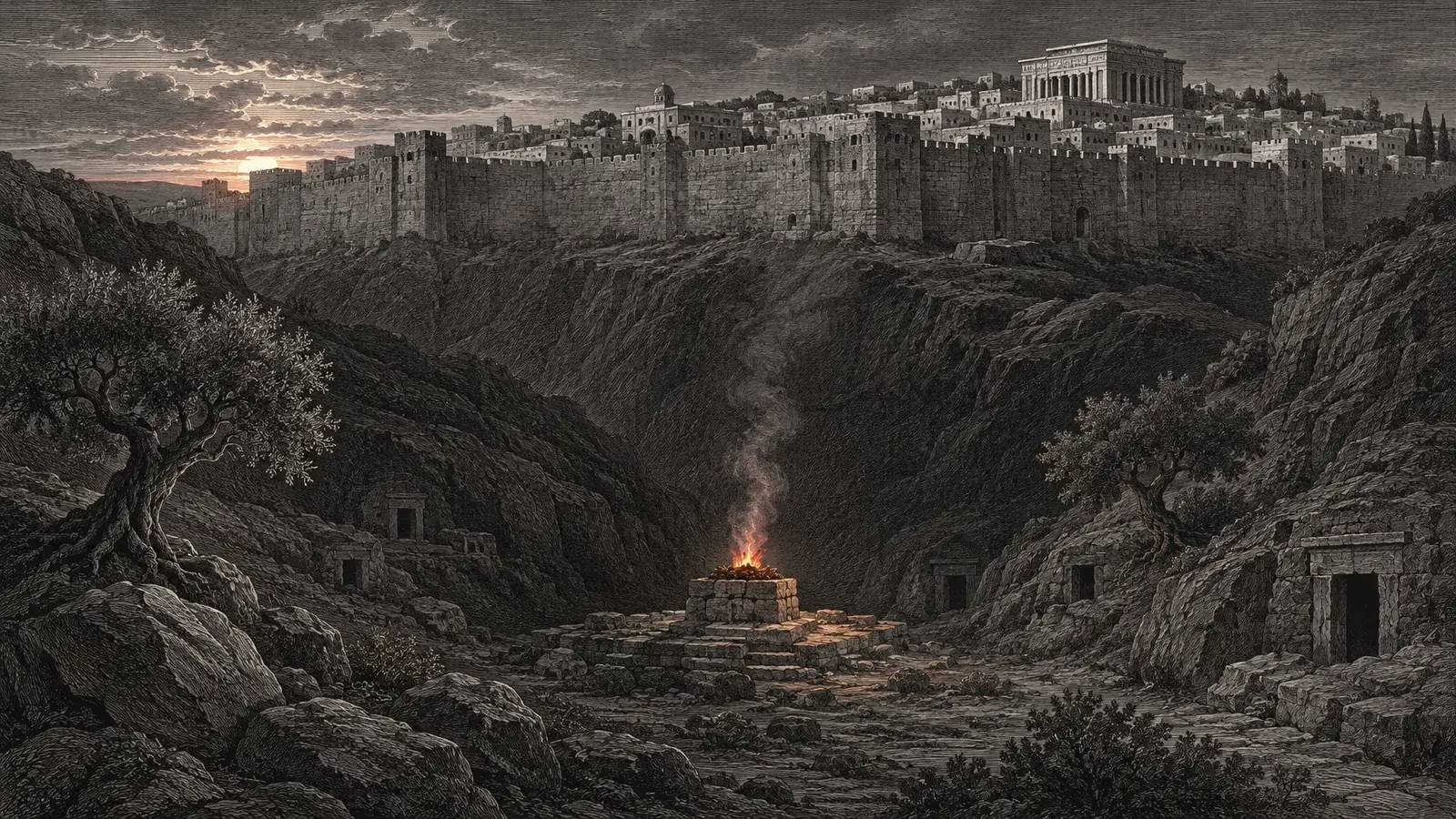
The word Jesus used most for hell wasn't an abstract idea. It was a place you could walk to. Leave Jerusalem by its southern gate, go down the slope, and you were in the Valley of Hinnom, in Hebrew Ge Hinnom, in Greek Gehenna.
To understand why Jesus chose that valley, you have to know what happened there. Its story runs through a god called Molech, the kings of Judah, the prophet Jeremiah and the Book of Enoch. And it involves a popular explanation you've probably heard that turns out not to be true.
Who Was Molech?
Molech appears in the Bible almost always in the same breath as one terrible act: handing children over to be burned. The first mention is in the Law:
"And thou shalt not let any of thy seed pass through the fire to Molech, neither shalt thou profane the name of thy God: I am the LORD." (Leviticus 18:21)
Two chapters later the Law makes it a capital crime, and it is one of the few laws in Leviticus that names a foreign deity:
"Whosoever he be of the children of Israel, or of the strangers that sojourn in Israel, that giveth any of his seed unto Molech; he shall surely be put to death: the people of the land shall stone him with stones. And I will set my face against that man, and will cut him off from among his people; because he hath given of his seed unto Molech, to defile my sanctuary, and to profane my holy name." (Leviticus 20:2-3)
The law even punishes a community that looks away. If the people of the land "hide their eyes" and let the man live, God says he will set his face against that man "and against his family," along with "all that go a whoring after him, to commit whoredom with Molech, from among their people" (20:4-5).
Molech in the Bible: every key mention
The Hebrew Bible gives almost no description of Molech himself. What it gives is a trail of references:
- Leviticus 18:21 and 20:2-5. The prohibition and the death penalty.
- 1 Kings 11:7. Solomon builds "an high place for Chemosh, the abomination of Moab, in the hill that is before Jerusalem, and for Molech, the abomination of the children of Ammon." Elsewhere the same Ammonite god is called Milcom (1 Kings 11:5, 33), and many scholars think Molech and Milcom are two forms of one name.
- 2 Kings 23:10 and 13. Josiah tears down both Topheth and Solomon's old high places for Chemosh, the god of Moab, and Milcom.
- Jeremiah 32:35. Sons and daughters passed "through the fire unto Molech" in the Valley of Hinnom.
- Amos 5:26 and Acts 7:43. The only New Testament reference to Moloch. Stephen quotes the Greek version of Amos: "ye took up the tabernacle of Moloch, and the star of your god Remphan." The Hebrew text of Amos reads differently ("your king"), so this mention of Molech comes through the Septuagint.
Was Molech a god, and which one?
Most readers take Molech to be a false god, the Ammonite god of 1 Kings, worshipped with the sacrifice of children. Scholars have tested other ideas too:
- An underworld god. George Heider and John Day argued in the 1980s that Molech was a Canaanite deity of the dead, linked with a god named Malik known from texts at Mari and Ugarit, and equated in Mesopotamian god lists with Nergal, the god of the underworld. On this view the child sacrifice was tied to the cult of the dead.
- Baal under another title. Because Jeremiah speaks of Baal and Molech in the same breath, some think "the King" was a title for Baal, or that the Punic god Baal Hammon, worshipped at Carthage, is a later relative.
- No god at all, but a type of sacrifice. That's Eissfeldt's view, described below.
Nobody knows who created Molech or exactly where his worship began. What the Bible makes clear is how the Israelites came to practise it: by copying "the abominations of the heathen" around them (2 Kings 16:3).
What does the name mean?
The consonants of Molech, m-l-k, are the same as the Hebrew word melek, "king." Scholars have two main theories about the name:
- A deliberate insult. Since Abraham Geiger in 1857, many have argued that the scribes gave the word melek the vowels of boshet, "shame," turning "the King" into a name of contempt. The Bible does something similar elsewhere, where Baal is sometimes replaced by bosheth. Others call this theory clever but unproven.
- A kind of sacrifice, not a god. In 1935 Otto Eissfeldt noticed that mlk appears in Punic inscriptions from North Africa as the name of a type of offering. He argued that "to Molech" originally meant "as a molk-sacrifice." The main problem with that view is Leviticus 20:5, which speaks of whoring "after" Molech. That language only makes sense of a god.
Either way, the meaning of the rite is not in doubt.
What Happened in the Valley of Hinnom?
The Valley of Hinnom is first mentioned simply as a boundary line. Joshua 15:8 traces the border of Judah "by the valley of the son of Hinnom unto the south side of the Jebusite; the same is Jerusalem," up to a mountain "at the end of the valley of the giants northward." The valley sat right beside the Valley of Rephaim, the giants, whom we meet again in the stories of Goliath and the giants of Gath.
For centuries it was just a valley. Then, in the eighth and seventh centuries BC, two kings of Judah turned it into something else.
Ahaz "burnt incense in the valley of the son of Hinnom, and burnt his children in the fire, after the abominations of the heathen" (2 Chronicles 28:3).
Manasseh "caused his children to pass through the fire in the valley of the son of Hinnom: also he observed times, and used enchantments, and used witchcraft" (2 Chronicles 33:6).
The place where it happened was called Topheth (or Tophet). Jeremiah describes it:
"And they have built the high places of Tophet, which is in the valley of the son of Hinnom, to burn their sons and their daughters in the fire; which I commanded them not, neither came it into my heart." (Jeremiah 7:31)
How was Molech worshipped?
Some scholars have suggested that "pass through the fire" might describe a ritual where children were passed over flames and not harmed. The rest of the Bible doesn't allow that reading. Ezekiel says outright, "thou hast slain my children, and delivered them to cause them to pass through the fire" (Ezekiel 16:21), and the psalmist remembers that Israel "shed innocent blood, even the blood of their sons and of their daughters, whom they sacrificed unto the idols of Canaan" (Psalm 106:38).
Are Molech and Baal the same?
Not by name, but Jeremiah ties them together in the same valley. He speaks of "the high places of Baal, which are in the valley of the son of Hinnom, to cause their sons and their daughters to pass through the fire unto Molech" (Jeremiah 32:35), and elsewhere of those who built "the high places of Baal, to burn their sons with fire for burnt offerings unto Baal" (19:5). Whatever the exact relationship between the two names, the prophets saw one sin.
Josiah defiles the valley
King Josiah, Manasseh's grandson, ended the practice. During his reform:
"And he defiled Topheth, which is in the valley of the children of Hinnom, that no man might make his son or his daughter to pass through the fire to Molech." (2 Kings 23:10)
To "defile" it meant making the place ritually unclean, probably by scattering bones there, as he did at other shrines (2 Kings 23:14). The site could no longer be used for worship of any kind.
"The Valley of Slaughter": Jeremiah's Prophecy
Jeremiah did more than condemn the valley. He gave it a new name. Standing at its entrance with a clay jar, he announced:
"Therefore, behold, the days come, saith the LORD, that this place shall no more be called Tophet, nor The valley of the son of Hinnom, but The valley of slaughter." (Jeremiah 19:6)
Then he smashed the jar and said God would break the city the same way, and that "they shall bury them in Tophet, till there be no place to bury" (19:11). The valley where children had been killed would become the valley where the judged were thrown.
That reversal is the bridge to everything that follows. Hinnom stopped being just a place of sin and became the picture of what happens to sin.
Depictions of Moloch: What the Bible Doesn't Say
You've probably seen Moloch drawn as a bronze idol with the face of a calf or bull and outstretched arms over a furnace. That picture is not from the Bible.
It comes mostly from later sources. Greek writers such as Diodorus Siculus described a bronze statue at Carthage, the Phoenician colony in North Africa, with arms outstretched over a fire. The medieval Jewish commentator Rashi, explaining Jeremiah 7:31, described Molech as a hollow brass idol heated from below, with priests beating drums so parents couldn't hear their children cry. He connected the name Topheth with toph, "drum." Later artists added a bull's head, borrowing from the legend of the Minotaur.
The image may hold some memory of how the rite was carried out, but the Bible itself never describes Molech's appearance. It only describes what was done.
What archaeology says
No mass grave of children has been found in the Valley of Hinnom, though the area has been built over and dug up for nearly three thousand years.
The best evidence comes from Carthage, whose people descended from the Phoenicians of the Canaanite coast. Its "tophet," a name borrowed by archaeologists from the Bible, held thousands of urns containing the burnt bones of infants and young animals, many under stones with dedications to the gods. Scholars still disagree about what it means. A 2010 study of the bones argued that many infants died of natural causes. A 2014 paper in the journal Antiquity, drawing on the inscriptions and ancient writers as well, concluded that the Carthaginians really did sacrifice their children. Many of those stones are dedicated to Baal Hammon and the goddess Tanit. The debate continues, but the evidence suggests that child sacrifice, a rare form of human sacrifice even in the ancient world, did happen at least at times in the wider Canaanite and Phoenician world the prophets were warning about.
From Valley to Judgement: Gehenna in the Book of Enoch
The step from a cursed valley to a place of final judgement happened in the centuries between the Old and New Testaments, and the Book of Enoch is one of the earliest witnesses.
In 1 Enoch 26, Enoch is taken to "the middle of the earth," a "blessed place" with a holy mountain and deep ravines around it, an unmistakable description of Jerusalem. He asks about the deep valley beside it, and the angel Uriel answers:
"This valley is for those who are accursed for ever: here shall all the accursed be gathered together who utter with their lips against the Lord unseemly words and of His glory speak hard things." (1 Enoch 27:2, Charles translation)
Later, in Enoch's animal vision, a fiery abyss is opened "in the midst of the earth," "to the right of that house" (the temple), and the unfaithful sheep are cast into it (1 Enoch 90:26). The geography of judgement had become the geography of Jerusalem. (For more on this book and why it was read so widely, see The Book of Enoch.)
Gehenna in the Teaching of Jesus
By Jesus' day, Gehenna was a common word for the place of punishment after death. It appears about a dozen times in the New Testament, almost all from the lips of Jesus, and the King James Version translates it "hell":
"And fear not them which kill the body, but are not able to kill the soul: but rather fear him which is able to destroy both soul and body in hell." (Matthew 10:28)
The most vivid passage is in Mark 9, where Jesus says it is better to lose a hand than "having two hands to go into hell, into the fire that never shall be quenched: where their worm dieth not, and the fire is not quenched" (Mark 9:43-44).
That last line is a quotation. It is the final verse of Isaiah, describing the corpses of those who rebelled against God outside Jerusalem: "for their worm shall not die, neither shall their fire be quenched; and they shall be an abhorring unto all flesh" (Isaiah 66:24). When Jesus said Gehenna, his hearers heard Isaiah, Jeremiah's valley of slaughter and the shame of Topheth all at once.
Gehenna is also a different idea from Sheol or Hades, the realm of the dead, and from Tartarus, the prison of the fallen angels in 2 Peter 2:4. We explain the difference in Tartarus in the Bible.
Was Gehenna a Burning Garbage Dump?
This is the explanation most people have heard: the Valley of Hinnom was Jerusalem's rubbish heap, where fires burned day and night, so Jesus used it as a picture of hell.
It's a tidy explanation, and it appears in many study Bibles. But there's no ancient evidence for it. The idea first appears in the commentary of Rabbi David Kimhi on Psalm 27, written around AD 1200, more than eleven centuries after Jesus. Scholars who have looked for earlier support, in Jewish writings from before and after the time of Christ and in the archaeology of the valley, have not found it.
The real background is darker and more powerful. Jesus' hearers didn't picture smouldering trash. They pictured the place where Judah's kings had burned their children, the place Jeremiah said would become the valley of slaughter, and the place Isaiah and Enoch saw filled with the judged.
The Valley of Hinnom Through the Bible
| Period | Source | What happens |
|---|---|---|
| Conquest | Joshua 15:8 | A boundary of Judah, beside "the valley of the giants" |
| 10th century BC | 1 Kings 11:7 | Solomon builds a high place for Molech facing Jerusalem |
| 8th century BC | 2 Chronicles 28:3 | Ahaz burns his children in the valley |
| 7th century BC | 2 Chronicles 33:6 | Manasseh does the same |
| About 622 BC | 2 Kings 23:10 | Josiah defiles Topheth |
| Late 7th century BC | Jeremiah 7:31-32; 19:6 | Jeremiah renames it "the valley of slaughter" |
| 3rd century BC | 1 Enoch 27 | Enoch sees the "accursed valley" of judgement |
| 1st century AD | Mark 9:43-48; Matthew 10:28 | Jesus uses Gehenna for hell |
| About AD 1200 | Rabbi David Kimhi | First mention of a burning garbage dump |
Why "The Spirit of Molech" Still Comes Up
Molech is one of the most searched names in the Bible today, partly because it is often invoked in modern debates, especially about abortion, where some speakers describe "the spirit of Molech." That is a modern application, and readers will judge it differently. What the biblical texts themselves condemn is clear: parents giving up their own children to death for the sake of a god, and a nation's leaders leading the way.
What the Valley Teaches
The story of the Valley of Hinnom moves in a straight line. A people chose to sacrifice their children. God said it never entered his heart. The prophets promised that the place of that sin would become the place of judgement. And Jesus took the name of that valley as his word for the final end of evil.
That makes Gehenna less a picture of God's cruelty than of his justice. The valley was not cursed because God enjoys punishment. It was cursed because the weakest people in Judah, its children, were killed there, and God did not forget them.
If you want to keep exploring the unseen world behind texts like these, read Who Are the Watchers? and Tartarus in the Bible.
Bible quotations are from the King James Version. 1 Enoch is quoted from R. H. Charles's translation (1912).
Categories:
Related Articles
Divination in the Bible: What It Is, Why God Forbids It, and What About Remote Viewing?
What is divination in the Bible? The nine forbidden practices of Deuteronomy 18 in Hebrew, the spirit of divination in Acts 16, and how remote viewing and astral projection compare.
Psalm 2 Meaning: A Verse-by-Verse Guide to the Psalm of God's Son
What does Psalm 2 mean? Read the full KJV text, find out who speaks each stanza, what 'this day have I begotten thee' and 'Kiss the Son' mean, and every New Testament use.
Leviathan and Behemoth in the Bible: The Two Great Beasts God Showed Job
What is Leviathan? What is Behemoth? Read God's own description in Job 40-41, the fire-breathing sea serpent of Isaiah and the Psalms, and what Enoch says about both.
Is the Trinity in the Old Testament? The Passages, Ranked From Strongest to Weakest
Is the Trinity in the Old Testament? Check every passage in your own Bible: two LORDs in one verse, the Angel who is God, Psalm 2's Son, and the arguments that don't hold up.